How the West poisoned Bangladesh
A UN project aimed to help millions - but it brought them water contaminated with arsenic
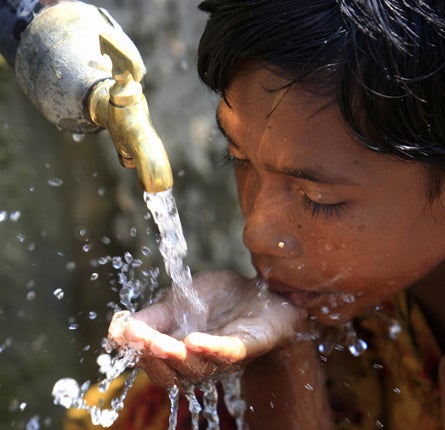
Up to 20 million people in Bangladesh are at risk of suffering early deaths because of arsenic poisoning – the legacy of a well-intentioned but ill-planned water project that created a devastating public health catastrophe.
Four decades after an internationally funded move to dig tube wells across the country massively backfired, huge numbers of people still remain at higher risk of contracting cancer and heart disease. The intellectual development of untold numbers of children is also being held back by the contamination of drinking water. Poor diet exacerbates the risk.
Bangladesh's arsenic crisis dates back to the 1970s when, in an effort to improve the quality of drinking water and counter diarrhoea, which was one of the country's biggest killers of children, there was large-scale international investment in building tube wells. It was believed the wells would provide safe supplies for families, otherwise dependent on dirty surface water which was killing up to 250,000 children a year.
Yet the move, spearheaded by the UN and the World Bank, was fatally flawed. Although checks were carried out for certain contaminants in the newly sourced water, it was not tested for arsenic, which occurs naturally in the Ganges and Brahmaputra deltas. By the early 1990s, when it was found that up to half of 10 million tube wells were contaminated with arsenic, Bangladesh was confronting a huge problem. The World Health Organisation called it "the largest mass poisoning of a population in history... The scale of the environmental disaster is greater than any seen before; it is beyond the accidents in Bhopal, India, in 1984, and Chernobyl, Ukraine, in 1986".
Some subsequent studies predicted that, ultimately, one person in 10 who drinks water from the arsenical wells would go on to die from lung, bladder or skin cancer. Even though some of these conditions take decades to develop, by 2004, about 3,000 people a year were dying from arsenic-related cancers.
Since the 1990s, organisations such as Unicef have led the effort to develop and provide alternative sources of water, such as collecting rainwater and filtering surface water. Slowly, the percentage of families exposed to contaminated water has fallen. But a survey conducted by Unicef last year found that 13 per cent of people are still using contaminated water. "That equates to 20 million people," says Yan Zheng, a Unicef arsenic specialist based in Dhaka. "The health impacts vary. The skin lesions that arsenic causes are well recognised by the villagers. But the cancer and cardiovascular diseases are still not fully recognised by the villagers and some health professionals." Ms Zheng says a recent study showed significantly higher death rates for those exposed to arsenic: "It was as you would expect – the higher the exposure, the higher the risk.".
Government and UN officials will publish a new report tomorrow calling for urgent action to tackle what remains a huge problem of contamination, both from drinking water and from crops such as rice that are irrigated with contaminated water. According to the report, being released to coincide with World Water Day, arsenic poses health risks to a significant proportion of the population, though children are particularly vulnerable.
The skin lesions caused by arsenicosis are just the first sign of many possibly fatal health problems. The lesions still attract widespread social stigma in Bangladesh, with many people until recently believing they were the result of a curse.
"Urgent action is needed to refocus the attention of the nation towards an arsenic-safe environment," says Renata Lok Dessallien, the UN chief in Bangladesh. "Concerted efforts by the government and all stakeholders are necessary to reinvigorate arsenic monitoring and mitigation efforts, and to conduct comprehensive research on emerging threats."
The arsenic contaminating so much of Bangladesh's water occurs naturally in the water courses of the rivers that sustain hundreds of millions of people. Many underground sources around the world suffer from arsenic contamination and there have been health issues in countries ranging from Argentina to Taiwan and India. There is also considerable arsenic contamination in parts of the US.
In Bangladesh, a fierce row continues to rage over the responsibility for the massive contamination. While aid groups and the UN insist their testing at the time met international standards, others have argued that there should have been a more thorough awareness of the local geology and topography. Yet more have said that the UN and the World Bank were slow to acknowledge their role in the tragedy.
Dipankar Chakraborti, of the Jadavpur University in West Bengal and a leading expert, says the level of arsenic contamination in Bangladesh is worse than anywhere else globally. He says the international bodies have never fully acknowledged their role in a crisis that will be played out for years to come. "It is a major problem," he says. "We have found that when we went back to people with skin lesions whom we interviewed 15 years ago, about 30 per cent of them had developed some sort of cancer."
Last year scientists concluded that arsenic entered the water in tube wells as a result of thousands of ponds that were dug across Bangladesh to provide soil for flood protection. Disturbing the ground released the organic carbon, which in turn causes arsenic to leach from sediments. The scientists from MIT in Boston concluded that one solution would be to dig "deeper drinking-water wells, below the influence of the ponds".
Meanwhile, educating the public about the dangers of arsenic poisoning, and disabusing them of the widespread idea that its effects are the result of a curse, or infectious, is essential. "Raising awareness among people on the danger of arsenic is essential," says Bangladesh's minister of health, Dr A F M Ruhal Haque. "Health workers can disseminate this message, while the government will continue to invest in screening and treatment of arsenicosis patients in affected districts."
Britain's toxic beer
Arsenic was a pervasive contaminant in Britain and the US in the 19th century. It was used in wallpaper, fabric dyes, and even as a colouring in confectionery.
One of the worst instances of man-made arsenical poisoning came in Lancashire in late 1900. Large numbers of people in the Manchester and Salford areas displayed symptoms of what was thought to be simple over-indulgence. But, as the cases mounted, and people began to turn up with blackened skin and other tell-tale signs, arsenic poisoning was suspected. This was confirmed, and eventually traced to the firm that supplied sugar used in brewing.
Before the poisonings had run their course, more than 6,000 people had been affected, and 80 of these died. The episode was instrumental in securing more rigorous legislation on food safety.
Join our commenting forum
Join thought-provoking conversations, follow other Independent readers and see their replies
Comments