Indian government drafts in jailed MPs to avert collapse
Multimillion-pound bribes, MPs serving jail terms and some in intensive care are among the arsenal of weapons being wielded in a dramatic battle as India's government and its political opponents prepare for tomorrow's crucial confidence vote.
Ahead of a ballot that could trigger an early general election, both sides are feverishly battling to recruit new supporters to their ranks and to prevent presumptive supporters from being stolen by the other side. Indian politicians speak openly of being offered vast bribes for their votes, while others have reportedly been gifted senior government positions for their support.
The political drama that is playing out in the capital of the world's largest democracy relates to a nuclear energy deal the government has been pursuing with the United States. But the issue has been seized on by its opponents as an opportunity to strike at an administration made vulnerable by soaring inflation, and many of the country's smaller parties are using the affair to try to bolster their political capital.
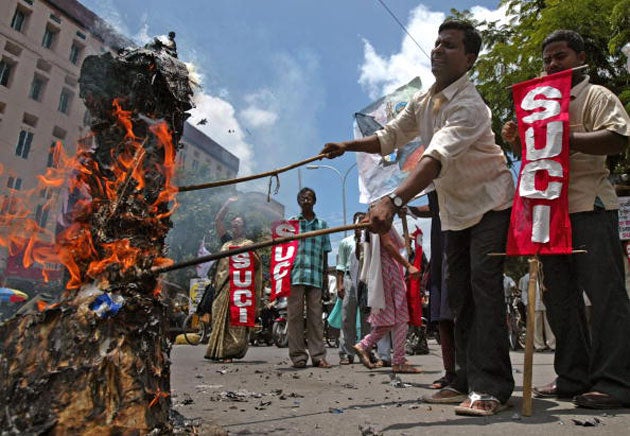
The so-called "trust vote" was called two weeks ago by the coalition government headed by the centrist Congress Party under the leadership of Sonia Gandhi and the Prime Minister, Manmohan Singh. It decided to call the vote after a group of Communist allies withdrew their support for the coalition in a row over the nuclear deal, fearful that it would give the US too much influence over Indian foreign policy.
Since then the Congress Party's main opponent, the right-wing Bharatiya Janata Party (BJP), has been trying to recruit more MPs to join its unlikely alliance with the Communists. In recent days a key player to emerge in the drama has been the so-called Dalit Queen, Mayawati Kumari, the head of India's largest state, Uttar Pradesh, who has vowed that her own caste-based party will also vote against the government. Indeed, there are many who believe that if she plays her hand carefully, she could conceivably become India's next prime minister.
"Whether she will emerge as prime minister this time is the big question," said Ajai Shukla, anchor with the NDTV news channel. "But the way Indian politics is going there is very good chance she will become prime minister one day. If not in this election then perhaps in [the next.]"
Yesterday, the broad avenues of south Delhi were abuzz with official cars, bearing the flashing red light that denotes an MP, as politicians raced across the capital for meetings with the various factions. At the Prime minister's Residence on Race Course Road, so many official cars were arriving that police had to make them form a queue. There were similar scenes at the Congress Party's office and in an annexe of the Parliament where the opposition parties were plotting the government's undoing.
But with so much at stake, it appears the two sides are not banking on simple friendly meetings to try to tie up sufficient support. The Congress Party this week renamed an airport in Lucknow after the father of a local MP whose support it requires. It has also reportedly offered a cabinet post to Shibhu Soren, the leader of a small regional party in Jharkhand who was convicted and then acquitted of murdering his secretary 15 years ago. The alleged motive for the killing had been his secretary's knowledge of a deal Mr Soren had made with the Congress Party to bring down the government in 1993.
Parties on both sides of the aisle are accused of offering cash bribes to potential supporters. The leader of a party based in Uttar Pradesh that has thrown its support behind the government said his MPs were being offered 300m rupees (£3.5m) to join the opposition. Meanwhile a rebel government MP upped the stakes over the weekend claiming that he had been offered an astonishing 1bn rupees to vote in support of the ruling coalition.
The rival sides are also looking to India's jails for support. There are six Indian MPs in prison, three having already been convicted of crimes including murder and kidnapping, and the other three awaiting trial. Under Indian law, all six remain MPs and are eligible to vote until the government term expires.
The opposition is also looking for support on the intensive care units of various hospitals. One BJP MP from Gujarat is recovering from open heart surgery; one in Maharashtra is recovering from multiple operations after a traffic accident; and a third is in Los Angeles having had a knee intervention. The party has been considering plans to arrange special flights to bring all three politicians to the parliament building in Delhi if their doctors give them permission.
Ironically, for all the headlines it has garnered, there is little evidence that the nuclear deal with the US is much of an issue for most Indian voters. Indeed, the trust vote is taking place against a backdrop of an inflation rate approaching 12 per cent and soaring food prices.
Although the government has to call a general election by May 2009, the public dissatisfaction over soaring prices means it wants to put off setting a date for as long as possible. The opposition has other ideas.
Nuclear deal that triggered the crisis
*Pithily entitled the Henry J Hyde United States-India Peaceful Atomic Energy Cooperation Act of 2006, the US-India nuclear deal provides India with access to American civilian nuclear technology in exchange for India agreeing to oversight by the IAEA.
*The deal is unusual because India – a nuclear weapons power – is not a signatory to the Nuclear Non-Proliferation Treaty. Many believe the deal will open up India to the US's nuclear power industry.
*Undoubtedly, the deal has great strategic significance and would represent the very final nail in the coffin of India's long-held non-alignment policy.
The parliamentary power-brokers
*SONIA GANDHI: Ruling Congress Party president. The 61-year-old widow of Prime Minister Rajiv Gandhi gave up the chance to become prime minister in 2004, earning the respect of many Indians as a selfless politician.
*MANMOHAN SINGH: The Prime Minister and architect of India's economic reforms that have seen growth reach more than eight per cent a year. While many have accused him of being a weak leader, the 75-year-old refused to budge on the nuclear deal.
*LAL KRISHNA ADVANI: The man who would like to be prime minister if the BJP, a right-wing, Hindu nationalist party, won power. Advani is described as a hardliner, a hawk and a wily politician. He has been credited with the upswing in the party's fortunes after it won a string of state elections in recent months. Formerly served as deputy Prime Minister from 2002-2004.
*PRAKASH KARAT: General secretary of the Communist Party of India-Marxist (CPI-M), one of several Leftist groups that quit the government and triggered the trust vote. He has been criticised for siding with the BJP and Mayawati's party.
*MAYWATI: Serving her third term as the Chief Minister of India's largest state, Uttar Pradesh, Mayawati has emerged as the focus point of the so-called Third Front, distinct from the Congress Party and BJP. A founding member of the Bahujan Samaj Party (BSP), Mayawati has built her power on the support of the Dalits, or so-called untouchables, of which she is a member. A shrewd politician, many believe she is a future prime minister.
Join our commenting forum
Join thought-provoking conversations, follow other Independent readers and see their replies
Comments
Bookmark popover
Removed from bookmarks