India's father of Communism dies, aged 95
Kolkata mourns for Jyoti Basu, who ruled West Bengal for 23 years

For free real time breaking news alerts sent straight to your inbox sign up to our breaking news emails
Sign up to our free breaking news emails
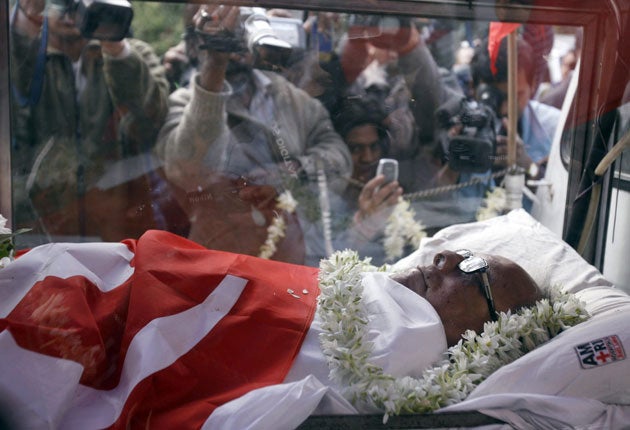
Tens of thousands took to the streets of Kolkata yesterday, mourning the death of Jyoti Basu, the man considered the patriarch of Communism in India and who was chief minister of West Bengal for a record-breaking 23 years.
The 95-year-old politician, who was twice offered the opportunity to become India's first Communist prime minister but turned down the chances, died of multiple organ failure yesterday morning. He had been in hospital since the beginning of the year.
Outside the clinic, from where his coffin was driven away in a hearse, large crowds gathered, some brushing away tears, others raising their hands in Soviet-style salutes.
"The passing away of Basu from the scene marks the end of an era in the annals of Indian politics," said India's Prime Minister, Manmohan Singh, reflecting the breadth of Mr Basu's six-decade political career, from a staunch campaigner for India's independence to the chief minister of the state of West Bengal.
Perhaps most of all, he will be remembered for a series of radical land-reforms that handed out parcels of land to more than two million farming families in a state with a recent memory of deadly famine.
Born into an upper-middleclass Bengali family, Mr Basu completed his training as a lawyer in London then returned to India and made contact with leaders of the Indian Communist Party. In 1944, encouraged by members of his party, he became involved in the country's railway unions and subsequently the head of a new, combined group. Representing the union, he was first elected to the Bengal Assembly in 1946; 11 years later, after India's independence, he had risen to become leader of the assembly's opposition.
In 1977, having served as a home minister in a state government dominated by the Left, he was elected chief minister of the state, a position he would hold until 2000. His would be the longest-serving elected Communist government in the world.
As such, as head of the Communist Party of India-Marxist (CPI-M) he oversaw a period when the Leftist parties of India were dominant in West Bengal, a state where hammer and sickle banners still fly and where citizens – particularly in Kolkata – pride themselves for being informed, literate and involved. Only the southern state of Kerala even comes close as a stronghold for the politics of the left in India.
"He is the patriarch for the Indian left and he certainly led the movement since the 1940s," said Abhirup Sarkar, an economist at the Indian Statistical Institute in Kolkata
A dispassionate assessment of Mr Basu's time as head of West Bengal would have to conclude that his record was mixed. In 1943, Bengal, still under British rule, suffered a widespread famine that claimed perhaps three million lives as the colonial government continued to export rice from the state.
In that context, Mr Basu's most vital contribution may have been thesweeping land-reforms that empowered the landless and helped create a deep pool of support for the left. Yet critics say his failure to counter the power of trade unions also led to a failure to bring in foreign investment to an area sorely lacking in jobs and wealth creation. Others have accused his administration of stagnating, particularly in its later years.
Mr Basu's final decline coincided with the dramatic fall from grace of his party. His successor as chief minister, Buddhadeb Bhattacharjee, tried to invigorate the state's economy by tempting in heavy industry, but when he invited Tata Motors to build its tiny Nano car on prime farmland, he ignited a farmers' revolt which threw into doubt the values on which communist rule in the state had long been founded.
The car plant was eventually shelved after a bitter struggle, but the party was already on the skids.
Subscribe to Independent Premium to bookmark this article
Want to bookmark your favourite articles and stories to read or reference later? Start your Independent Premium subscription today.
Join our commenting forum
Join thought-provoking conversations, follow other Independent readers and see their replies