India's 'third sex' win a measure of public acceptance
But despite a beauty pageant and changes to the law, the hijras still fear harassment and abuse

For free real time breaking news alerts sent straight to your inbox sign up to our breaking news emails
Sign up to our free breaking news emails
Miss Mumbai has big brown eyes, long lustrous hair, and an unusually strong jaw. Her lips are stained with a dark red lipstick, her gaze frequently drifts to her reflection, captured in a grubby mirror above the cracked sink. Like most beauty queens on the eve of a big competition, she is worrying about her weight, her outfit and that all-important runway walk. Today she will compete for the title of "Super Queen" in India's first transgender beauty pageant; an event seen by some as a sign that the marginalised "third gender" group – eunuchs, transsexuals and transvestites – is finally being welcomed into mainstream society.
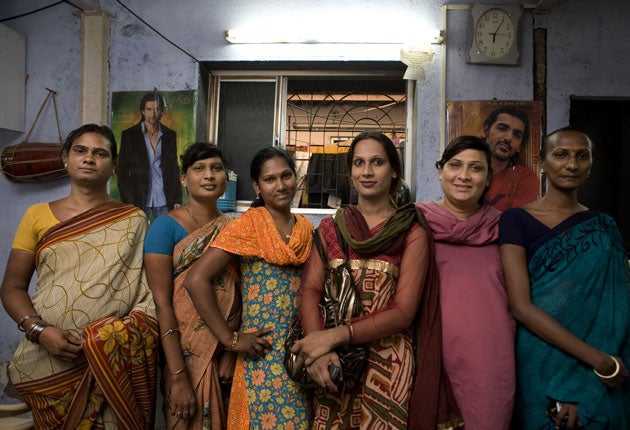
Although the pageant has brought India's hijra community – estimated to be anywhere between 500,000 and one million strong – into the public eye, the gaggle gathered in a small room above a row of shops in Malvani, a western suburb of Mumbai, questions whether attitudes towards them have really changed.
"This is only one person in the community being accepted, it won't reach to the roots of the problem," said Kiran Patel, 31, adjusting her vivid blue sari. "In the media, in movies, on TV, we are ridiculed, and in the street we are teased. There is a struggle just for basic identity."
A few streets from where we sit, hijras loiter in twos and threes at traffic lights, begging for money from drivers sitting on red. If the drivers do not comply, hijras will sometimes claim to place a curse on them. This is one way in which the group exploits its unique place in Indian culture, with many people believing that they possess spiritual powers.
"They are discriminated against on every level, all the time," says Sanjay Shinde, a project manager for Navnirman Samaj Vikas Kendra (NSVK), a group which works with hijras. "People won't give them jobs, and we've tried to set up businesses for them, but it doesn't work. Every so often the girls will get badly beaten."
However, the past few months have brought several improvements in the hijras' status. In November, India's Election Commission allowed eunuchs to choose their gender as "other" on ballot forms; in July, homosexuality was finally decriminalised; while recent changes in the laws in Pakistan have increased hijras' rights relating to inheritance and employment.
The community is close-knit, with many living in communal arrangements, with younger members supervised by older "guardians", who often take their earnings in return for food and lodgings. While these guardians are often benign, other hijra have less positive experiences.
"I worked as a sex worker to make money, but my guardian took everything I earned," says Amisha Chopra, 26, who moved to Mumbai from Uttar Pradesh in northern India nine years ago. "I left and work on my own. It is not that dangerous. But walking home is: I get shouted at by the local boys and hassled by the police." Chopra is not alone in having problems with the police. Despite the decriminalisation of homosexuality, many hijras claim to have been harassed, and say that the crimes they report are not properly investigated.
While India's hijra community still faces numerous problems, many point to its very existence as evidence that the country is more open to fluid gender roles than places such as Britain. Serena Nanda, a cultural anthropologist and author of Neither Man nor Woman: the Hijras of India, says: "Many other cultures have similar roles, including indigenous cultures who value gender bending and blending. Or, even if they do not value them, they make room for them. The question I would ask is why Western culture, especially in the US, is so transgender phobic."
Subscribe to Independent Premium to bookmark this article
Want to bookmark your favourite articles and stories to read or reference later? Start your Independent Premium subscription today.
Join our commenting forum
Join thought-provoking conversations, follow other Independent readers and see their replies