Interned Tamil refugees face two-year wait to return home
International concern mounts after Red Cross denied access to camps
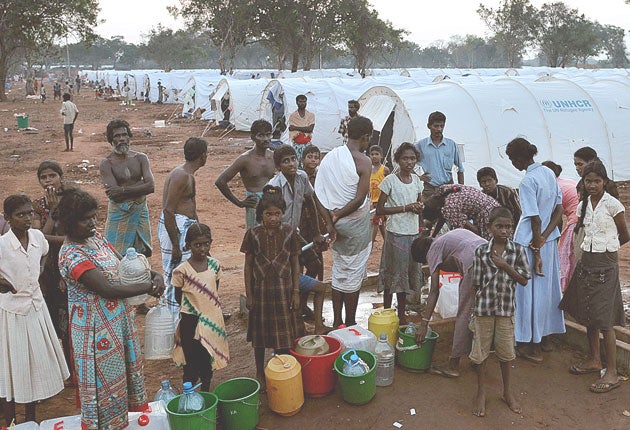
Thousands of Tamil civilians forced from their homes by the conflict in Sri Lanka could be interned in refugee camps for up to two years before they are permitted to return home, authorities in Colombo said.
And in a further revelation that will spark concern among the international community, the International Committee for the Red Cross (ICRC) said that it had been forced to suspend its aid supply to the refugees after it was refused access to the camps.
"Yes, we have concerns. Yes, we are asking for access," said Paul Castella, the head of the ICRC delegation in Sri Lanka. The UN humanitarian chief John Holmes has also called for officials to be allowed into the camps.
A senior government official, Lakshman Hulugala, said more than 230,000 civilians were being held in camps, a figure the UN believes could rise.
He said screening so many people to identify rebels and resettling the northern area of the country would be a lengthy process. "Not all the people will be held for two years," he said.
Asked about the conditions in the camps, he said: "You cannot expect five-star hospitality in a place like that. We are providing the basics: food, security, health, schools and playgrounds. You cannot expect an Oxford college."
In his "victory" speech earlier this week to announce the end of the long-running civil war, President Mahinda Rajapaksa reached out to the Tamil community and said Sri Lanka must now work towards equality.
"Our intention was to save the Tamil people from the cruel grip of the [rebels]. We all must now live as equals in this free country," he said.
In an attempt to avoid that new era beginning with a Tamil Tigers (LTTE) revival, the government spokesman Mr Hulugala said that the body of the rebels' leader, Velupillai Prabhakaran, would be cremated or buried in secret.
Mr Prabhakaran died in battle on Monday and the government will be keen to dampen efforts to portray him as a martyr. "The body will be treated like that of any other terrorist," Mr Hulugala said.
An important factor in building a new consensus will be resettling those held in the basic, shadeless camps where people complain about a lack of water. The camps are surrounded by razor wire, patrolled by armed guards and while some elderly refugees have been allowed to live with family members, the overwhelming majority are not permitted to leave.
Earlier this year when the Sri Lankan authorities revealed plans for "welfare villages" that would hold the refugees for three years, there was an immediate outcry from aid groups. The government backtracked and vowed that 80 per cent would be resettled within 12 months. The new revelation will trigger fresh concern.
"It's absolutely controversial," said a senior official with a Western aid organisation that works in Sri Lanka. "It's a big discussion point among the aid community. This will be of concern to the organisations and to the donors.
"What the international community is saying is that the government needs to do proper screening to separate those who might be LTTE. What is not acceptable is for the whole population to be incarcerated."
The government has begun screening the tens of thousands of Tamils that have poured from the war zone. Dozens have identified themselves as LTTE fighters and have been taken to rehabilitation camps. It is understood "hard core" suspects, accused of the most serious crimes, are being held in a detention camp near Boosse.
Campaigners have expressed mounting concern about three doctors who have been detained by the government, which claims they gave false information about war zone casualties to the media. Journalists were banned from the war zone and the doctors – Thurairaja Varatharajah, Thangamuttu Sathyamurthi and V Shanmugarajah – were among the few sources of information on civilian casualties and regularly spoke to the media organisations, including The Independent. Amnesty International says it believes Dr Shanmugarajah and Dr Sathyamurthi may be being held at the Terrorist Investigation Division in Colombo.
However, a detention order has not yet been issued so their relatives remain unsure of their whereabouts and they do not have access to a lawyer. Dr Varatharajah, the regional director of health services in Mullaitivu, was seriously injured and is reported to have been airlifted to an unknown destination.
Speaking from his home in Norway, Dr Shanmugarajah's brother-in-law, Suresh Kumar, said relatives were extremely worried about the doctor as well as his wife, Renuka, and their 14-month-old son, who are understood to be in a refugee camp.
Asked about government claims that the doctor was an LTTE supporter, Mr Kumar said: "They are trying to misinterpret things. He is a doctor. There were no other doctors in the area. When I spoke with him two weeks ago, I asked why he had not left. He said there were a lot of people in the hospital. He said he was a doctor and how could he leave the patients?"
Join our commenting forum
Join thought-provoking conversations, follow other Independent readers and see their replies
Comments