
For free real time breaking news alerts sent straight to your inbox sign up to our breaking news emails
Sign up to our free breaking news emails
Japan put its nuclear calamity on a par with the world's worst nuclear disaster, Chernobyl, today after new data showed that more radiation leaked from its earthquake-crippled power plant in the early days of the crisis than first thought.
Japanese officials said it had taken time to measure radiation from the plant after it was smashed by March 11's massive quake and tsunami, and the upgrade in its severity rating to the highest level on a globally recognised scale did not mean the situation had suddenly become more critical.
"The situation at the Fukushima Daiichi plant is slowly stabilising, step by step, and the emission of radioactive substances is on a declining trend," Prime Minister Naoto Kan told a press briefing today.
Kan said he wanted to move from emergency response to long-term rebuilding.
"A month has passed. We need to take steps towards restoration and reconstruction," he said.
He also called on opposition parties, whose help he needs to pass bills in a divided parliament, to take part in drafting reconstruction plans from an early stage.
The operator of the stricken facility appears to be no closer to restoring cooling systems at the reactors, critical to lowering the temperature of overheated nuclear fuel rods. Japan's science ministry said small amounts of strontium, one of the most harmful and long-lasting radioactive elements, had been found in soil near Fukushima Daiichi.
Hidehiko Nishiyama, a deputy director-general of the Nuclear and Industrial Safety Agency (NISA), said the decision to raise the severity of the incident from level 5 to 7 - the same as the Chernobyl disaster in Ukraine in 1986 - was based on cumulative quantities of radiation released.
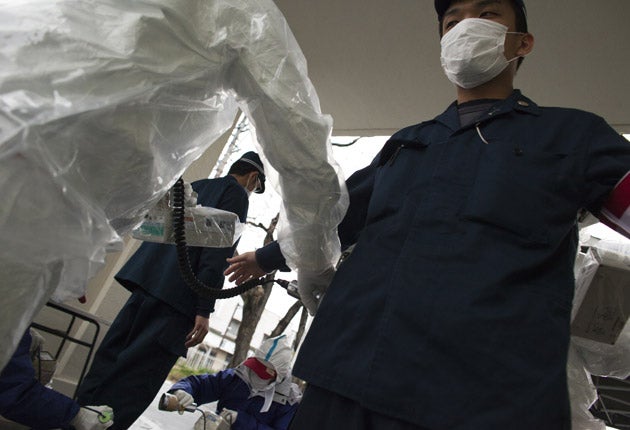
No radiation-linked deaths have been reported since the earthquake struck, and only 21 plant workers have been affected by minor radiation sickness, according to Chief Cabinet Secretary Yukio Edano.
"Although the level has been raised to 7 today, it doesn't mean the situation today is worse than it was yesterday, it means the event as a whole is worse than previously thought," said nuclear expert John Price, a former member of the Safety Policy Unit at the UK's National Nuclear Corporation.
A level 7 incident means a major release of radiation with a widespread health and environmental impact, while a 5 level is a limited release of radioactive material, with several deaths, according to the International Atomic Energy Agency (IAEA).
Several experts said the new rating exaggerated the severity of the crisis.
"It's nowhere near that level. Chernobyl was terrible - it blew and they had no containment, and they were stuck," said nuclear industry specialist Murray Jennex, an associate professor at San Diego State University in California.
"Their containment has been holding, the only thing that hasn't is the fuel pool that caught fire."
The blast at Chernobyl blew the roof off a reactor and sent large amounts of radiation wafting across Europe. The accident contaminated vast areas and led to the evacuation of well over 100,000 people.
Nevertheless, the increase in the severity level heightens the risk of diplomatic tension with Japan's neighbours over radioactive fallout. Chinese Premier Wen Jiabao told Kan today he was "concerned" about the release of radiation into the ocean.
"If Japan mishandles this issue, especially if, to solve its own problems, it affects the safety of neighbouring countries, then that will have a bad effect on relations at the government and public levels," said Sun Cheng, a professor specialising in Japanese politics and Sino-Japanese relations at the China University of Political Science and Law in Beijing.
Chinese worries have not reached that point yet, he said.
China has so far been sympathetic rather than angry, though it and South Korea have criticised the plant operator's decision to pump radioactive water into the sea, a process it has now stopped.
The March earthquake and tsunami killed up to 28,000 people and the estimated financial cost stands at $300 billion, making it the world's most expensive disaster.
Japan's economics minister warned the damage was likely to be worse than first thought as power shortages would cut factory output and disrupt supply chains.
NISA said the amount of radiation released into the atmosphere from the plant, 150 miles north of Tokyo, was around 10 per cent that of Chernobyl.
"Radiation released into the atmosphere peaked from March 15 to 16. Radiation is still being released, but the amount now has fallen considerably," said NISA's Nishiyama.
Lam Ching-wan, a chemical pathologist at the University of Hong Kong and member of the American Board of Toxicology, said this level of radiation was harmful.
"It means there is damage to soil, ecosystem, water, food and people. People receive this radiation. You can't escape it by just shutting the window," Lam said.
Subscribe to Independent Premium to bookmark this article
Want to bookmark your favourite articles and stories to read or reference later? Start your Independent Premium subscription today.
Join our commenting forum
Join thought-provoking conversations, follow other Independent readers and see their replies