Japan turns back clock to give new life to lost storks
News in pictures
News in pictures
On Facebook
From the blogs

Tyrannosaur and Drive: The difference between loneliness and being alone

The prospect of loneliness is probably one of the biggest fears that humans have to contend with. Mo...

The Woman in Black: From page, to stage, to film

Director James Watkins and screenwriter Jane Goldman discuss how they kept up the constant high leve...

The future of academic publishing

These are the most uncertain times in living memory for academic publishing. After decades of bumpin...

Books with soundtracks: no, really, this one works…

Books with soundtracks. The idea is so glaringly obvious, and so obviously feeble, that I hesitate t...

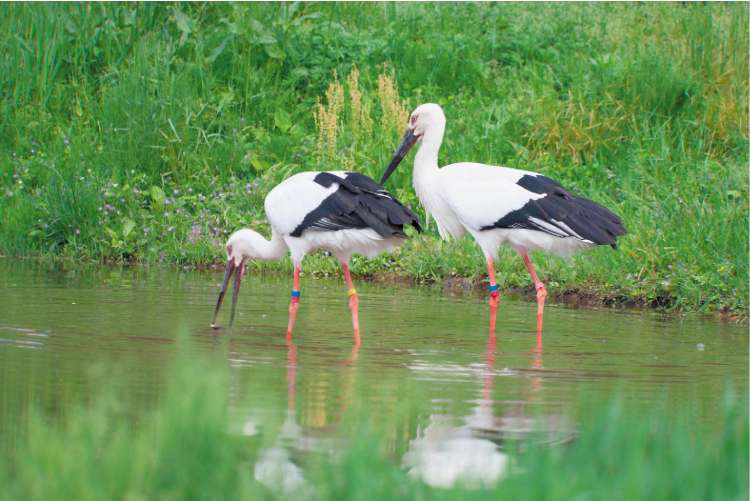
When Japan's last oriental white stork died in 1971 it was thought that the birds had disappeared forever. The wetlands where the stork nested had been irrigated, and development damaged its habitat. But in a remarkable success story, the storks are thriving again after a reintroduction programme.

After more than three decades of extinction, the first captive storks were released into the wild in 2005. By 2007 the first chick had hatched, and this year a further nine chicks arrived.

Yoshito Ohsako, who heads the breeding programme at Toyooka, said: "We were so happy when we found the nests. It's not so long since we started, and this is real progress; a lot of people didn't even think we'd succeed at all."

Japan was forced to do the unthinkable: it had to go back in time. Aggressive development had driven the birds to extinction, so the only option left was to attempt to return the ecosystem to its pre-1971 state.

The Hyogo district – once the birds' heartland – bore the scars of heavy industrialisation and modern farming. Land that was not polluted or developed was used for farming, so the paddyfields which had once supplied plentiful food for fish, frogs and snakes dried up and became contaminated with pesticides.

To make this landscape hospitable again has meant going back to more traditional irrigation systems that allow rivers and ditches to flow into paddyfields. This creates pools of shallow stagnant water that encourage the ecosystem that the birds can feed on.

Cutting pesticides and using more traditional cultivation methods has also helped make the wetlands less toxic. Some electricity cables have been put underground to stop the birds flying into them.

Professor Ohsako said: "The connections between the paddyfields and the streams and ditches disappeared. In our project we reinstated the aquatic connection to create 'fish ways', that channelled fish to shallow water."

The total number of oriental white storks in the world is believed to be as low as 2,500, with most in China, Korea and Russia.

The renaissance of the birds comes as biodiversity takes centre stage in global politics. Biodiversity will be high on the agenda today when environment ministers gather for pre-G8 summit talks in Kobe.

Yuri Onodera, of Friends of the Earth Japan, said that while such reintroduction schemes were laudable, Japan lacked commitment to biodiversity on a global scale. "Japan may be putting energy into conserving its own domestic landscapes, but its commitment internationally is failing," said Mr Onodera.

"It has been a strong opponent of a binding commitment to global biodiversity; its domestic commitment has little impact while they are lagging behind on international commitment."

Independent Comment
blog comments powered by Disqus

Day In a Page

Samuel Aranda wins World Press Photo

World Press Photo

The winners in pictures
Picture preview: Cotton Global Threads

Cotton Global Threads

Picture preview
Eat it don't tweet it: Do table manners still matter?

Eat it don't tweet it: Do table manners still matter?

In the technological age, modern dining etiquette is about so much more than just keeping your elbows off the table.
The 10 best knife sets

The 10 best knife sets

From blades inspired by Japanese master sword craftsmen to ceramic blades that feel as light as a feather
Once a Redgrave: Joely Richardson on playing the role made famous by her mother and sister

Once a Redgrave: Joely Richardson

The actress discusses playing a role made famous by her mother and sister
The growth industry: Veg boxes have gone from a niche product for worthies to a foodies' essential

The growth industry: Veg boxes

Vegetable boxes have gone from a niche product for worthies to a foodies' essential
RIBA's latest exhibition charts the changing face of the British home

Changing face of the British home

Oliver Bennett explores the Royal Institute of British Architects’ latest exhibition
First Night: In the Land of Blood and Honey, Berlin Film Festival

First Night: In the Land of Blood and Honey

Courage under fire! Jolie's debut is not for faint-hearted
The XX files: The hunt for victims of Guatemala's 36-year war

The XX files

The hunt for victims of Guatemala's 36-year war
Rein man: did Dustin Hoffman harm horses in his new drama?

Did Dustin Hoffman harm horses in his new drama?

Big-budget HBO series targeted by campaigners after two star performers had to be put down
How the FA can win with Harry's game

How the FA can win with Harry's game

Even an initial part-time role up to Euro 2012 would work, while England could be set free by Redknapp
James Lawton: Blame for this awful mess lies squarely with Capello

James Lawton

Blame for this awful mess lies squarely with Capello
Chris Ashton: Not so flash but still keen to make a splash in Rome

Chris Ashton interview

Not so flash but still keen to make a splash in Rome
London Eye: She's buddies with Bolt but this golden girl revels in anonymity

Simon Turnbull's London Eye

Jamaica's Trecia Smith is buddies with Bolt but this golden girl revels in anonymity
The data goldmine: Why forgetting to log out can cost you dearly

Data goldmine: Have you forgotten to log out?

David Crookes finds out how much stolen Twitter accounts, hacked eBay pages and more are really worth.