Japan's concrete ceiling
'Glass ceiling' hardly does justice to the sexism rife in Japanese business life. Anne Penketh reports on the battle for equality
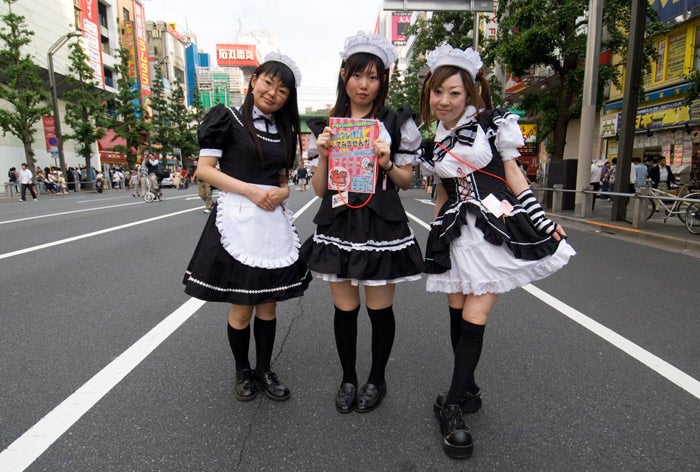
The scene is a fifth-floor cafe in Tokyo's neon-lit Electric City district. It is one of the breed of "maid cafes" that have sprung up to lure the Japanese capital's introverted geeks away from their laptops.
The customer is greeted by a phalanx of heavily made-up young waitresses wearing stockings, mini-skirts and pigtails. "Welcome home, master," they squeal in unison, tongue firmly in cheek of course.
A woman's place has traditionally been in the home in Japan, the only leading industrialised nation where women are still struggling for equal rights in the workplace. It comes as a shock to learn that, on the eve of International Women's Day 2008, only 0.8 per cent of Japanese chief executives are women, compared with 10 per cent in Britain and 23 per cent in Sweden. Only 10 per cent of Japanese MPs are women, one of the lowest rates of participation in the developed world. In the professional classes, women make up 9 per cent of lawyers and 8 per cent of the accountants.
In Japan, the glass ceiling is so thick it is known as the "concrete ceiling". In fact, Tomoyo Nonaka, the former chief executive of the electronics giant Sanyo, describes the barrier to women's professional advancement as "an iron ceiling – with a few holes in it". Thanks to a combination of women's and government efforts, the effects of the ageing population and a diversifying economy, the holes are getting bigger.
Ms Nonaka knows all about Japanese boardrooms where she is the only woman. Soon after she joined Sanyo, in 2005, she started to hear such whispers as "the female head of a manufacturing company doesn't look right". After less than two years as chief executive, she was out of a job. She says she fell victim to the money-men whose eye was on the financial bottom line. "The media said my vision was too naive, too feminine."
Ms Nonaka is a former television presenter who is one of the most prominent women in Japan and now heads the Gaia Initiative, a non-profit organisation promoting renewable energy projects. She didn't get to the top by being a traditional Japanese wife. "They called me the smiling killer," she says, smiling, perched on an armchair in a 49th-floor meeting room of a private members' club with dizzying views over the city.
She started out as a photojournalist with the television channel NHK and realised while she was covering the royal wedding of the Prince of Wales and Lady Diana Spencer in 1981 that "out of 250 people, I was the only woman journalist – the others were helpers".
Ms Nonaka, now 54, was not out there with women's lib activists burning her bra in the 1960s. "In Japan, if you got involved in that, you were seen as a kind of strange creature in the zoo."
To succeed in Japan, "you have to prove that you are three times as good as the men", she says. "I might feel angry or tired, and I was entitled to be, yet I had to carry the tripod to show that I was better than the men to make sure they would accept me." She became one of the country's best-known presenters – and one of the first women anchors – before joining government committees and what she calls the "boys' club".
Ms Nonaka points out that after the Second World War, under American occupation Japan was catapulted into the 20th century and women were given the right to vote "without even fighting for it". As the economy recovered, "the castle became the company which gave you lifetime employment. Women simply weren't included. "They stayed at home to raise children."
That tradition has been long in changing, despite an equal-opportunity law passed in 1985. The sociologist Yuko Kawanishi agrees that the corporate culture has held women back. "The men became slaves to the company which became like a family. People got sucked into the system and women had to take care of the home, in a kind of division of labour."
But she also acknowledges Japan's long history of Confucianism and patriarchy. "Foreigners think that because Japan is an industrialised society, it's comparable to other G7 countries. But Japan is uniquely Japanese. If you look around Asia, the status of women goes up with educational achievement. That's not the case in Japan, where almost as many women complete a university education as men." A government Gender Equality bureau – staffed by 50 people with equal numbers of men and women – was set up in 1999 under the authority of the prime minister. Atsuhiro Kaneko, a bureau official, says that as the economy diversifies, more women are needed in the economy. At present, 50 per cent of Japanese women are in full-time work where they earn one third less than men.
The greatest discrimination facing women is when they have a child: 70 per cent of women do not return to a job after having a first baby. If they do return after a maximum 14-week paid maternity leave, they see their income decline. "Once they quit there are no laws to protect women," says Mr Kaneko.
Mizuho Fukushima, the leader of Japan's opposition Social Democratic Party, is battling for women's rights. She is the author of such books as What Happens When A Woman Becomes A Politician and Never Get Married To A Man Like This.
She wants to give women the right to keep their maiden name, an uphill struggle that has so far seen a bill rejected 10 times, and is an advocate of the rights of children born out of wedlock, which negatively affects their inheritance. Ms Fukushima, 52, has kept her maiden name and has not married her partner with whom she has a child.
She also campaigns against sexual harassment, domestic violence and for improved maternity leave and child care. When she was elected to the Upper House, 10 years ago, she had to share the male lavatories. Now she and her female colleagues have separate loos.
Ms Fukushima pins her hopes on the women in their forties who will not tolerate the old ways. "I am looking forward to this generation coming through, who might develop into role models for other women," she says. Studies show a gradual change in attitude.
A survey in 1979 found that 70 per cent agreed with the statement "the husband should be the breadwinner, the wife should stay at home", where paradoxically the woman rules supreme. This year, for the first time, a majority of 52.1 per cent disagreed.
Single and childless women in their thirties now take pride in a career and a disposable income. "Until recently, Japanese women felt it's a good deal to be a housewife," says Dr Kawanishi. "But that's now changing with the economy."
Keiko Kitahara's story is revealing. She is a 54-year old architect with the top-level first-grade licence. Male colleagues with the same qualification questioned her presence, and in particular the way she responded to them without the submissive replies that they had expected.
But even now, she says, "in the place where I work, the women always make the coffee. When I arrived, I said, 'hey guys, let's make our own coffee'. But as more women have joined the company, they've started getting it for the men. The guys are still on top."
Join our commenting forum
Join thought-provoking conversations, follow other Independent readers and see their replies
Comments
Bookmark popover
Removed from bookmarks