Killed by the enemy within
Five British soldiers shot dead and others critically wounded after rogue Afghan policeman turns machine gun on his colleagues as they relax in base
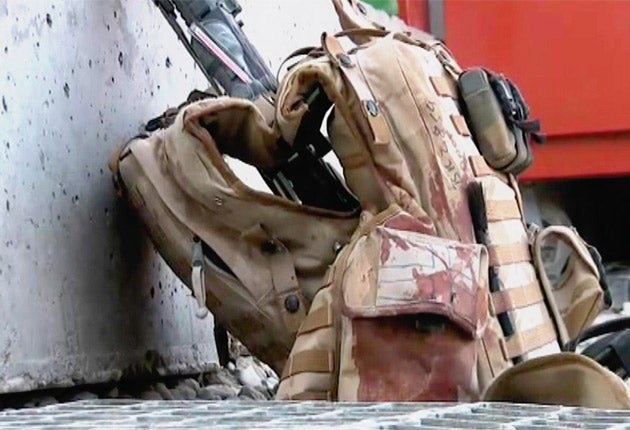
The killings were sudden and savage. There was no escape from the raking bursts of machine-gun fire for the soldiers hemmed in by the walls of the police checkpoint.
The British troops at Blue 25 had no chance to defend themselves, and a terrible price was paid. Four men lay dead, and seven others were injured, one of them to die later. Their attacker, an Afghan policeman, was also wounded, but managed to escape on a motorcycle under covering fire from his accomplices.
One of the men who died was yesterday named by his family as Sergeant Matthew Telford, of the Grenadier Guards, who was the father of two sons, aged four and nine. He had been in Afghanistan two weeks. Another was named as 18-year-old Guardsman James Major. The others who fell were Warrant Officer Darren Chant, also of the Grenadier Guards, and Acting Corporal Steven Boote and Corporal Nicholas Webster-Smith, both of the Royal Military Police.
The deaths bring the number of British service personnel killed this year to 95, of which 92 have been in Afghanistan. The killings of three Guardsmen and two members of the Royal Military Police at Nad-e-Ali in Helmand matched the previous biggest loss suffered by UK forces in Afghanistan in a single attack. Even in this particularly savage war the attack has shocked British troops. They now have to work with the spectre of a fifth column – infiltrated amongst their supposed allies.
The attack also comes in the middle of an intense debate about the war. Even as Barack Obama considers sending 40,000 more troops to the country there is rising opposition to further involvement. The victory awarded to Hamid Karzai after an election riddled with vote-stuffing has led to questions about why British, American and other Nato troops should fight and die to prop up a government internationally labelled as corrupt.
The fact that the Nad-e-Ali killings were carried out by an Afghan policeman has raised fundamental questions about the West's exit strategy – which is to train Afghan forces to take over security in their own country.
The massacre was the latest in a series of attacks on Western troops and officials involving the Afghan police. Four weeks ago a policeman in Wardak province opened fire on American soldiers, killing two of them before fleeing. Last year, over a period of less than a month, Afghan police twice attacked US forces, killing two soldiers and wounding three others. Last week men in police uniforms forced their way into a guest house in Kabul and murdered five UN election workers. They were not members of the force, but had information on the target of their attack, which, say investigators, could only have come from official sources.
In the latest incident, the killer, named as Gulbuddin, had been a policeman for around two and half years. It was not known last night what kind of vetting he had received, if any, when he joined the force at Musa Qala. He had subsequently attended a police academy in Kandahar.
Gulbuddin had been based with an Afghan National Police detachment at the village of Shin Kalay, west of Nad-e-Ali, who were being trained by Grenadier Guardsmen and Royal Military Police from 11 Brigade which had recently taken over at Helmand.
Lieutenant-Colonel David Wakefield, the British military spokesman in Helmand, stressed that the UK team had been working and living with the Afghan policemen at the base for over two weeks without any problems. Defence sources in the UK and Afghanistan insisted that there was no evidence that the police unit at Shin Kalay had been infiltrated by insurgents, and there were reports yesterday that Gulbuddin had been involved in a row with a local police commander called Mohammed Wali Issaqzai.
But a number of Afghan sources maintained that Gulbuddin had contacts with the Taliban in Musa Qala and a member of his extended family had been involved with insurgents.
At around 2.15pm on Tuesday a mixed British and Afghan team arrived at the checkpoint, Blue 25, after a patrol. Inside the safety of the compound the men laid down their weapons and began taking off their body armour. It was at this point that Gulbuddin is said to have opened fire with a PK machine gun, a Russian-era weapon used by the Afghan security forces. There had been no altercation – the assault appeared to be premeditated. The unsuspecting British soldiers were cut down.
There were scenes of confusion with shots being fired by both British and Afghan forces and Gulbuddin was said to have been hit on the thigh. However, he managed to get out of the compound and flee on a motorcycle which had been positioned beside a track. His pursuers, British and Afghan, were said to have been pinned back by covering fire from surrounding areas.
The injured British troops were flown by a US Blackhawk helicopter to the UK-run hospital at Camp Bastion, before being returned to Birmingham last night. Two Afghan policemen injured in the attack were taken to a hospital at the Helmand provincial capital, Lashkar Gah. Sgt Telford's uncle, William Ferrand, said he had come from an Army family and was a veteran of several Army tours. "It was his job and he loved doing it," he said. "Nobody wants their family to go out there but it's what he wanted to do."
Gordon Brown paid tribute to the "courage and professionalism" of the fallen men and said: "The death of five brave soldiers in a single incident is a terrible loss." The Conservative leader David Cameron said: "I pay tribute, as will the whole country, to their professionalism and their courage."
The Labour MP Kim Howells, chairman of the Commons Intelligence and Security Committee, said: "There are many people who have argued that there is only one way out of this for Britain and America and that is to train up the Afghan army and police force so that they can become responsible for their own security. This is a real blow because it strikes right at the heart of that policy."
Join our commenting forum
Join thought-provoking conversations, follow other Independent readers and see their replies
Comments
Bookmark popover
Removed from bookmarks