'Most of them were corrupt and stoned on opium'
A senior serving soldier reveals how the Afghan policemen in Helmand are often a danger to the British forces they work with
SUSANNAH IRELAND
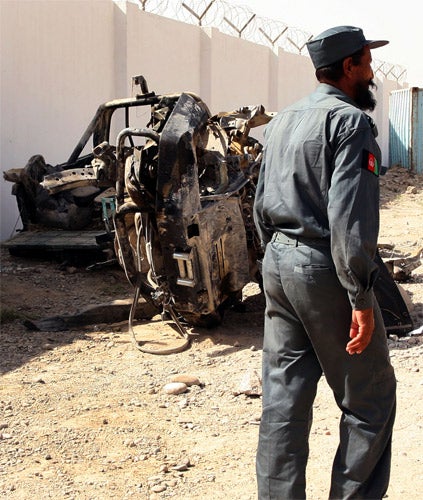
An Afghan police officer walks past the remains of a vehicle destroyed by a roadside bomb that has been placed outside the police compound in Nad-e-Ali
When I heard the news this morning, I thought "Christ, five in one go..." I was shocked and saddened – but I was not surprised that it had happened. I'm surprised it took this long.
We went out to Helmand to mentor the Afghan National Police without understanding the level they were at. We thought we would be arresting people, helping them to police efficiently. Instead we were literally training them how to point a gun on the ranges, and telling them why you should not stop cars and demand "taxes".
Most of them were corrupt and took drugs, particularly opium. The lads would go into police stations at night and they would be stoned; sometimes they would fire indiscriminately at nothing.
They had no understanding of the basics of what it means to be a policeman. We expected to be teaching adults at a certain level and then realised we would be changing nappies. Give them 20 rounds and they will hit the target once.
The first time I saw them I realised that they had almost no training; some of them had very little ability. Their uniforms were dirty and didn't fit. Their weapon-cleaning was non-existent.
They certainly didn't have a concept of being upstanding members of the community. They had no loyalty, esprit de corps or cameraderie. That should have been incorporated in their training. They did have pride – because of the power and status they felt.
How do you train this band of idiots and turn them into a force to be reckoned with if they have no sense of loyalty, no sense of belonging?
The biggest problem was that we didn't know who we were getting. There were no security checks – they were literally allowed to come into the compound and we had to rely on the local chief of police, who recruited them. We kept a close eye on them because we didn't know or trust them – it was for our own security.
Perhaps half of them genuinely wanted to try to make the community safe: they had the right intention but the attention span of gnats. Twenty would turn up one day, none the next, then 15, then suddenly a new face would appear.
It was difficult just getting them to a basic level, to do things like man a post. They would take drugs, go to sleep, leave their post, have sex with each other. Very few were vigilant or alert.
When we went out of camp to do stop-and-searches, we became sitting ducks – nothing more than bodyguards or babysitters while they worked.
British troops felt extremely vulnerable. If they were going out on patrol they didn't tell the Afghans where, so they couldn't pass on the information – they didn't want improvised explosive devices (IEDs) laid in the area. They didn't trust them one bit.
There was an operation involving the Brits and the Afghan National Army to clear Nad-e-Ali, and it cost lives. The police were left at checkpoints, but within 48 hours all the checkpoints had been overrun or the police just buggered off. As soon as the ground was won it was lost again.
The Afghan army are a lot more switched on. They have started to stand up for themselves. But the police have not had the same investment. There is no point in pushing the army through to clear ground if you leave a void behind with the police.
Lives get lost for nothing.
The Afghan police are very good at understanding the environment and if the atmospherics have changed because they are local: they know the area and the people. They are also good at spotting IEDs, although some just pick them up and walk off with them, or put them into the back of their vehicle.
Progress is being made, but it is extremely slow. I am convinced that a lot of money has been wasted and people have lost their lives unnecessarily because it was for a political end, and not a military decision. The British Army has been pushed into doing something it should not be. This type of mentoring role could be fulfilled by our Ministry of Defence police or civilian coppers (in a secure compound).
A lot could be done without putting British soldiers' lives at risk. They should recruit the right Afghans, security check them, pay them regularly and train them properly – at least three months out of the area – all before the squaddie ever gets to see them.
The author's identity has been withheld
View all comments that have been posted about this article.
Offensive or abusive comments will be removed and your IP logged and may be used to prevent further submission. In submitting a comment to the site, you agree to be bound by the Independent Minds Terms of Service.
- Print Article
- Email Article
-
Click here for copyright permissions
Copyright 2009 Independent News and Media Limited


Comments
Since you're too stupid, I'll give you a clue.
If someone came to Britain with a fucking great army, took over your town and said they were running your country from now on, would you just accept it because they were a bunch of WANKERS with absurd ideas of running an Empire again and a past history of invasion? Or would you fight back?
It's WANKERS like you who are the cause of this war. If you expected sympathy, support or understanding, you've come to the wrong place, arsehole. Rot in HELL for what you've done in Afghanistan, you SCUM.
Link | Reply | Thread
The thing I find really inexplicable about media coverage of Afghanistan is that we never, ever, hear or see anything of the civilian population - the people it's supposed to be all about.
And we've only heard about the police, and what they're like, because one of them yesterday defended his country by shooting five of the occupying soldiers.
Suddenly we hear all about them, how they are all on drugs, "having sex with each other", have "the attention span of a gnat", will no cooperate etc. Didn't anyone in the occupying army realise at any point that these guys are not cooperating because they are not interested in collaborating with the occupiers?
I don't see anyone yet who has come up with an intelligent exit strategy for the occupiers.
You silly little angry man. It's a bit more complicated than your pea brain has worked out. Britain doesn't need an foreign army because Britain is not a failed state that grows 90% of the world's heroin and harbours thousands of Islamic Fundamentalist terrorists and their training camps. True, we do have homegrown terrorists, but they do not make up part of the government.
Also, crucially, the writer wasn't writing about why he was there - he was writing about the reality on the ground. He was part of a group of soldiers sent by the UK government (so if anyone's a WANKER then it's the government - the army don't make these decisions. Now who's the WANKER?) to train the police force into learning how to protect their communities.
I suggest for you some anger management, and a lot of reading. Clearly issues for you are simply black or white whereas in life you will find, when you finally grow up, that things are often in the grey area.
And Reiner 'rot in hell' is wrong - I think you mean "burn in hell' - but I have some terrible news for you; hell doesn't exist. It was something cooked up by the religious to make simple people terrified.
I offer the writer all my sympathy, support and understanding for what he and the rest of our armed forces are being made to do in Afghanistan. It can't be easy.
Most DEPRESSING though is the Repetition of "WANKER", and the TOTAL Absence of Originality in General in your Terms of PERSONAL ABUSE.?!?!?!?!
If you Wish to be taken SERIOUSLY kindly ATTEND TO DETAIL or you Risk being Ignored and Written Off as a CRANK!!!!!!!!!!!!!!!!!!!!!!!!!!!
The author is making up the bit about seeing policemen having sex with each other. AF is a most interesting country in this regard but the hardest to crack.
I gather the SAS are following a Search and Destroy mission for the killer of the five soldiers. Pity they don't do so with some of the UK officers.
that is, when their governments decide to cut their losses and say. . . adieu!.
As the author said, one would have to know the area well, (and the various dialects!), to have a feeling for what goes on. It must hard not to be able to see the forest for the (Taliban) trees.
It worked pretty well before mass air travel.
The initial defeat of the Taliban fitted that model pretty well. What followed seemed a reasonable start. And it's all been wasted.
It must indeed be difficult to find oneself in so unenviable a situation as that described above by the 'senior serving soldier' (one might ask just whom is he serving ?) - the page fairly reeks with his contempt for the Afghanis he was supposed to be training. Can't shoot straight, no morale, learning ability close to null - am I the only one to be reminded of the descriptions given by 'senior serving soldiers' from the US concerning the Vietnamese with whom they were supposed to be working ? Yet for some reason, the Vietnamese on the *other* side were able to shoot straight, had high morale, and were able to learn how to fight a war - indeed, so well that in the end they managed to drive the invaders out. What was the reason for this signal success ? Did they have superior trainers ? Why is it that today, the invading NATO forces in Afghanistan seem to be losing, despite their massive superiority in weaponry and fire power ? Do they also have superior trainers, who, unlike our good 'senior serving soldier' are able to turn uninspired recruits into resourceful fighters ? Or is it the case that fighting against the invaders of one's land is something other, and more inspiring, than fighting alongside them ? Get those foreign troops out of Afghanistan and let those who call the country home resolve their own disputes - even if that means allowing the profits of those who supply the means of war and the perks of the bought-and-paid-for politicians that serve them in our own countries to decline....
Henri