Murky past of Japan's troubled nuclear industry revealed
The main nuclear power operator has cut corners over the years – with the government's knowledge. Daniel Howden reports in Fukushima prefecture
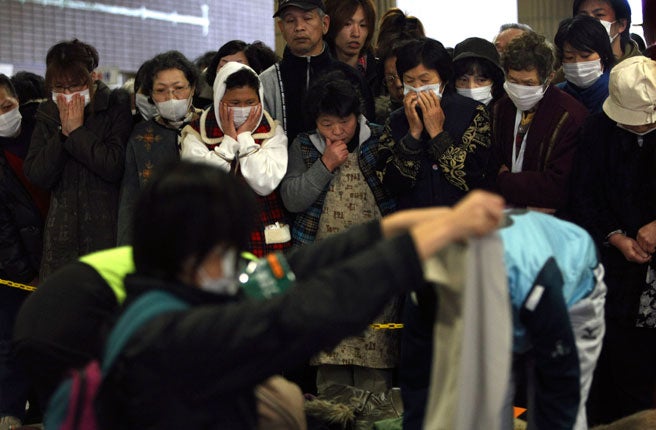
Miwa Tamagana has been hearing the same thing for days and she has stopped believing it. "I don't trust the government or the power company. On the TV and in the papers they say the condition is the same."
The mother of two sits on a mattress in a school gymnasium with her sons sleeping next to her and scores of other evacuees camped around them. Boxes of balloons for the kids are covered by newspapers with pictures of smoking devastation at the Fukushima nuclear power station about 20 miles away.
Despite escaping the earthquake and the tsunami, her family is now being stalked by something they can't see – radiation. "I know it has come this far," she says. Her two-year-old son, Ryoka, is only allowed outside the gym for half an hour a day to limit his exposure.
Hironao Ueda volunteers at the shelter, giving daily nuclear bulletins over a loud-hailer. He's not sure what to believe either. The school on the outskirts of the half-deserted city of Iwaki, ringed by rippled and cracked motorways, is in what Mr Ueda calls the "grey zone" – the area just beyond the 20-kilometre nuclear exclusion zone.
The plant's owners, the Tokyo Electric Power Company (TEPCO), and the government say people will be safe here as long as they stay inside. Mr Ueda sent his wife and two children to Tokyo despite the reassurances. "I don't know who to trust," says Mr Ueda. "TEPCO have hidden problems in the past."
Two weeks after Japan's worst earthquake tremor sent a devastating tsunami into the northeastern coast, the consequent nuclear crisis is being amplified by the industry's murky past. Traces of radioactive iodine have contaminated food and water supplies and airborne radiation is fanning out around the stricken Fukushima plant. But the ensuing panic that has prompted many countries to reconsider their nuclear programmes has been darkened by revelations from Japan's own troubled industry.
Peter Gale, sometimes called the Red Adair of nuclear accidents, is a scientist who made his name during the Chernobyl disaster. He arrived in Tokyo this week to tell the government that its first priority must be to regain credibility. "The truth can be a hard sell to the public," he warned. And it's not made easier when TEPCO has a history of not disclosing information, he added. "People are right to be disbelieving."
Japan's power giant is denying any responsibility for the current crisis at its Fukushima Dai-Chi plant and is set for a legal scrap over liabilities which could have a profound influence on the future of nuclear power worldwide.
TEPCO insists that the magnitude 9 earthquake on 11 March was outside the range of anything previously predicted. But testimony from those involved in the design and regulation of the plant, as well as leaked documents, portray a company that cut costs and ignored warnings in the build-up to the disaster.
Mitsuhiko Tanaka worked on the design of one of the four damaged reactors where teams are battling to prevent a catastrophic meltdown. Now retired, he says that TEPCO were told from the start that the primary containment vessels, based on 50-year-old US technology, were too small. "I was deeply involved 40 years ago and it was clear then that there were basic design problems with the containment vessel. They were too small by volume."
He says that TEPCO went ahead regardless as it was cheaper and a Mark II improved vessel only came later. Of Fukushima's six reactors the four that are at risk all use the earlier, cheaper design. "Old power stations like Fukushima were not designed for Japanese earthquakes," says the retired nuclear engineer. "But these earthquakes shake Japan frequently and the design must pay attention to a big earthquake."
Mr Tanaka rejected official assurances that the crisis was easing and criticised the lack of official information on how they were attempting to cool the vessels. He said that whatever is said in pubic the government and TEPCO are haunted by a possible "China Syndrome" – the name given to a total meltdown where molten nuclear fuel burns its ways through the protective vessel and falls to the concrete floor of the reactor triggering a huge release of radioactive material.
Electricity has been reconnected at Fukushima's command centre after a desperate battle inside the exclusion zone to cool the overheated reactors and spent nuclear fuel. Two of the 200 workers who have been risking their lives inside were taken to hospital yesterday after officials said that contaminated water had seeped into their boots giving them "beta-ray burns".
When the scale of the nuclear crisis became clear, TEPCO was forced to admit to the International Atomic Energy Agency, the IAEA, that it had repeatedly missed safety checks over the last 10 years and had allowed uranium fuel rods to accumulate at the plant.
The admissions compounded revelations from diplomatic cables released by Wikileaks showing that the IAEA had warned that a strong earthquake would cause "serious problems" and that safety systems were out of date. A US embassy cable quoted an unnamed expert warning that Japan's "safety guides for seismic safety have only been revised three times in the last 35 years".
TEPCO's last president was forced to resign after company documents requested by the government were found to contain more than 200 mistakes.
Japan gets one-third of its power needs by operating 55 of the world's 450 reactors. Its nuclear industry was supposed to have been shaken out of its complacency by the Niigata earthquake that struck the Kashiwazaki-Kariwa plant in 2007.
On that occasion TEPCO initially failed to report the leak, then admitted it was 50 per cent bigger than originally announced. In the aftermath one of Japan's leading seismologists, Ishibashi Katsuhiko, who coined the term "genpaku shinsai", or nuclear disaster triggered by earthquake, called Japan's nuclear technocrats dangerously delusional. He later resigned from the Japan Nuclear Safety Commission saying that the new standards they were drafting were not "sufficient" as they only foresaw a magnitude 7 quake.
The Commission has remained silent since the big one struck on 11 March, says Taro Kono, an influential MP who says Japan's leading political parties are too cosy with the power utilities. "The commission has no idea what the hell is going on," he told The Independent. "Bureaucrats leave the government and go to TEPCO. The regulator and the regulated are the same people."
The power company doesn't have the ability to handle the crisis, he complains, which is making the fallout worse. Models designed to predict air pollution are being run, says Kono, but the results are not being released to the public.
Tokyo's Citizens' Nuclear Information Center, an independent watchdog, has been warning for years that the nuclear plants dotted along Japan's coast were vulnerable to a tsunami. "They say no one saw it coming but we've been telling them repeatedly," says Philip White, a spokesman for CNIC. "The government wanted more nuclear power and steamrollered anyone who got in its way. TEPCO and the government are not victims of anything other than their own stupidity and irresponsibility."
But Fukushima was not the "big one" that seismologists were waiting for. That is still due at Hamaoka, a nuclear plant 100 miles southwest of Tokyo where scientists say there is an 87 per cent chance of a magnitude 8 quake in the next 30 years. That's the one that keeps Mr Tanaka up at night: "The wind always blows west to east from there. The fallout would hit Tokyo directly in about six hours."
Join our commenting forum
Join thought-provoking conversations, follow other Independent readers and see their replies
Comments