My job is too big for one man, says Dalai Lama
After 500 years of autocracy, Tibetan leader calls for democracy
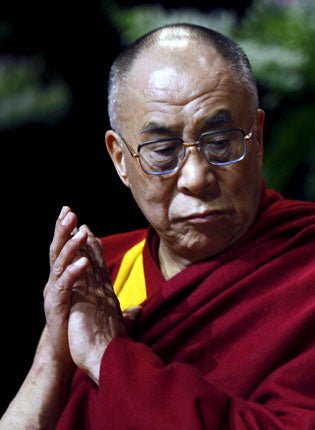
In a speech that underscored the pressures he has had to bear during his life serving as both a spiritual and political leader, the Dalai Lama has said there is no need for his successor to perform the two roles.
In a video clip shown to hundreds of monks, nuns and lay people gathered in the mountain town of Dharamsala, the 73-year-old said it was essential that the Tibetan community in exile embraced democracy if it were to keep step with the wider world.
"The Dalai Lamas held temporal and spiritual leadership over the last 400 to 500 years. It may have been quite useful. But that period is over," said the Nobel prize winner. "Today, it is clear to the whole world that democracy is the best system despite its minor negativities. That is why it is important that Tibetans also move with the larger world community."
The Dalai Lama has long stressed the need for the Tibetan community to elect a political leadership, and the first election to select a prime minister was held in 2001. Indeed, the symposium at which his comments were broadcast late on Saturday night in the Indian Himalayan town where he has lived for almost five decades, was being held to discuss the next election for the government-in-exile – due to be held in 2011.
Karen Lang, an associate professor of religion at the University of Virginia, said: "He is going to be 74 on 6 July and he is only human. He is looking ahead to when he passes away and the undeniable political problems there will be in choosing his successor. What he is saying [about dividing the political and religious role] makes a lot of sense, especially given the long interim period between announcing his successor and that person coming of age."
The speech put the firmest cap possible on the idea that the Lama should be the sole repository of leadership for the Tibetan people. "When we put the whole responsibility in the person of the Dalai Lama, it is dangerous," he said. "It is appropriate that a democratically elected leader lead a people's movement. In reality, a change is happening in the responsibility of the Dalai Lama as the temporal and spiritual leader. This, I think, is very good. A religious leader having to assume political leadership, that period is over."
Yet there is often a gulf between the opinions expressed by the Dalai Lama and what actually happens within the Tibetan Buddhist community. Last October, for instance, he announced that his moderate, so-called middle-way approach was having no success with the Chinese authorities and that he wanted to take a back-seat role. He also called a mass meeting to discuss the way forward and for people to vote on whether they wanted to continue with his tactics. Though many within the Tibetan community disagreed with his approach, when it came to the vote the Dalai Lama's view won.
Robert Thurman, professor of Indo-Tibetan studies at Columbia University, said that while the Dalai Lama had managed to perform both a political and religious role, it was his belief that the Tibetan people would benefit from more secular education and taking more personal responsibility. "He thinks that democracy is the best way for this. He has dealt with Chinese autocracy for more than 60 years and he has seen what that has done," he said.
Many Tibetans fear that the death of the Dalai Lama, who has lived in exile in India since he fled a crackdown by the Chinese after a failed uprising in 1959, could create a leadership vacuum that Beijing could exploit to tighten its grip on Tibet. China has claimed the Dalai Lama must follow "historical conventions", including an endorsement from Beijing. The authorities have gone as far as to say that his incarnation must be chosen by drawing lots from a gold urn given to Tibetans by the ethnic Manchu emperors of the Qing dynasty.
Despite the Dalai Lama's stated commitment to democracy, some observers believe a "regent" could be appointed to lead the freedom struggle in the form of Ogyen Trinley Dorje, who is the Karmapa, or spiritual head of the Kagyu order of Tibetan Buddhism and the third highest-ranking figure across the various schools. Whilst the 17th Karmapa could not inherit the title of Dalai Lama, he could act as a figurehead and help fill the void should the Dalai Lama fall ill or die. Such a move has been publicly discussed amid concerns last year about the Dalai Lama's health.
Earlier this year, the 23-year-old Karmapa, who was born and raised in Tibet but who escaped to India in 2000, told reporters: "His Holiness has been very successful in laying the foundations for the Tibetan struggle. He has done a great job. Now it is time for the next generation to build on this and carry it forward."
Tenzin Taklha, a spokesman for the Dalai Lama, said the Tibetan leader had been promoting a democratic framework for the Tibetan community in exile since the late 1960s.
Join our commenting forum
Join thought-provoking conversations, follow other Independent readers and see their replies
Comments