Nepal seeks legal cover for shawl that conquered the world
Foreign rivals put pressure on the original pashmina
It takes a particularly fluffy goat to survive a Himalayan winter, and the chyangra goat – the source of pashmina wool – is the fluffiest of all.
Coveted for its lightness and warmth, the wool – used in scarves and shawls sold in boutiques from Paris to Manhattan – has brought much-needed income to the mountain kingdom of Nepal. But recently exports have slumped, thanks to competition from cheap imitations mass-produced mainly in China and India, Nepal's much larger neighbours, from inferior wool or synthetic fibres.
Now producers in Nepal, backed by the government, are fighting back, registering the trademark "Chyangra Pashmina" after the sub-species of goat. Pashmina garments made there will carry a special logo, and Nepalese producers will monitor markets around the world to protect their trademark.
Spun from the short, soft hairs found beneath the goats' long outer coat, pashmina wool has become popular – with celebrities as well as ordinary consumers – in the past couple of decades. A pure pashmina scarf can easily cost £100 or more. Nepal exported $103m (£62m) worth of the wool in 2000, but by last year that figure had dropped to just $18m.
The reason, local producers believe, is the cheap Chinese and Indian-made scarves sold for a few dollars in tourist shops in Hong Kong, London and Bangkok. Rebecca Ordish, an Australian intellectual property lawyer based in Nepal, told Associated Press: "Pashmina has gone from being a luxury product associated with royalty to a cheap shawl or scarf." She believes that pashmina wool has lost its expensive, rare aura, and that consumers now associate the name chiefly with low-quality imitations, "so they won't be prepared to pay more for the expensive genuine product".
The new trademark, intended to set those genuine products apart and ensure the content of the wool, has been registered in dozens of Western countries, according to Manoj Acharya, a senior official in Nepal's Ministry for Commerce and Industries. The Government also plans to set up a laboratory in the capital, Katmandu, to provide scientific backing for the superiority of its goods. "Our hope is to separate Nepal's products from others, so that consumers are not fooled," Mr Acharya said.
Mandu Bahadur Adhikari, the head of an umbrella body that groups Nepalese producers, said members would monitor wool markets to make sure others did not use the Chyangra Pashmina label. They would also check the labels of goods sold in shops in the West, and were planning a media campaign to alert importers and consumers to possible imitations.
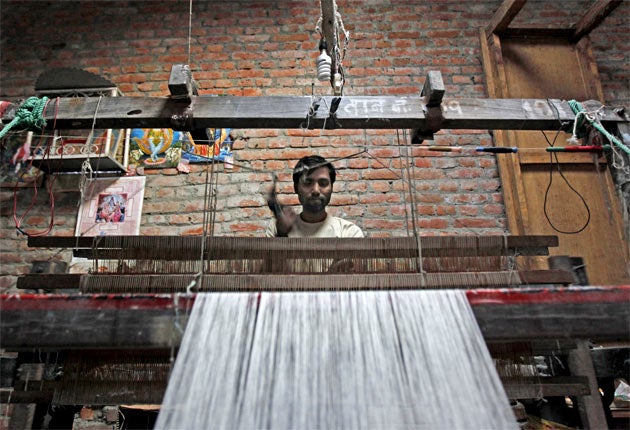
Thousands of Nepalis, from Himalayan goatherds to wool processors, weavers and exporters, are involved in pashmina production. About half have lost their jobs or businesses over the past decade. The industry requires hard labour and skills, with the wool sorted by hand and then painstakingly spun, woven and dyed.
The goats – found at high altitude in Nepal, India and Pakistan – are sheared just once a year, in spring, with each goat producing only 100 grams or less of usable wool. It takes the wool of three goats to make one pure pashmina scarf, yet the wool is so fine that the scarf is almost weightless. If silk is added to give weight, the price decreases.
Nepal is not the only place suffering from competition from cheap imitations. Pashmina producers in Indian-controlled Kashmir have also seen exports decline steeply. They, too, have begun stamping their goods, although they say it is not yet clear whether the move is helping to protect their market share. While pashmina wool accounted for only 3 per cent of Nepal's exports last year, it was the third-ranked product for sales in hard currencies such as US dollars, which the country needs in order to import goods such as electrical equipment.
Sudarshan Man Singh, the owner of the Himalayan Chyangra Pashmina shop in central Kathmandu, said it was difficult to compete with mass-produced imitations. "The imitation [goods] are obviously of low grade, and people who buy them will most likely not like them," he said. "It is hampering our reputation in the market, and we need to act now."
Join our commenting forum
Join thought-provoking conversations, follow other Independent readers and see their replies
Comments