North Koreans dare to protest as devaluation wipes out savings
Rush for dollars and Chinese yuan after Kim Jong-il's surprise move to reassert control over economy
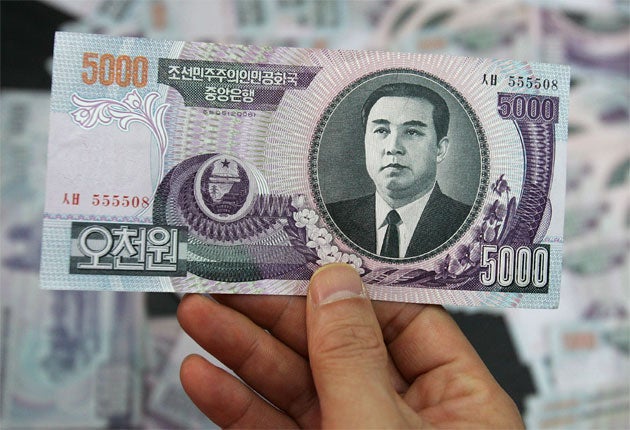
The North Korean leader Kim Jong-il is trying to smother his country's fragile free market with a shock currency devaluation that has reportedly sparked panic, chaos and protests inside the isolated Stalinist state.
Monday's devaluation of Pyongyang's nearly worthless currency from 100 to a single won has wiped out the savings of impoverished North Koreans and generated a scramble for dollars and Chinese yuan, say sources behind the bamboo curtain.
Millions of Koreans have been given until next Monday to exchange their savings for the new won following Monday's decree, which has caused "great confusion" and anger, says South Korea's Chosun Ilbo newspaper.
Intelligence services in the South report that Pyongyang has stepped up security around the country of 23.5 million people as a safeguard against possible protests and riots, with army bases placed on standby. Officials are bracing themselves for a furious reaction to news that a deposit of 200,000 won in cash to a North Korean bank will yield just 1,100 won in the new currency. There were unconfirmed reports that brief protests on the streets of Pyongyang had already forced the authorities to slightly increase the amount of currency people would be allowed to exchange.
The devaluation has already sent the price of rice skyrocketing 15-fold, according to Daily NK, an online newspaper sourced by defectors and informers in the North. "This move will do nothing other than destroy the fortunes of the people," it warns.
The significance of the move has divided Pyongyang analysts with some seeing it as an attempt to end inflation. But others believe the ailing Mr Kim is struggling to reassert control over the economy before he hands the keys to power to his son, Kim Jong-un.
Kim Jong-un has already been declared leader-in-waiting, according to Japan's Mainichi newspaper, which claims to have seen official documents confirming the handover. Many believe his father is worried he may not survive the transition unless the North's disintegrating economy improves.
Famine, compounded by a series of natural disasters, is thought to have claimed 2-3 million lives inside the country since the mid-1990s. Mr Kim has responded with a series of limited Chinese-style reforms designed to loosen central control over the economy.
The reforms have increased wealth disparities and incubated a growing class of wealthier farmers and merchants who are evading state controls and using bribery to keep government officials in line, say Pyongyang watchers. In January, the government failed in its attempt to rein in the reforms by limiting or closing private markets.
"Currency reform was probably the only option left to neutralise the wealthy merchant class," a North Korean defector and analyst, Cho Myong-chol, told Chosun Ilbo yesterday. "The latest measure has made everyone poor again and possibly raised the North Korean government's hopes of regaining control over its people."
News of Mr Kim's decree comes amid claims that the North's military has also reasserted control over mines and other areas of the economy in a bid to earn hard currency before the transition of power – likely to be one of the most traumatic periods in the country's troubled history. The army is reportedly selling minerals to China and hoarding the earnings.
Observers say the devaluation will destroy the savings of poorer and middle-class North Koreans while leaving wealthier traders, who have hoarded yuan, dollars and gold, mostly untouched. Analysts in South Korea were warning last night that the move could backfire and even spark revolt.
"Currency reform... will follow in the footsteps of past currency reforms, most likely resulting in further reduced confidence in the North Korean currency and heightened reliance on foreign currency holdings, whilst doing nothing to address the underlying causes of inflation in the highly distorted North Korean market economy," says Daily NK. It said some areas of the North were under curfew and that shops have been ordered shuttered while the currency transition takes place.
"I worked like a dog for two months for the winter, but the money became useless paper overnight," said one man quoted by the Seoul-based support group Good Friends.
Join our commenting forum
Join thought-provoking conversations, follow other Independent readers and see their replies
Comments