Pakistan flood survivors now face threat of malaria
The waters have receded but new perils trail in their wake: deadly disease and abject poverty
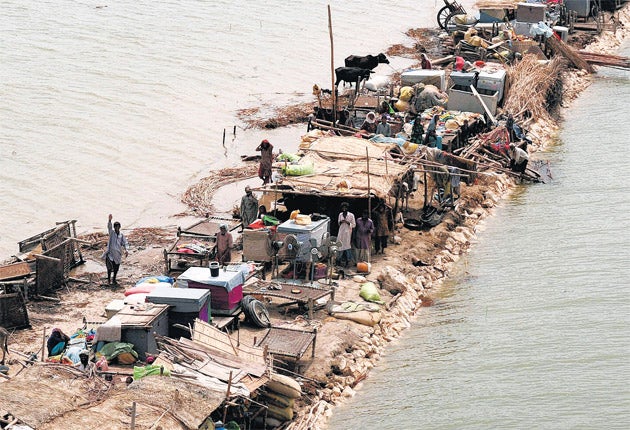
Wali Khan shifts his eyes nervously from side to side as he points to the tumbled walls which are all that remain of his mud-brick house. The 45-year-old labourer is frightened that his neighbours in the battered town of Charsadda will suspect he is receiving help denied to other flood victims. He says: "I mustn't be seen with foreigners for too long or people will think I am getting special treatment."
As water levels in the rivers drop in this part of north-west Pakistan, victims of the flood are divided between those who have lost everything and those with just enough left to get back on their feet. Mr Khan, living with his wife and six children in a tent in a camp with 650 other people a mile from his old home, recalls: "The first I knew of the flood was when four foot of water came pouring into my house at ten in the morning. I came back today for the first time, but there is nothing left."
Most of the better-built buildings in his old neighbourhood are still standing, with a water-mark over the doorways showing where the flood peaked at about 10 feet above street level. The future of some houses is still in doubt. Kashif Jan, who sells soap for a living, points to the dun-coloured side wall of his own home just behind the ruins of Wali Khan's house, where the central part of the wall has given way so that the topmost bricks are precariously held in place by a wooden pole.
Mr Jan is dubious how long the wall will survive and adds that he lost all his savings, which he kept in cash, along with his soap supplies, on the day of the flood. Otherwise, standing in a clean brown robe amid the wreckage of his home and business, he sounds surprisingly confident that he will soon be back in business, though all the local shops are still shuttered.
His neighbours agreed that the government had done nothing for them and that any aid they received came from international non-governmental organisations. The local transformer had been knocked out by the floods but was now back in operation. Shahid Ali, an electrician, said: "Our main need is clean water and rope beds to sleep on."
For those like Mr Khan, who were already poor before the flood and have now lost their houses, the future looks grim and uncertain. At his camp, set up by the National Rural Support Programme and funded by the government and the World Bank, officials say it will be three months to a year before the houses which were destroyed can be rebuilt. The people in the tents are given tea in the morning and two meals a day but are without jobs and have no money for clothes.
Charsadda is normally a prosperous Pashtun town at the centre of a well-watered agricultural area in Khyber-Pakhtunkhwa province. Its fields and orchards benefit from being close to the Kabul and Swat rivers, which made it particularly vulnerable to flooding following this year's epic monsoon rains. But in the centre of the town it is already difficult to see signs of disaster. The havoc wreaked by the flood water only becomes obvious close to the banks of the rivers, where the buildings and land look as if they have been smashed by an artillery barrage.
As the flood waters recede in northern Pakistan the losers are the poor, who have lost their houses and livestock, and those living close enough to the rivers to be in danger. In some areas flood victims claiming compensation from the government are furious that they are outnumbered by fraudulent claimants whose houses and lands were unaffected by the rising waters.
The falling water levels in the rivers may mean that the worst is over but a fresh danger now threatens. All over Pakistan, pools and small lakes left behind by the floods provide ideal breeding grounds for mosquitoes carrying the parasite that causes malaria. The disease is endemic in Pakistan and its incidence normally increases after the monsoon. But this year there is far more stagnant water at the right temperature for the mosquitoes to breed in, the local health system is in disarray and people are on the move and more likely to be bitten.
"If you sleep outside because your house is gone you are vulnerable to mosquito bites," says Dr Naeem Durrani, a malaria specialist for the medical charity Merlin. "We must be prepared to respond to as many as many as two million cases of malaria over the next four months in all areas that are mildly or severely flood affected." He adds that effective treatment simply means taking a few pills – but if victims don't do so, the death toll from the illness could be as high as 40,000.
Aid: Cameron urges EU to boost trade to stricken nation
David Cameron will today urge Europe's leaders to give Pakistan a €1bn (£835m) a year trade boost to help it recover from the devastating floods. At an EU summit in Brussels, he will argue that enabling Pakistan to increase its exports will ultimately be far more effective than sending large aid packages.
The Prime Minister's move will be seen as an attempt to rebuild relations with the country after he accused Pakistan two months ago of "looking both ways" on terrorism.
He will call for the EU's leaders to support Pakistan's economy by temporarily lifting tariffs on key exports such as textiles. He also wants the country to have better overall access to EU markets, like other developing countries.
Downing Street suggested last night that the move could be worth €1bn a year to Pakistan's economy. Supporters of the move also believe it will bolster the government in Islamabad in its efforts to counter Islamist extremism.
The EU is divided on the proposed trade boost. Britain, Germany and Denmark support concessions, while some members are wary about relaxing textile tariffs.
Nigel Morris
Join our commenting forum
Join thought-provoking conversations, follow other Independent readers and see their replies
Comments