Pakistan tries to ease tensions with India
Zardari pleads for peace as troop buildup continues on anniversary of his wife's murder
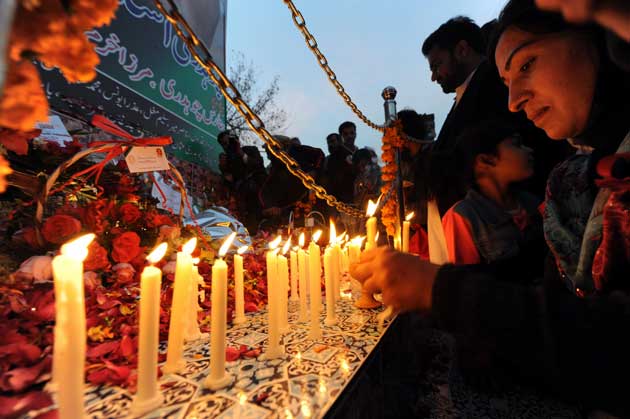
Pakistan's President Asif Ali Zardari marked the anniversary of his wife Benazir Bhutto's assassination yesterday with a charged speech warning neighbouring India against going to war with his deeply troubled country. Both sides have moved troops to the border in recent days amid rising tensions in the wake of the Mumbai terror attacks.
"War would cause the whole region to suffer," Mr Zardari told more than 150,000 mourners who gathered at the Bhutto family mausoleum in Sindh province to mark the first anniversary of the former prime minister's death in a gun and suicide bomb attack at a rally in Rawalpindi.
India blames the same Pakistan-based militant elements that killed her for last month's attacks on luxury hotels and other targets in Mumbai, where more than 170 people died.
Mr Zardari's remarks came a day after up to 20,000 Pakistani troops were diverted from the country's western border with Afghanistan to take up positions on its eastern border with India – a decision that is certain to trigger anxieties in Washington. The US has exerted constant pressure on Islamabad to act more decisively against Taliban and al-Qa'ida forces entrenched in the wild tribal areas along the Afghan frontier.
The embattled Pakistani President, dressed in black, had blunt words for both Washington and Delhi, saying: "I want to tell the oldest democracy and the largest democracy of the world: listen to us, learn from us. We have experiences to share with you." In a reference to the successive killings of members of the Bhutto dynasty, he said: "We have lost our people... We do not talk about war, we do not talk about vengeance."
Pakistani military and government officials said the country's troop movements were a response to a build-up of Indian troops and air force jets across the border. Since the Mumbai attacks, fear of Indian military retaliation has simmered in Pakistan, with sections of the local media and political opposition stoking up anti-Indian sentiment.
Shah Mehmood Qureshi, Pakistan's Foreign Minister, told The Independent on Sunday that while the government was "pursuing a policy of defusing tensions" it could not remain oblivious "to certain developments that are taking place – on the ground and in the air". He added: "Unfortunately, there has been a lot of jingoism and irresponsible behaviour. It has caused a lot of concern in Pakistan and among our neighbours. We do not want to escalate the situation. Pakistan has no aggressive designs."
Iran and China have expressed concern at escalating tensions between the two nuclear-armed neighbours, with a Chinese envoy due to visit the region this week in an attempt to ease relations. Washington has urged both sides to exercise restraint, but most analysts believe the brinkmanship will not tip into war. Although Pakistan and India have gone to war three times, they are more accustomed to stepping back from what has many times appeared to be inevitable conflict.
The emotions felt in Pakistan yesterday, a year after Ms Bhutto's death, contributed to the febrile atmosphere. Supporters of her ruling Pakistan People's Party gathered in the country's large cities. Vast crowds filled Liaquat Bagh in Rawalpindi, the site of her death, to read the Koran, light candles and raise banners in support of the Bhuttos.
In Garhi Khuda Baksh, the ancestral village where Ms Bhutto is buried beside her father, the former prime minister Zulfikar Ali Bhutto, and her two brothers, both of whom died in still-disputed circumstances, people jostled to lay flowers. Others wept and beat their heads and chests, according to Shia mourning ritual.
Since Ms Bhutto's assassination, Pakistan has continued to lurch from crisis to crisis. Hopes that the return of a civilian government would restore stability have dissipated. Islamist militants, who have staged more than 50 suicide attacks this year, wield increasing influence, while the fast-deteriorating economy is dependent on aid from the International Monetary Fund, which comes with tough conditions.
Now Pakistan is faced with a deepening crisis with India. Mr Zardari's high-voltage smile and confident swagger have disappeared over recent weeks as he struggles to balance contending pressures from Washington, an army traditionally raised to be ready for war with India, and rising unpopularity among his people. All threaten to sweep away his shaky civilian government.
Yesterday the President betrayed signs of nervousness. "We know that Pakistan is in difficulty. We need more help," he said, adopting a plaintive tone. "We deny that Pakistan is a failed state. We ourselves have accepted that we have a cancer. But we are the cure."
Join our commenting forum
Join thought-provoking conversations, follow other Independent readers and see their replies
Comments
Bookmark popover
Removed from bookmarks