Pressure piles on Karzai as Afghan waiting game drags on
President threatens to defy UN on eve of release of corruption probe findings

For free real time breaking news alerts sent straight to your inbox sign up to our breaking news emails
Sign up to our free breaking news emails
Afghanistan's President, Hamid Karzai, has threatened to ignore findings by a UN-backed watchdog that hundreds of thousands of votes cast in August's presidential election were fraudulent.
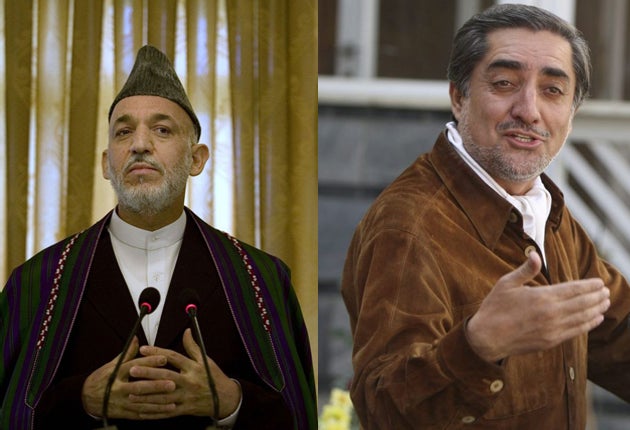
The French Foreign Minister, Bernard Kouchner, flew to Kabul at the weekend to try to broker a deal between Mr Karzai and his main rival, Abdullah Abdullah. Other Western politicians, including Gordon Brown and the US Secretary of State, Hillary Clinton, telephoned the President in an attempt to break the impasse.
Although M. Kouchner claimed to detect a "willingness" in Messrs Karzai and Abdullah to be reconciled, he said Mr Karzai was refusing to accept the possibility that once all fraudulent ballots had been discarded he might slip below the 50 per cent threshold that is needed to win in one round of voting.
Mr Abdullah's campaign manager, Saleh Mohammad Registani, told the Associated Press that Mr Karzai was forcing officials to delay release of the report and was insisting that the commission announce he had won a clear majority – even after the fraud probe. A Karzai campaign spokesman, Waheed Omar, for his part said the President had made no attempt to influence the election commission. "There is no way we can influence them, and even if we can, we are not going to do it," he said.
A provisional tally gives Mr Karzai 55 per cent of the vote to Mr Abdullah's 28 per cent, but fraud investigators yesterday delivered their findings – widely expected to cut Mr Karzai's lead by about eight points – to the Independent Election Commission, which is constitutionally bound to accept them. In theory, a result could be ready as early as today.
The President fears that a run-off could fracture the coalition of Afghan powerbrokers he has forged, leaving him more vulnerable to a challenge than the numbers suggest. Just before polling day, several powerful warlords threw their support behind him, including General Abdulrashid Dostum, notorious for his record of human rights abuses and for switching sides, and Ismail Khan, Governor of Herat.
"Certain elements within the Karzai government think that if there's a second round, it's all over," political analyst Omar Shariff said. "Karzai's supporters are not the floor he stands on – they are the ceiling above him. If there is a second round, they will fall upon him."
Diplomatic efforts are concentrated now on persuading Mr Karzai that if he agrees to a second round, Mr Abdullah will feel he has the necessary leverage to start negotiating, and there will be no need for one. But Mr Karzai suspects that the extent of the vote-rigging has been exaggerated by the international community in a plot to discredit him, and sees no reason to surrender what he perceives as his advantage.
There is little appetite for a run-off. Repeating a process which has so far taken two months, coinciding with unprecedented levels of violence, and which has brought development work grinding to a halt, is unappealing to most. Afghans from across the country are threatening to boycott any more voting. "If there's a second round there will be more instability, the same problems all over again," said Ghulam Sakhi, a shopkeeper in Kabul.
And the usual mid-November snows might make for a short timeline.
Yet even hardened cynics say they have been surprised by the level of electoral fraud. Angry and disenchanted, they say a result – any result – would at least let people know what is happening and enable them to get on with their lives. A report by Oxfam said that corruption and incompetence at all levels of government have "fuelled frustrations and undermined the legitimacy of the government in the eyes of many Afghans". Under Mr Karzai, security has worsened, opium production has boomed and initial progress on women's rights has been largely eroded.
Despite their rivalry, there is little to choose between the policies of the two leading candidates. The main difference is Mr Abdullah's pledge to reform the constitution, stripping the presidency of some of its power and strengthening parliament. And over the past week, he has softened his stance on the idea of doing a deal.
Subscribe to Independent Premium to bookmark this article
Want to bookmark your favourite articles and stories to read or reference later? Start your Independent Premium subscription today.
Join our commenting forum
Join thought-provoking conversations, follow other Independent readers and see their replies