Questions raised over Zardari mental health
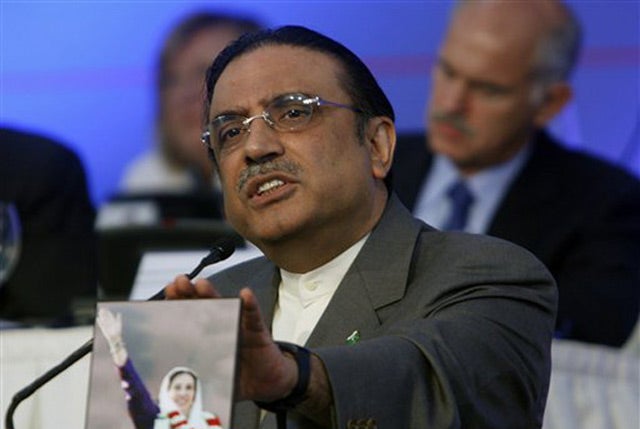
Fresh questions have been raised about Asif Zardari, the man poised to become Pakistan's next president, after it was revealed that doctors who examined him said he was suffering from severe mental health problems as recently as last year.
In a revelation that adds to the concern about Pakistan's ongoing political turmoil, court documents filed by Mr Zardari's doctors suggest he had been diagnosed as suffering from a series of serious conditions including severe depression, dementia and post-traumatic stress disorder. He had even experienced suicidal thoughts.
Mr Zardari, the widowed husband of Benazir Bhutto, was thrust into the centre of Pakistan's political maelstrom following the assassination of his wife last December. Named by Ms Bhutto as her successor, the man who spent 11 years in jail over corruption charges has been nominated by the Pakistan People's Party (PPP) as its candidate for next week's presidential election - a contest he is expected to win. If he does, he will cement his position as the country's most powerful politician.
The details of Mr Zardari's mental health examination, revealed yesterday by the Financial Times, were presented to a court in London to support an application to delay a now-defunct corruption case that was being brought against him by the Pakistan government. His lawyers presumably were looking for reasons to persuade the court to postpone the hearing - something they were successful in achieving.
Mr Zardari's confidants now say he is entirely healthy. However, analysts said it was possible that the PPP leader's enemies could seize on the revelations and use them to attack him. "I don't know if someone's going to raise it or not, but being of sound mind is a condition of becoming president," said Shafqat Mahmood, a newspaper columnist. "His opponents may bring it up to attack Mr Zardari, and submit a petition to the Election Commission."
Either way, the revelations will add to the controversy surrounding the man nicknamed Mr 10 Per Cent for his alleged corruption and who has been Pakistan's de facto prime minister since elections last February saw the PPP win the largest number of seats.
Ordinary Pakistanis overwhelming hoped those elections would usher in a new era of stability and economic progress, but that has not happened. Instead, the last six months have been marred by persistent disagreements between the PPP and the Pakistan Muslim League-N (PML-N) of former prime minister Nawaz Sharif, which formed a coalition government. On Monday - a week after Pervez Musharraf resigned as president to avoid impeachment charges - Mr Sharif finally withdrew his party from the coalition in a row about the reinstatement of judges sacked during last year's state of emergency.
Yesterday Mr Zardari went on television to appeal for Mr Sharif to put aside their differences and to return to the coalition. "We are sad over Nawaz Sharif's decision. We want to move together and solve the problems facing the nation," he said. "We will request Nawaz Sharif to return to the government."
But Mr Sharif is unlikely to agree to such a move without the reinstatement of the judges, including the former chief justice Iftikhar Chaudhry. The PML-N has instead nominated its own candidate for president, Saeeduzzaman Siddiqui, and has called for the powers of the presidency to be markedly reduced to the extent that the position becomes largely ceremonial. Many observers believe the infighting between the two main parties has distracted the civilian government from confronting Pakistan's most pressing problems: militant violence and a sagging economy.
Yet the bad blood between Mr Zardari and Mr Sharif goes back a long way. It was under the PML-N leader's administrations that Mr Zardari was twice imprisoned, initially in the early 1990s when his wife's first term in office was halted and again in 1997 when her second term was brought to a similarly abrupt end.
Mr Zardari has always denied the allegations of corruption levelled against him and last year an amnesty issued by Mr Musharraf permitted him to return to Pakistan. However it is believed the PPP leader thinks the amnesty could be over-turned by Mr Chaudhry and the other judges. That is the reason, say analysts and insiders, why Mr Zardari has repeatedly put off reinstating them, despite a powerful campaign on their behalf by the legal community.
The documents presented to the High Court in London by Mr Zardari's lawyers about his mental health reveal he was examined by two New York-based doctors. Psychologist Stephen Reich reportedly said that the PPP leader was unable to remember the birthdays of his wife and children, was continually apprehensive and had even had suicidal thoughts. The other, psychiatrist Philip Saltiel, who examined Mr Zardari in March 2007, apparently said his years in jail had left him suffering from emotional instability and concentration and memory problems that he did not believe would improve for at least a year.
Neither of the doctors was last night available to comment. But Hussain Haroon, a friend and ally of Mr Zardari and soon to become Pakistan's UN ambassador, said: "The report has been quoted out of context. The report refers to something three years old. He is fit and well. He was jogging around the Prime Minister's House just a moment ago."
Join our commenting forum
Join thought-provoking conversations, follow other Independent readers and see their replies
Comments