Mounting problems, including badly miscalculated radiation figures and inadequate storage tanks for huge amounts of contaminated water, stymied emergency workers Sunday as they struggled to nudge Japan's stricken nuclear complex back from the edge of disaster.
Workers are attempting to remove the radioactive water from the tsunami-ravaged nuclear compound and restart the regular cooling systems for the dangerously hot fuel.
The day began with company officials reporting that radiation in leaking water in the Unit 2 reactor was 10 million times above normal, a spike that forced employees to flee the unit. The day ended with officials saying the huge figure had been miscalculated and offering apologies.
"The number is not credible," said Tokyo Electric Power Co. spokesman Takashi Kurita. "We are very sorry."
A few hours later, TEPCO Vice President Sakae Muto said a new test had found radiation levels 100,000 times above normal - far better than the first results, though still very high.
But he ruled out having an independent monitor oversee the various checks despite the errors.
Officials acknowledged there was radioactive water in all four of the Fukushima Dai-ichi complex's most troubled reactors, and that airborne radiation in Unit 2 measured 1,000 millisieverts per hour, four times the limit deemed safe by the government.
Those high airborne readings - if accurate - would make it very difficult for emergency workers to get inside to pump out the water.
Officials say they still don't know where the radioactive water is coming from, though government spokesman Yukio Edano earlier said some is "almost certainly" seeping from a damaged reactor core in one of the units.
The discovery late last week of pools of radioactive water has been a major setback in the mission to get the crucial cooling systems operating more than two weeks after a massive earthquake and tsunami.
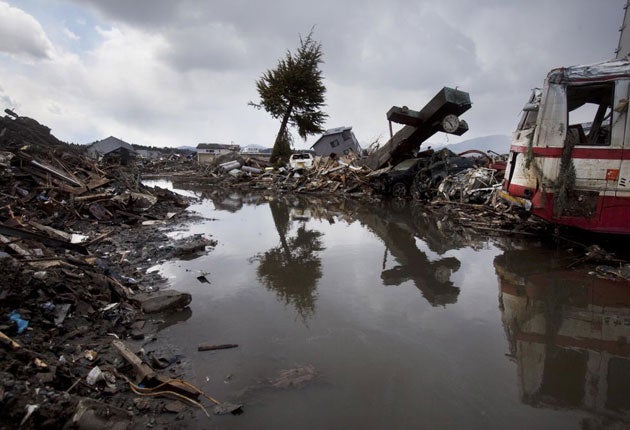
The magnitude-9 quake off Japan's northeast coast on March 11 triggered a tsunami that barreled onshore and disabled the Fukushima plant, complicating a humanitarian disaster that is thought to have killed about 18,000 people.
A top TEPCO official acknowledged it could take a long time to clean up the complex.
"We cannot say at this time how many months or years it will take," Muto said, insisting the main goal now is to keep the reactors cool.
Workers have been scrambling to remove the radioactive water from the four units and find a place to safely store it. Each unit may hold tens of thousands of gallons of radioactive water, said Minoru Ogoda of Japan's nuclear safety agency.
Safety agency officials had been hoping to pump the water into huge, partly empty tanks inside the reactor that are designed to hold condensed water.
Those tanks, though, turned out to be completely full, said Hidehiko Nishiyama of Japan's Nuclear and Industrial Safety Agency.
Meanwhile, plans to use regular power to restart the cooling system hit a roadblock when it turned out that cables had to be laid through turbine buildings flooded with the contaminated water.
"The problem is that right now nobody can reach the turbine houses where key electrical work must be done," Nishiyama said. "There is a possibility that we may have to give up on that plan."
Despite Sunday's troubles, officials continued to insist the situation had at least partially stabilized.
"We have somewhat prevented the situation from turning worse," Edano told reporters Sunday evening. "But the prospects are not improving in a straight line and we've expected twists and turns. The contaminated water is one of them and we'll continue to repair the damage."
The protracted nuclear crisis has spurred concerns about the safety of food and water in Japan, which is a prime source of seafood for some countries. Radiation has been found in food, seawater and even tap water supplies in Tokyo.
Just outside the coastal Fukushima nuclear plant, radioactivity in seawater tested about 1,250 times higher than normal last week — but that number had climbed to 1,850 times normal by the weekend.
Nishiyama said the increase was a concern, but also said the area is not a source of seafood and that the contamination posed no immediate threat to human health.
Up to 600 people are working inside the plant in shifts. Nuclear safety officials say workers' time inside the crippled units is closely monitored to minimize their exposure to radioactivity, but two workers were hospitalized Thursday when they suffered burns after stepping into contaminated water. They were to be released from the hospital Monday.
A poll, meanwhile, showed that support for Japan's prime minister had risen amid the disasters.
The poll conducted over the weekend by Kyodo News agency found that approval of Prime Minister Naoto Kan and his Cabinet rose to 28.3 percent after sinking below 20 percent in February, before the earthquake.
Last month's low approval led to speculation that Kan's days were numbered. While the latest figure is still low, it suggests he is making some gains with voters.
About 58 percent of respondents in the nationwide telephone survey of 1,011 people said they approved of the government's handling of the March 11 earthquake and tsunami, but a similar number criticized its handling of the nuclear crisis.
The death toll from the disasters stood at 10,668 Sunday with 16,574 people missing, police said. Hundreds of thousands of people are homeless.
Join our commenting forum
Join thought-provoking conversations, follow other Independent readers and see their replies
Comments