Revealed: British plan to build training camp for Taliban fighters in Afghanistan
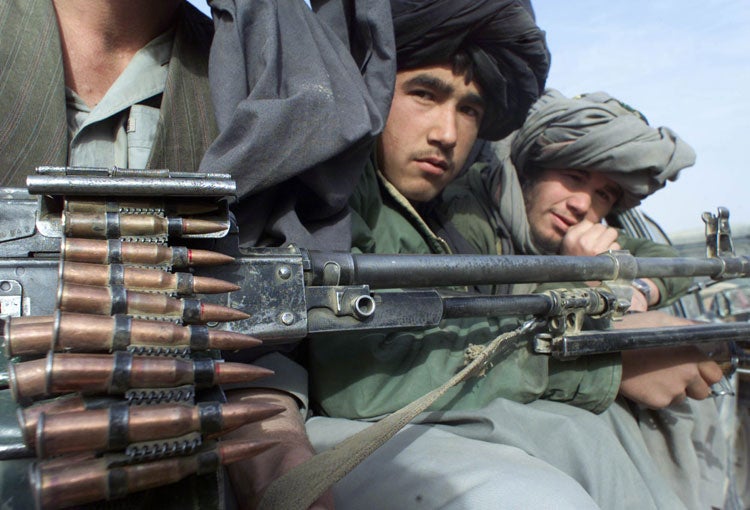
Britain planned to build a Taliban training camp for 2,000 fighters in southern Afghanistan, as part of a top-secret deal to make them swap sides, intelligence sources in Kabul have revealed. The plans were discovered on a memory stick seized by Afghan secret police in December.
The Afghan government claims they prove British agents were talking to the Taliban without permission from the Afghan President, Hamid Karzai, despite Gordon Brown's pledge that Britain will not negotiate. The Prime Minister told Parliament on 12 December: "Our objective is to defeat the insurgency by isolating and eliminating their leaders. We will not enter into any negotiations with these people."
The British insist President Karzai's office knew what was going on. But Mr Karzai has expelled two top diplomats amid accusations they were part of a plot to buy-off the insurgents.
The row was the first in a series of spectacular diplomatic spats which has seen Anglo-Afghan relations sink to a new low. Since December, President Karzai has blocked the appointment of Paddy Ashdown to the top UN job in Kabul and he has blamed British troops for losing control of Helmand.
It has also soured relations between Kabul and Washington, where State Department officials were instrumental in pushing Lord Ashdown for the UN role.
President Karzai's political mentor, Sibghatullah Mojaddedi, endorsed a death sentence for blasphemy on the student journalist Sayed Pervez Kambaksh last week, and two British contractors have been arrested in Kabul on, it is claimed, trumped up weapons charges. The developments are seen as a deliberate defiance of the British.
An Afghan government source said the training camp was part of a British plan to use bands of reconciled Taliban, called Community Defence Volunteers, to fight the remaining insurgents. "The camp would provide military training for 1,800 ordinary Taliban fighters and 200 low-level commanders," he said.
The computer memory stick at the centre of the row was impounded by officers from Afghanistan's KGB-trained National Directorate of Security after they moved against a party of international diplomats who were visiting Helmand.
A ministry insider said: "When they were arrested, the British said the Ministry of the Interior and the National Security Council knew about it, but no one knew anything. That's why the President was so angry."
Details of how much President Karzai was told remain murky. Some analysts believe Afghan officials were briefed about the plan, but that it later evolved.
The camp was due to be built outside Musa Qala, in Helmand. It was part of a package of reconstruction and development incentives designed to win trust and support in the aftermath of the British-led battle to retake the stronghold last year.
But the Afghans feared the British were training a militia with no loyalty to the central government. Intercepted Taliban communications suggested they thought the British were trying to help them, the Afghan official said.
The Western delegates, Michael Semple and Mervyn Patterson, were given 48 hours to leave the country. Their Afghan colleagues, including a former army general, were jailed. The expulsions coincided with a row within the Taliban's ranks which saw a senior commander, Mansoor Dadullah, sacked for talking to British spies. One official claimed the camp was planned for Mansoor and his men.
The computer stick contained a three-stage plan, called the European Union Peace Building Programme. The third stage covered military training.
Curiously, the European Union says the programme did not exist and there were no EU funds to run it.
Afghan government officials insist it was bankrolled by the British. UK diplomats, the UN, Western officials and senior Afghan officials have all confirmed the outline of the plan, which they agree is entirely British-led, but all refused to talk about it on the record. President Karzai's office claimed it was "a matter of national security".
The memory stick revealed that $125,000 (£64,000) had been spent on preparing the camp and a further $200,000 was earmarked to run it in 2008, an Afghan official said. The figures sparked allegations that British agents were paying the Taliban.
President Karzai's spokesman, Humayun Hamidzada, accused Mr Semple and Mr Patterson of being "involved in some activities that were not their jobs."
The camp would also have provided vocational training, including farming and irrigation techniques, to offer people a viable alternative to growing opium. But the Afghan government took issue with plans to provide military training, to turn the insurgents into a defence force.
Afghan government staff also claimed the "EU peace-builders" had handed over mobile phones, laptops and airtime credit to insurgents. They said the memory stick revealed plans to train the Taliban to use secure satellite phones, so they could communicate directly with UK officials.
Mr Patterson, a Briton, was the third-ranking UN diplomat when he was held. Mr Semple, an Irishman, was the acting head of the EU mission. Officially, the British embassy remains tight-lipped, fuelling speculation that the plan may have been part of a wider clandestine operation.
A spokesman repeated the line used since Christmas: "The EU and UN have responded to inquiries on this. We have nothing further to add."
But privately, the UN maintains it had no role in setting up the camp. Meanwhile, Mr Semple's EU boss, Francesc Vendrell, admitted he had very little idea what was going on.
Yet the British ambassador, Sir Sherard Cowper-Coles, cut short his Christmas holiday to meet President Karzai and "spell out the Foreign Office paper-trail" which diplomats claim proves his government had agreed. They met twice, but it was not enough to stop Mr Semple and Mr Patterson being forced to leave.
Gordon Brown has also said Britain would increase its support for "community defence initiatives, where local volunteers are recruited to defend homes and families modelled on traditional Afghan arbakai".
Background to the proposal
* December 11
British and Afghan troops take Musa Qala, a Taliban stronghold in Helmand, after President Hamid Karzai reveals that a senior Taliban commander swapped sides.
* December 23-24
The acting head of the EU mission, Michael Semple, and the third-ranking UN diplomat in Afghanistan, Mervyn Patterson, hold talks with local dignitaries and Taliban sympathisers in Helmand. Afghan secret police arrest their colleague, General Stanikzai, and seize a memory stick containing plans for training camps.
* December 25
Semple and Patterson are given 48 hours in which to leave Kabul.
* December 27
The two diplomats fly out of the Afghan capital, despite international appeals to let them stay.
Join our commenting forum
Join thought-provoking conversations, follow other Independent readers and see their replies
Comments