Revealed: Burma's human exports
It echoes the slave trade – in the hotels of Rangoon a smart woman is busy selling people for work abroad, reports Phoebe Kennedy
Her glasses were Gucci and her bag YSL. The smart Burmese businesswoman was perched neatly on a sofa in the lobby of a Rangoon hotel, delivering her sales patter to a small group of businessmen. Her product? Human beings. "We supply only strong bodies," she says crisply. "That is our guarantee."
I am sitting at the next table using the hotel wi-fi, and, as she speaks in clear English, I am drawn into a world of desperation and exploitation. The woman is a supplier of workers for deep-sea trawlers, and her stock of men come from Burma's beautiful but impoverished Inle Lake area, where fishing the tranquil waters no longer makes enough to feed a family. "These are just simple fishermen; they are not educated, but what we promise you is strong bodies," she says, using a phrase she repeats again and again.
It appears that the businesswoman's potential customers are middlemen, probably Chinese. Through a translator, they discuss placing the men on boats in the South China Sea, trawling for tuna. First, they will be flown to a Chinese city. In echoes of the slave trade, she describes a selection process worthy of a livestock market. In a 21st-century twist, she does so with the aid of pictures on her laptop.
"We make them stand in the sun for one hour," she says. "In the middle of the day when it is very hot. We see how they manage, if they look uncomfortable." The group leans in to see the pictures on her computer. "We make them carry 20 kilos, like this," she continues, showing them photographs I cannot see. "For deep-sea fishing, they may need to carry very big fish for long distances across the ship."
Then comes the seasickness test. "We put them in here," the woman says, but I can't see the picture. I think it must be an enclosed truck or some sort of container on water. "Then we start to move them around. If they are sick or find it hard to breathe we don't select them. This is how we select the best bodies."
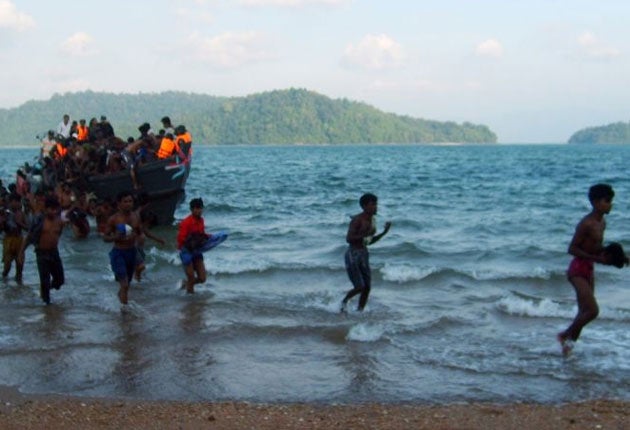
The group nods. The images of Burma's Rohingya boat people, fleeing oppression only to be allegedly abused and cast adrift by the Thai military, has drawn international attention to the plight of one of the world's most downtrodden people. The Muslim Rohingyas face particular persecution in military-ruled Burma, but throughout the country, impoverished men and women who see no future at home are embarking on risky journeys abroad in search of an income for their families.
During the eavesdropping session, I learn more about the business. The fishermen are to earn $2,400 (£1,600) a year, an enticing wage in Burma, where average rural incomes are about $300 a year. But their rights are few, and they are expected to work very long hours for their money. "During the high season, they can work 23 hours a day," says the saleswoman. "Then in the low season they can relax a little and rest." Any fee the agent wishes from the salaries is up to them, the woman says, and the fishermen should only be paid every six months "in case they fall sick, or violate the contract".
Finally, one of the businessmen appears to ask a question about the welfare of the fishermen. The saleswoman suggests there should be an area on board the ships for the fishermen to live and cook, and says that those who operate machinery should get a bonus. "We hope they can make money to help their families," she says, smiling, and the group nods again.
Hit by the global recession and the mismanagement and neglect of Burma's ruling generals, in power for nearly five decades, the country's farmers and fishermen are suffering as never before, say aid workers.
"The agricultural sector, which employs 80 per cent of the population, is imploding," said Kerren Hedlund, an adviser to a consortium of aid agencies in Rangoon. "People are getting into greater and greater debt to finance a livelihood that's not possible."
In the cities, there is high unemployment, frequent power cuts and ever-climbing prices for food and basic goods. Most people try to scratch a living in the informal economy or the black market.
Lack of opportunity has driven millions of Burma's young people on dangerous journeys to South-east Asia's wealthier nations. They sneak across the border to Thailand, to work illegally as domestic helps, labourers, or in the fish-processing industry. Many young men make perilous sea voyages in the hope of reaching Malaysia, paying agents hundreds of dollars for places on rickety boats. If they make it, construction work is relatively well-paid, but migrant workers run the risk of abuse at the hands of employers and the authorities.
The migrants live simply, and try to send all the money they can back home. "There is a huge exodus of people from Burma," said Debbie Stothard, of the Bangkok-based Burma lobby group Altsean. "It is a land of no opportunity. The only way people can survive is to have a family member overseas, sending money home."
Join our commenting forum
Join thought-provoking conversations, follow other Independent readers and see their replies
Comments