Revealed: How strategy to train Afghan forces is in deep trouble
<i>IoS</i> investigation finds Afghan army and police riddled with addicts, illiterates and insurgents
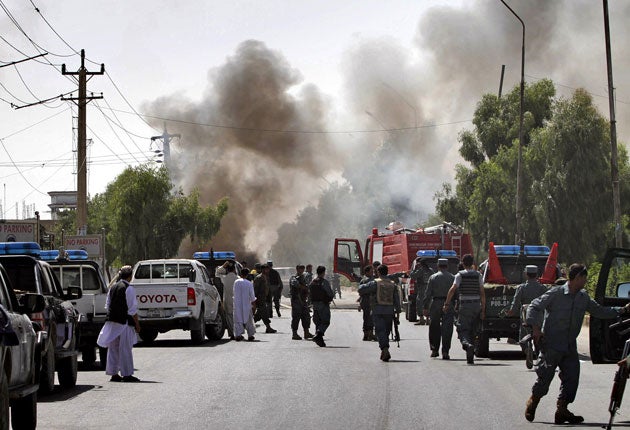
The strategic plan of creating an Afghan security force to replace US and British troops fighting in Afghanistan is in serious disarray with local forces a fraction of their reported size, infiltrated by the Taliban at senior levels, and plagued by corruption and drug addiction, an Independent on Sunday investigation can reveal.
And the way in which their capacity has been assessed over several years, during which time tens of billions of dollars have been spent on building up Afghan security forces, is so flawed that it has been scrapped.
Less than a quarter of the army and less than one in seven police units are rated as "CM1" – meaning they are capable of operating independently. Yet the true picture is worse. An audit of the Capability Milestone (CM) rating system used to rate police and army units has revealed a misleading picture of the true level of progress.
Arnold Field, US Special Inspector General for Afghanistan Reconstruction (Sigar) described the system as "unreliable and inconsistent". His audit warns that Afghan military and police assessments "have overstated operational capabilities", with even the top-rated units unable to operate independently. As many as 50 per cent of police units in some areas are failing drugs tests it notes. On one occasion, coalition soldiers witnessed Afghan police openly smoking cannabis and unwilling to conduct operations or leave their compound.
The report details how army units can be as low as 59 per cent of their supposed size when it comes to going on duty. On average, only 74 per cent of Afghan soldiers in combat units were actually found present for duty, according to the report.
It warns of critical shortages of military advisers needed to "meet the demands of current force development goals", with a shortfall of more than 200 mentoring and partnering teams as of March this year.
The International Security Assistance Force's (Isaf) leaders acknowledge problems with the local security forces, as they brace themselves for an increase in attacks over the summer months. Isaf hopes to increase the combined strength of the Afghan Army and police from under 200,000 at the start of 2009 to over 300,000 next year, in the hope that this will accelerate a withdrawal of international forces from Afghanistan.
But an analysis by the IoS reveals that the true strength of the Afghan security forces – those that have been trained and judged to be able to operate independently – is barely 34,000. This is almost a seventh of the 236,000 claimed by Nato/Isaf.
Insurgents have been able to infiltrate Afghan security forces at senior levels. In one case, a police commander was found to have been involved in a number of indirect fire and IED attacks on coalition forces, as well as the kidnap and murder of a American civilian. In another, a known Taliban commander was discovered serving in the Afghan army.
Both examples, cited in a recent US Department of Defense report, highlight what coalition forces are up against in trying to push through political pledges of building up a sustainable Afghan security force. Corruption is now so rife within the army that officers are now allocated postings through a lottery in an attempt to stop people buying positions.
The police are seen as a particular problem. A purge of the corruption-riddled force by the Afghan Ministry of the Interior (MOI) resulted in more than one-in-five senior police leaders being sacked or prosecuted for corruption or misconduct in the past 18 months. All senior police and MOI officials must declare their income and assets, and take lie-detector tests.
Barely a tenth of police units are rated effective. Some 70 per cent of police are illiterate, and half have had no formal training, according to experts. In a specialist newsletter published by the Nato Training Mission they warn that current training capacity "falls short of meeting the urgent and basic needs of training the untrained ANP and new recruits."
A trail of confidential correspondence between Foreign Office officials, obtained by the IoS, highlights the concerns within the government. The drive to speed up training in response to political pressure for an exit strategy has led to officials lowering the bar. "We want high quality recruits – as high a quality as we can get for forthcoming activities. This means lowering the bar – a bit – in terms of literacy, but maintaining it in terms of [for example] the threshold on drug addiction," admitted an official in the British Provincial Reconstruction Team in Lashkar Gah in June last year.
101st British soldier dies in Sangin
A Royal Marine killed in an explosion in Afghanistan last week was named yesterday as David Charles Hart, 23, of 40 Commando. He was the 101st British serviceman to die in Sangin and the 314th to die in Afghanistan. His death, coincided with the Defence Secretary's announcement that British troops were pulling out of the town.
His family said he showed "Commando spirit" throughout his life.
He died after he was caught in a blast while on foot patrol in the Sangin District of Helmand Province. He was deployed to Afghanistan in April, to mentor the Afghan National Police in Sangin.
His parents Dilys and Chris Hart, from Upper Poppleton, North Yorkshire, said: "Throughout his life David showed the qualities of the Commando spirit, he had a great personality and was a friend to everyone.
"His cheerfulness, his sense of humour and his smile will be sorely missed, but never forgotten. We are immensely proud, as he was, of his achievements."
The Ministry of Defence said Hart passed out for duty as a Royal Marines Commando on 16 October 2009 and was awarded the Commando Medal.
Join our commenting forum
Join thought-provoking conversations, follow other Independent readers and see their replies
Comments
Bookmark popover
Removed from bookmarks