Selling yoga to India
Swami Ramdev caused uproar when it was claimed he could cure Aids. Now, however, India's government has recruited him to help halt an obesity epidemic. Andrew Buncombe investigates
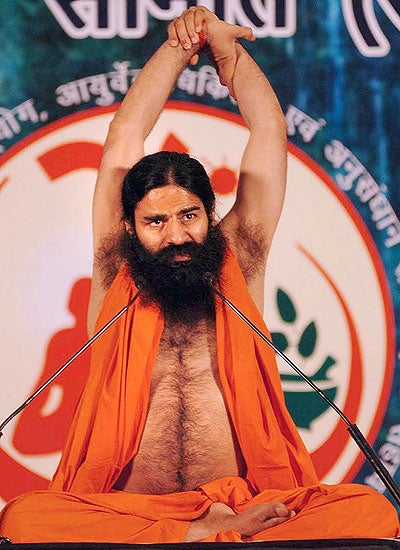
Whatever might be said of the yoga master Swami Ramdev, one cannot accuse him of being dull. Clad from head to foot in orange robes, his early morning television show pulls in 20 million viewers in India alone, and there are the usual video and summer camp spin-offs, as well as the more unusual ones, like yoga cruises.
Two years ago, Ramdev triggered a row with the country's health minister after allegedly claiming yoga could cure Aids. He also managed to upset followers of Mahatma Gandhi by appearing to question the contribution he had made to winning India's independence, and he fell out with a female MP who alleged the Ayurvedic treatments produced by the guru's Himalayan laboratory contained human bone.
Now, in the latest addition to his colourful curriculum vitae, Swami Ramdev is being recruited by the government for a new health initiative. In what might seem like a case of selling coal to Newcastle, the Indian Health Ministry wants the guru to help persuade more Indians to take up yoga.
Yoga, which was originally designed to bring about spiritual and physical transformation, was first developed in India more than 3,000 years ago. Ancient seals contain figures in various postures, or asanas, while yoga is mentioned in the Hindu scriptures, the Upanishads. Yet while there have been efforts to introduce yoga in schools and many people may do basic yoga in their homes, only a fraction of the population practises it seriously.
Experts say that in the past decade, growing numbers of Indians have become interested in yoga, not for religious reasons, but for the health benefits that come along with it. Some believe the uptake has also been boosted by the growing popularity of yoga in the US, especially "celebrity styles" such as Bikram yoga, as practised by Madonna and the actor George Clooney. The Indian actress Shilpa Shetty recently produced her own yoga video.
On the face of it, the thinking behind the government's grand yoga plan makes sense. One of the side effects of India's economic growth is that a changing diet and increasingly sedentary lifestyle have created a health crisis. While up to 60 per cent of Indian children under the age of three are malnourished, in urban areas an estimated 20 per cent of men and 30 per cent of women are considered clinically obese. Around 40 million people suffer from diabetes.
Yet there are several peculiar things about the recruitment of the guru by the centrist government, which is led by the Congress Party – not least his affiliation with the far-right organisation, the Rashtriya Swayamsevak Sangh. Even more curious is the fact that the man turning to the guru for help, Anbumani Ramadoss, is the same health minister with whom he had an unseemly public spat two years ago. But that's not what Mr Ramadoss wants to concentrate on.
"We are focusing on preventive health care and we see yoga to be a leader in preventative health care," he explained on the sidelines of an anti-smoking rally at Delhi University. "[Guru Ramdev] is working to help the government. Our vision is that each village should have a yoga teacher."
Guru Ramdev became aware of yoga's benefits many years ago. Born Ramkishan Yadav in Haryana state, he studied yoga at an early age. He has claimed that as a child he suffered paralysis and that it was only through yoga that he gained the full use of his body. He then began to live a monastic life and started teaching in villages. He may have started small, but his business has become very big indeed. In 1995 he established an organisation to promote yoga located in the Himalayan foothills at Haridwar, where the river Ganges emerges from the mountains. His headquarters is home to yoga camps and is also equipped with a modern laboratory to research the scientific evidence behind yoga's benefits. Reports suggest the Patanjali Yogpeeth, as his flagship project is known, earns about £20m a year.
Beyond the money, there is little doubt that the 55-year-old has become immensely popular. Reports vary as to the number of people who follow his teachings, either through videos, television or at the camps he also holds in the US, Canada and Europe. It is safe to say, however, they are in their millions.
Yet whatever Swami Ramdev has so far been able to accomplish, he has been unable to avoid controversy. His now notorious clash with Mr Ramadoss came when a website promoting his products claimed the CD4 cell count – which drops over time in people suffering from HIV – had increased after yoga. It was reported that the guru was claiming yoga could cure HIV and the Health Ministry ordered him to put a stop to the claims. The guru responded by saying he had been misquoted but continued to argue yoga could increase someone's immunity. He has also continued to claim it can cure various forms of cancer.
Guru Ramdev is currently in the US, where last week he announced the setting-up of a £2.5m centre in Houston. He has been holding classes for 2,000 people and has told his students that yoga – or yog as he prefers – can cure everything from cancer to heart disease. A report in the Voice of Asia said a participant at the camp, Parul Rawal, described how yoga had saved her life when she was suffering from terminal lung disease. Discovering a CD by the guru, she turned to his lessons when all other methods had failed to cure her. To loud cheers, Ms Rawal said that within six months of starting the yoga she underwent a recovery that stunned her doctors.
Swami Ramdev's spokesman said he could not arrange a telephone interview, but the guru confirmed his plan to work with the government via email. "The government of India is willing to help us in our movement for a healthy India, since our aim too is to ensure health to each and every Indian," he said. "The Patanjali Yogpeeth and Health Ministry are eager to work together to build a healthy and an ideal India. Besides, efforts are afoot to reduce or eliminate the use of [carbonated] drinks, fast-foods, drugs, alcohol and tobacco, which are causing adverse effects on the health of people."
Asked about the benefits of yoga, he said: "There are instant benefits of yoga. On average, 250g to 1kg of weight gets reduced in a day. In many other diseases, like heart ailments, hypertension, high blood pressure and diabetes... one also gets immensely benefited by doing yoga. In India, nearly 50 per cent of people over the age of 40 years are suffering from different types of arthritis... the stress level is also on the increase. All these problems are taken care of effectively by yoga."
The Indian government's Department of Ayurveda, Yoga and Naturopathy, Unani, Siddha and Homeopathy readily admits the benefits of yoga, but officials are somewhat sceptical of Guru Ramdev's claims. "It's wrong to give the impression that yoga is a cure-all," said Varghese Samuels, the department's joint secretary. "Diabetes and hypertension have been treated by yoga but that does not mean it's a standard treatment."
Join our commenting forum
Join thought-provoking conversations, follow other Independent readers and see their replies
Comments