Sharp rise in Army deaths from small arms fire prompts inquiry into Taliban snipers
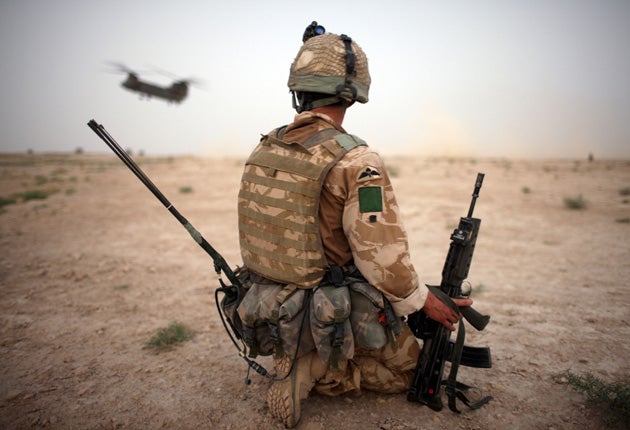
Commanders in Afghanistan are examining whether a sharp rise in troops being killed by gunfire is a sign that a better trained or equipped Taliban is targeting soldiers with snipers.
More soldiers have been killed by small arms fire in the past four months than in the whole of any previous year. While deaths by bullet accounted for just 13 per cent of those killed in combat in 2009, that figure has risen to almost 40 per cent in recent months.
Most worrying is the indication that a proportion of these were accurate single shots from sharpshooters, or even trained snipers, rather than the traditionally haphazard "spray and pray" method used by the locally recruited Taliban.
While roadside bombs continue to be the greatest killer in Afghanistan, the latest deaths could prove a disturbing indication of a change in insurgent tactics. Since the early days of the fighting in Helmand, the Taliban has retreated from fierce battles, opting for IEDs (improvised explosive devices).
Over one nine-month period, not a single UK serviceman was killed by gunfire and the focus has been on tackling the lethal devices that carpet the southern Afghan province.
Yet the deaths of Corporal Taniela Tolevu Rogoiruwai and Kingsman Ponipate Tagitaginimoce, of the 1st Battalion The Duke of Lancaster's Regiment, in Nad Ali, on Tuesday brought the total killed by small arms fire to 14 since February, out of 38 who have died in combat.
Most worryingly, five Britons were killed in a 10 day period in Sangin, raising fears of a sharpshooter who appeared to be targeting trained British snipers. On 6 March Rifleman Liam Maughan, a platoon sharpshooter with the 3rd Battalion The Rifles, was in an overwatch position in Sangin when he was killed.
British commanders are examining the increase in small arms deaths, but say it is too early to know whether this represents a significant change in enemy tactics.
American General James Conway, however, recently told the US House Armed Services Committee: "Right now, the biggest threat in Marjah is not necessarily the IEDs for our killed in action. It is the sniper that takes a long-range shot and can penetrate our protective equipment, particularly the helmet."
He said the Marine Corps was pressing the defence industry to come up with a helmet that can withstand a 7.62mm round from the AK-47 assault rifles favoured by insurgents.
Military experts suggest this latest rise in killings could be an indication of a change in both British and enemy tactics. The Taliban, aware of the focus on tackling bombs, is taking a more aggressive stance. Equally, UK forces, keen to interact with the local population, are conducting more foot patrols with the Afghan National Army and Police in outer lying areas.
Recently, Lieutenant Colonel Nick Kitson, commanding officer of 3 Rifles, wrote in The Independent that the war was being won by altering the focus from larger enclaves to smaller patrol bases among the population, from which frequent, smaller patrols could be sent.
Traditionally, troops moving into new areas will face more gunfire, but that turns to an increased level of roadside bombs once a footprint has been established and the Taliban is predominantly forced out of the area.
"The presence of troops patrolling on the ground, as opposed to vehicles, arguably makes them less vulnerable to IEDs but more vulnerable to small arms fire," explained Colonel Richard Kemp, a former commander of British forces in Afghanistan.
He continued: "It could be that they are getting more effective at countering gun fire with sniper fire. It is a cycle of tactics. They resorted to IEDs but as we counter that threat they respond to it. They are still in a situation where they are reluctant to take us on in firefights but they could be improving their sniping capability."
A senior British military spokesman, Major General Gordon Messenger, added: "It is right that there has been a slightly greater proportion of gunshot fatalities but it would be wrong to leap to conclusions that this represents a significantly changed threat at this stage. Commanders on the ground are constantly looking at the threat they face and adapting their techniques and procedures to counter that threat."
Professor Chris Bellamy, a defence expert from Cranfield University, said the deaths raised the question of whether the Taliban had succeeded in getting better weapons with telescopic or even night sights.
"The Afghans have a long history of exploiting long range, accurate small arms fire against the British in the 1890s and against the Russians in the 1980s. The late Professor John Erickson believed that the mujahideen were using Lee-Enfield rifles and that was the reason for scoring an inordinate number of kills against the Russians," said Professor Bellamy.
US Marines in Marjah and Nad Ali recently revealed that since Operation Moshtarak began, snipers or sharpshooters had hit several of their soldiers, as well as Afghans. One was killed after being hit in the neck by a bullet fired from a range of 500 to 700 yards. Meanwhile, a dead insurgent was found with an ancient but powerful Lee-Enfield rifle.
"The Taliban have got some quite experienced snipers, not many, but we know some have been trained in Iran. They have got people who are very skilled. They are not just sitting in a tree waiting for a patrol to pass. They are setting incidents, knowing the reaction will be that more troops turn up," explained Professor Michael Clarke, director of military sciences at the Royal United Services Institute.
After the "all out war" of 2006, the Taliban learned that IEDs could be more effective but are now altering their tactics again as coalition forces counter that weapon, he said.
"They are retaliating for Operation Moshtarak. They want to prove they have not been beaten. They are transferring into an effective force. There is enough talent within Taliban ranks to keep the ragtag guerrilla force active and dangerous and they are determined to try and hit back."
Join our commenting forum
Join thought-provoking conversations, follow other Independent readers and see their replies
Comments