Soldier captured by rebels as US launches Afghan offensive
4,000 Marines storm Taliban heartland in first test for 'surge strategy'

For free real time breaking news alerts sent straight to your inbox sign up to our breaking news emails
Sign up to our free breaking news emails
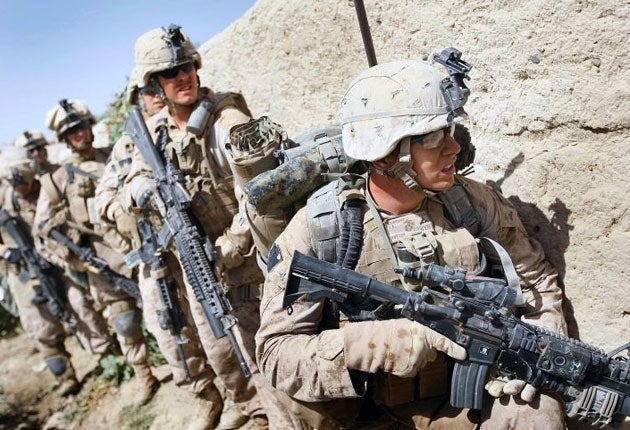
In the biggest military offensive of the Obama presidency, more than 4,000 US Marines, backed by heavy artillery and helicopter gunships, stormed into the Taliban heartland yesterday, the first assault in what one commander called a "summer of decision" aimed at stabilising Afghanistan ahead of next month's elections.
As the mission unfolded, news broke that a US soldier had been kidnapped in Paktika province further south. The man, who has not been named for fear of jeopardising his safety, was believed to be the first US soldier seized in either Iraq or Afghanistan for two years. However, US officials said the soldier had not been on military duty when he disappeared and Taliban commanders claimed he had been found drunk outside his base.
Operation Khanjar, Pashtu for "Strike of the Sword" saw troops strike through a valley which has been a "blooding ground" for jihadists and a major centre for poppy harvesting. "You're going to change the world this summer and it starts this morning," Lieutenant-Colonel Christian Cabaniss, the commander of the 2nd battalion, 8th Marines, told his troops who were dressed in desert fatigues, before they mounted helicopters and Humvees. "The United States and the world are watching," Reuters quoted him as saying. "Their expectations are enormously high during this summer of decision."
In an indication of the dangers facing coalition troops, it was confirmed that Britian had lost its highest ranking British soldier since Colonel H Jones was killed in the Falklands. Lieutenant-Colonel Rupert Thorneloe, the officer commanding the Welsh Guards, died alongside a trooper when a Viking armoured vehicle in which he was travelling was hit by a roadside bomb in Helmand. Six other soldiers were injured in the attack.
Yesterday's operation – which also involved 400 Afghan government troops – marked the first big test of Washington's surge strategy. US army Brigadier General Larry Nicholson said the operation differed from previous ones because of its "massive size". "The intent is to go big, go strong and go fast, and by doing so we are going to save lives on both sides," he said.
The number of Marines deployed is about the same as was used during the bloody and controversial first siege of Fallujah, in central Iraq, in 2004. That operation was halted before the town was taken after international shock at the scenes of carnage. For the next six months, Fallujah became an insurgent headquarters, with waves of suicide bombers striking across the region.
The marines are part of a 22,000-strong group of reinforcements sent to Afghanistan by Barack Obama in an attempt to stem the violence at what Washington is calling a seminal juncture in the war. The US Defence Secretary, Robert Gates, has said American patience is wearing thin and improvements are needed by year-end.
Operation Khanjar followed a smaller British operation further north along the Helmand River valley which regained control of the town of Babaji and surrounding areas north of the provincial capital, Lashkar Gar. British forces have, however, experienced problems in holding ground they have gained because of a lack of numbers.
The US mission began with helicopters dropping Marines into the village of Nawa, 20 miles south of Lashkar Gar, in an area which has not seen the permanent presence of either Western or Afghan government troops. The US military said the move had taken the enemy by surprise. "We are kind of forging new ground here. We are going to a place nobody has been before," said Captain Drew Schoenmaker.
The insurgents retreated into high ground and engaged the Marines in a firefight. Afghan troops were hit with rocket-propelled grenades. With gunfire echoing around them, residents fled into their mud-walled huts.
Following on from Operation Khanjar, a series of further "mini-missions" is expected to be launched but after that there will be a pause. US and British forces are not expected to launch any offensives just before the 20 August elections and in the period immediately afterwards "so as not to provoke violence".
Yesterday, the Taliban spokesman Qari Yousef Ahmadi declared that the Americans would not be allowed to "occupy Afghan soil". He added: "We have a large number of our fighters in the area. The Americans... will not have a permanent victory."
Subscribe to Independent Premium to bookmark this article
Want to bookmark your favourite articles and stories to read or reference later? Start your Independent Premium subscription today.
Join our commenting forum
Join thought-provoking conversations, follow other Independent readers and see their replies