Stop passing the buck on terror, Pakistan tells UK
You must be more sensitive to our difficulties in fighting Islamic extremism, says Foreign Minister
The British Government should stop "passing the buck" by repeatedly blaming Pakistan for home-grown terror plots targeted at the UK, the country's Foreign Minister has warned.
Shah Mahmood Qureshi said Pakistan could offer the West crucial help in ending the war in Afghanistan but stressed that, to achieve a lasting settlement in the region, Britain in particular, had to demonstrate "more sensitivity" to the political difficulties Pakistan faces in maintaining domestic support for its fight against Islamist extremism.
In an interview in London to The Independent, Mr Qureshi claimed recent military victories against the Taliban in the Swat Valley were a sign Pakistan was managing to "turn the tide" against the insurgency.
But in a sign of the frustration felt in Islamabad at being lectured to by Britain on the perceived failure to root out extremism, he delivered the blunt message: "We need to change the language."
The return of civilian government after years of military rule, and the commitment of President Asif Ali Zardari to ending militancy, had brought strong gains in the struggle to defeat jihadist groups, he said. For the first time, there was a "political ownership" of the war on extremism.
"We need to recognise the change that has come about in Pakistan," he said. "The problems we have are not solely of our creation. The rest of the world helped to create this menace; now we are saying, 'Help us to eradicate this menace, this evil'. If we are allies and friends we have got to work together. We need each other's co-operation but I do think we have to be more sensitive."
Such sentiments have emerged in briefings by unnamed officials before, but it is unusual for a high-ranking member of the Pakistani government to voice them so directly. Gordon Brown has claimed three-quarters of terror plots investigated by British intelligence originate in Pakistan
While the Foreign Secretary David Miliband recently softened the tone, there is still intense concern about "safe havens" in Pakistan's tribal belt which are largely off-limits to either the rule of Pakistani law or the reach of its army. The Afghan Taliban rely on such sanctuaries to regroup in their war against Nato, while al-Qa'ida uses them as bases for training camps.
The conviction in London this month of three al-Qa'ida "liquid bomb plotters" has revived alarm about the role of Pakistani training camps in grooming jihadists. But officials in Islamabad believe the criticism deflects attention from Britain's failure to shoulder its share of the reponsibility.
"It is easy to pass the buck", Mr Qureshi said, "but [the liquid bomb plotters] were British citizens. They went to school here, they are part of the British system, they live here. If they do something extraordinary is it fair that Pakistan should be blamed?" He acknowledged that Pakistan's military was not yet ready to deliver on US demands for a massive ground assault on South Waziristan, home to several pro-Taliban tribes and jihadist groups. But such an operation was "in the pipeline", he said.
Fears for nuclear-armed Pakistan's internal stability have been intense following a recent spate of high-profile suicide bombings, a push by militants into areas fewer than 100 miles from the capital, and an economic crisis which this week saw 20 people die in stampedes for food. But Mr Qureshi insisted the civilian government had built a new political consensus around tackling extremism.
His words amplified the message contained in a speech by President Zardari yesterday. Addressing the International Institute for Strategic Studies in London, he reaffirmed his determination not to allow Pakistan to be used as a launch pad for attacks by Islamist terrorists, and called for more counter-terrorism aid from the West. Pakistan wants the US to arm it with unmanned drones and helicopters. "Let me assure you we have not come this far, at this price, to fail," he said.
Despite its understandable preoccupation with the future of neighbouring Afghanistan and the fear of losing influence there to India, Mr Qureshi insisted Islamabad had "taken no sides" in the Afghan presidential election. He said Pakistan wanted only "a stable and peaceful Afghanistan" and a "friendly government" in Kabul.
But, perhaps with an eye on Pakistan's future interests, he stressed the importance of Pakistan's historic and cultural ties as the US moves towards engaging with Taliban fighters who can be reconciled into the Western-backed political mainstream. The Pakistani intelligence agency, the ISI, is widely believed to maintain close links to the Afghan Taliban, whose growth it fostered during the Soviet occupation, as a counter-balance to India's power in the region.
Mr Qureshi appeared to suggest cross-border links could be harnessed to deliver peace, saying: "Pakistan is willing to play the role of facilitator with our Nato allies. We can discuss the means for engagement. We have our contacts there, we are natural players. We understand the culture and the religion."
Islamabad is also keen to restore dialogue with India, suspended after the Mumbai attacks, a move that would allow Pakistan to focus on combating internal threats. Mr Qureshi will meet his Indian counterpart on the sidelines of the UN General Assembly next week but said he expected little movement from Delhi. "They are under tremendous internal political pressure," he added.
Despite the West's nuclear stand-off with Tehran, there is also an important role for Iran in the search for reconciliation in Afghanistan, he stressed.
Suicide bomber kills 33 in market attack
Reuters
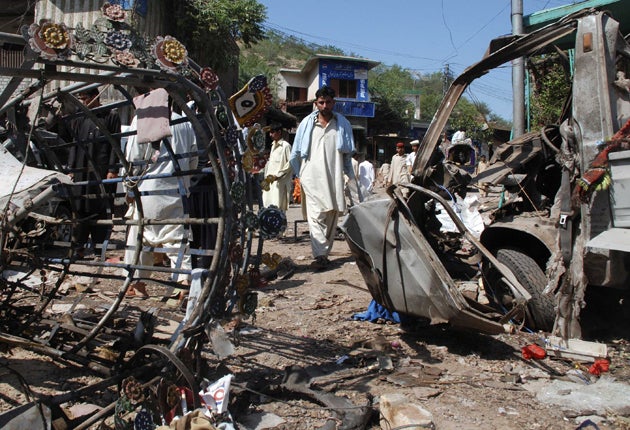
A suicide car bomber killed 33 people and wounded at least 80 in north-west Pakistan yesterday. The explosion brought down shops where people were stocking up before a holiday.
The bomb went off on a main road near the city of Kohat, a garrison town 100 miles from the capital, Islamabad, and close to the lawless ethnic Pashtun tribal belt on the Afghan border.
"A restaurant and many shops have collapsed," said Ibn-e-Ali, a former judge. "It is chaos here."
Police said the bomb contained 150kg of explosives. The Lahskar-e-Jhangvi al Almi militant group claimed responsibility.
Join our commenting forum
Join thought-provoking conversations, follow other Independent readers and see their replies
Comments