The Big Question: Is Google right to abandon its search engine in China over censorship?
Why are we asking this now?
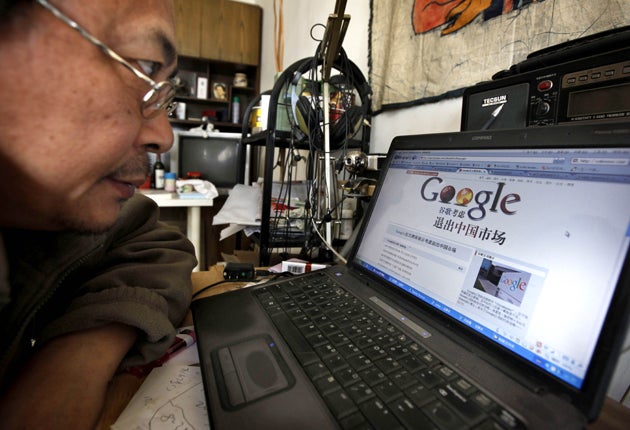
This week Google carried out its threat to abandon its Chinese-language search engine in China, google.cn, transferring it instead to Hong Kong, which is a Special Administrative Region of China since the handover in 1997 and does not have to obey Chinese censorship rules. Predictably, mainland Chinese users are not able to access the site easily.
Where's all this come from?
It's a big decision for Google to make, but it didn't come out of nowhere. Google, whose code of conduct includes the phrase "Don't Be Evil", announced in January that it could no longer continue to censor sensitive search items on its search engine and would leave China. But there was some surprise when the group actually went ahead and did what it threatened to do, and effectively left what is a potentially hugely lucrative market, the world's biggest internet market with nearly 400 million 'webizens' (web citizens).
Isn't this just about crushing dissent?
Possibly. Using the "Great Firewall of China" Beijing strictly monitors the internet to root out pornography and other corrupt practices. Human rights and free speech activists say the real reason for the army of tens of thousands of "net nannies" is to stop dissent spreading in China. Google basically said when they entered the market that would try and do as little evil as possible when it came to operating in China.
They have not been linked to any instances of jailings of dissidents or other cases where the Chinese government has put pressure on a company to give up information on people it doesn't like, which has happened with other web companies in China, such as Yahoo. Yahoo promised it wouldn't happen again.
How does censorship of the internet in China work?
You are a Chinese student sitting in a dormitory in Beijing, surfing away. You decide to check out some information about the Tibetan spiritual leader Dalai Lama, or the Tiananmen Square Massacre in 1989, or the Xinjiang independence movement and the error message comes up "the webpage cannot be opened".
Sometimes you get search results, but when you click on the web pages, they do not load. And then when you try to go back to your browser, it won't work for a few minutes. It's intensely irritating.
Sometimes, the censored results have been doctored for the Chinese sites. When I type in "4 June Tiananmen Square massacre" here in Hong Kong, I get a Wikipedia entry on the crackdown, plus YouTube footage of the man lying down in front of the tank, and all kinds of activist material relating to the incident. In China when you do the same search you get links to wholesome sites about the military and various heroes.
Most Chinese people don't care that the internet is censored, as they wouldn't be searching for anything sensitive online anyway. But a lot of younger webizens in particular are annoyed that they have to leave with the net nannies while the rest of the world seems to do fine without them. Many get around the Great Firewall using Virtual Private Networks.
How have the Chinese government taken it?
To say the Chinese are angry would be an understatement. The move caused extreme offence among the powers-that-be. As it became clear that Google was actually going to go, the commentaries in the state newspapers became more and more pointed in their criticisms. As the leadership rarely comments on these kinds of issues, this is the best way to feel the pulse of what is happening within the leadership. The message was one of deep irritation.
Face plays an element in this too. This is a company taking on a country, to a certain extent. Ok, Google is a powerful company, and could probably buy and sell any number of small countries, but the country in the equation is China, which is close to becoming a superpower and whose fiscal stimulus plan has helped prop up the world's faltering economy for the past year and a half.
An editorial in The People's Daily, which is the official newspaper of the Communist Party, Chinese authorities accused Google of links to US intelligence forces. "Its co-operation and co-ordination with the US intelligence agencies is well known," it thundered. "When Google was in trouble, senior US officials and media all stumbled to speak up for it. Is this appropriate for corporations or businesses?" it asked.
Beijing sees the evil hand of "vested interests" abroad at work, in language that is strangely familiar of an older, far less tolerant China from the 1960s and earlier. This is probably linked to the way Secretary of State Hillary Clinton weighed in so quickly on Google's side, infuriating the Chinese.
What about Chinese webizens?
Google was not the dominant search engine in China, with around one third of the market. It is dominated by a Chinese engine called Baidu. But it had very loyal users – how many companies in the world would get people laying bunches of flowers outside their corporate headquarters when they announce their departure? But others have reacted in the opposite way.
Chinese people are hugely proud of their country's emergence from economic and political backwater into a powerful country with considerable economic influence, and they do not take well to being dictated to by foreign companies. Some people have reacted by saying "Google Go Home" and "We have Baidu, we don't need you". Google's decision is being turned into a nationalist issue.
The line "We have Baidu, we don't need you" is significant. Some sector analysts have said that Baidu's strength in the market, with two thirds of the search engine pie, meant they could ultimately have dominated the whole search engine field.
Couldn't they have just worked out a compromise?
This is about two ideas that are very difficult to reconcile. The Communist Party is keen to foster the business and trade applications of the internet, but regularly embarks on crackdowns on pornographic material or items which are deemed subversive, which includes blogs by human rights activists or foreign pro-democracy groups, as well as organisations representing Tibetan or Uighur rights. It also means that social networking sites such as Twitter and Facebook, as well as online video site YouTube, are banned in China.
Google believes that its "Don't Be Evil" dictum is not compatible with this way of thinking and so it is hard to work out how they could have reached a compromise.
Should Google have stayed in China as a censored search engine?
Yes...
* 400 million webizens is a lot of potential users. Everyone wants a bit of China right now; it won't be long before someone else moves in
* A lot of webizens are hugely affectionate for Google, and unhappy it is gone
* It seemed to work reasonably well before all the fuss
No...
* A "Don't Be Evil" mantra means not encouraging censorship wherever it happens to occur
* A conflict of interest would have angered rights activists, leading to an escalation in tensions
* Baidu is a powerful competitor and would ultimately have driven them out of the market anyway
Join our commenting forum
Join thought-provoking conversations, follow other Independent readers and see their replies
Comments