World

12° London Hi 12°C / Lo 6°C

The British base called Stalingrad

Surrounded by the Taliban, British troops and their commander in north Helmand feel let down by the slow pace of reconstruction. Terri Judd reports
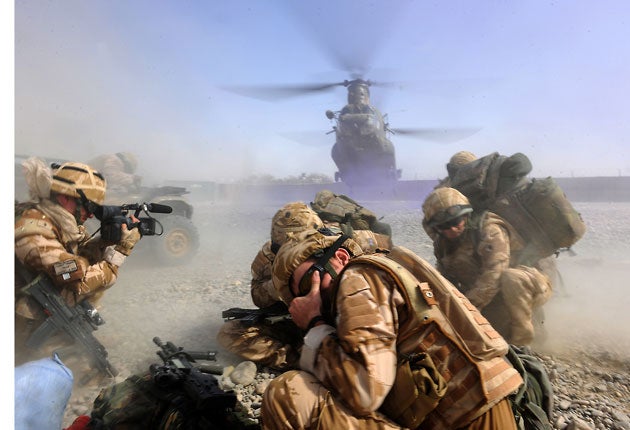
Soldiers of the Royal Regiment of Fusiliers patrol near Musa Qala last month. Although British squaddies are welcome in the town, patrols to the north are usually greeted with an ambush

SGT DAN HAMMER/MOD

Soldiers of the Royal Regiment of Fusiliers patrol near Musa Qala last month. Although British squaddies are welcome in the town, patrols to the north are usually greeted with an ambush

In his fortified headquarters, Lt-Col Charlie Calder drew a large red circle on a map with a laser pointer indicating a vast expanse of northern Helmand, his area of responsibility. He then ringed a spot the size of a 10p piece – less than 20km square – to highlight the ground he and his battlegroup of 775 men have held during the bloodiest summer to date in Afghanistan. "To be totally honest, the fact is they [the Taliban] still control everything beyond it and there is nothing we can do about it," he said.

Beyond the hulking form of Mount Doom, an ominous landmark dominating the skyline, the enemy fighters operate freely across the district and into the mountains of Baghran. They are held back by a circle of a dozen small patrol bases – inhabited by British and Afghan forces – that stand on the front line and battle any incursion from the insurgents who surround them in every direction. A home-made wooden sign in one camp said it all: "Welcome to Stalingrad".

Within Lt-Col Calder's "ring of steel", Musa Qala bazaar is bustling once again. A school, a mosque and a clinic are up and running, and a variety of small projects to provide electricity and work are bubbling away. The centre of Musa Qala is a relative oasis (for in Helmand any area that suffers only a few roadside bombs, mortars, rockets and Taliban threats constitutes a haven), but without further troops and reconstruction, the British find themselves in a virtual stalemate.

"We have been largely security-focused. I don't think governance and reconstruction are moving forward sufficiently fast. Not enough has been done. Go and ask the Afghans – 99 per cent will say it is not happening fast enough," said the commanding officer of the 2nd Battalion, The Royal Regiment of Fusiliers.

After the then-Brigadier Andrew Mackay and his men retook control of Musa Qala, he complained privately of a failure to provide adequate reconstruction to win over the hearts and minds of locals. British soldiers risking their lives were being let down by the Government, said the officer who, three weeks ago, became another to prominently resign.

Lt-Col Calder said that, 21 months on, the situation had not improved swiftly enough and more needed to be done to bring the wavering local fighters or "$10 Taliban" onside.

"We [soldiers] are good at consent- winning, low-level, short-term stuff. But we rely on the experts and reconstruction teams to deliver long-term reconstruction and governance. Ultimately, we have the consent of the people, but that lasts only so long unless they see progress within the government-controlled areas."

The young men on Lt-Col Calder's front line are determined their friends who have died will not have done so in vain and are quick to emphasise that – in military terms – their tour has been a success.

"We are killing a lot of Taliban," said Capt Olly Lever, 28, of the Black Watch. His platoon lost 22-year-old Cpl Sean Binnie in May when he tried to rescue Afghan soldiers he was mentoring. "People at home think we are taking a rogering. It is not true."

Cpl Jimmy Mather, 24, said: "We are smashing them. Every time we go forward they get a kicking. We are making an impact. He [Cpl Binnie] died doing something heroic. He chose to put himself in extreme personal danger to save others."

While the attention of people at home this summer was on Operation Panther's Claw, further south in Helmand, the north-west battlegroup, around Musa Qala, was involved in its own fierce engagements. During Operation Mar Lewe, they fought successfully to bring the 1,000 people of Yatimchay into the secure net, destroying a Taliban bomb factory and taking over narcotic strongholds in the process.

They pushed the enemy's forward line back three kilometres where A Company 2nd Battalion, the Royal Welsh, now occupies Patrol Base Minden. Surrounded on three sides, they can expect a friendly reception in Yatimchay to the north, albeit from locals who appeared blind last week to whoever had been placing roadside bombs on the British routes through their compounds.

"It is a time-honoured Pashtun tradition to keep a foot in each camp and play one against the other. They [the locals] haven't yet seen one side or the other having the upper hand," said Lt-Col Calder.

At Patrol Base Woqab, the most northerly post in Helmand, Major Richard Coates stood on the roof at dusk and pointed across the green zone at another building just a few hundred metres away. It is known simply as Compound 17, a Taliban firing point. In a mirror image of the situation at Minden, when Major Coates sends his men from B Company 2nd Battalion, the Royal Regiment of Fusiliers, south into the secure zone surrounding the town of Musa Qala they can usually expect a friendly reception from locals who furtively point out where the insurgents have planted IEDs (improvised explosive devices). But a patrol north is greeted with an ambush.

Major Coates said: "During our brief time here we have seen signs of improvement. It is going in the right direction. For the locals, six months is nothing. We have to bear that in mind." Of the 100,000 people in his region, one-fifth are protected and under government influence. The rest are subjected to the brutality of Taliban law, checkpoints and taxes.

Lt-Col Calder said that an increase in British soldiers was not the only option. However, of just 350 Afghan National Army soldiers and 150 police (ANP) he has had to work with during the past five months, a large proportion were diverted south to help with Panther's Claw. "The ANA and ANP are effective but, there again, they are limited."

Their hatred of the Taliban makes them fierce fighters, British mentors said, but they are erratic and much happier rushing out to a battle than holding ground in defensive positions. Meanwhile, Musa Qala remains isolated. Once a month, a re-supply convoy of 50 vehicles travels the 60 kilometres from the main British base of Camp Bastion. The final six kilometres are the most lethal.

The battlegroup has found 250 IEDs along this route in the past five months, a third of which have exploded. This has severely hampered progress. Determined efforts to clear the way when the Royal Welsh joined the battlegroup were, tragically, insufficient. They were hit four times. Pte Richard Hunt, 21, who had survived a bomb a day earlier, was fatally wounded on 13 August, the 200th British soldier to die in Afghanistan.

Abdul Ahad, a farmer with seven children living beneath the crossfire around the British base near Woqab, said: "I hope my children will grow up and have a better life than me. I wish they could be engineers or doctors, but there is no school near by." A farmer in Yatimchay said: "The enemy are everywhere. They are planting bombs. They don't care about us or our children."

The IEDs that pepper the area mean that every patrol resembles a game of Russian roulette. Equally worrying is that the enemy is now using such "prestige weapons" as anti-aircraft machine guns, AGS-17 automatic grenade launchers and heavy 120mm mortars.

For soldiers, winning local consent is less about the grand vision for Afghanistan and more to do with daily survival, and some assurance that the pain they are suffering is worthwhile. "An old man said 'God bless you' as the patrol was going past the other day. It was good to get a spontaneous, positive response," said Sgt Giles Hodgskins, 37, of the Royal Army Medical Corps.

Post a Comment

View all comments that have been posted about this article.

Offensive or abusive comments will be removed and your IP logged and may be used to prevent further submission. In submitting a comment to the site, you agree to be bound by the Independent Minds Terms of Service.

Comments

Remind me why we're there again?
[info]reinertorheit wrote:
Saturday, 17 October 2009 at 11:51 pm (UTC)

Oh yes, "to stop terrorism aimed at Britain". But mysteriously this "terrorism" (the military buzz-word for "fighting back") is only directed at, errr... Britain? And not at, say, Norway, or Portugal, or Iceland? D'ya think it could be because Norway, Portugal and Iceland aren't.... attacking Afghanistan?? No, surely those bright chaps like Sir John Scarlett would have thought of it already, wouldn't ya think eh?

I mean, you think back to the bomb attacks on 7/7, and they were all masterminded by.. people born in Britain who'd lived here all their lives? So what's that about, then, eh? Despite Tony Blair deliberately wasting Police time by sending the UK police in the Indian sub-continent to find the alleged perpetrators there.

So we arrested some Brits who happened to be in Afghanistan, and then we took them to Cuba, where we attached their goolies to the mains electricity, to prevent London from being attacked by people from, errr, Birmingham and Bradford? That chap Scarlett must be jolly bright, because many people would think that the way this has been handled has been criminally incompetent? Unless, of course, you had John Scarlett's, ooops I mean SIR John Scarlett's brilliant "insight" into these matters.

And let's not forget 9/11. In which no Afghans were involved at all. No, not a single one of them. Buuut, well, Uncle Sam had to take it out on someone, and the Afghans and Iraqis - not actually having any WMD - were the ones least likely to retaliate. Next time we could try attacking Tibet. After all, we did so at the beginning of last century when the Younghusband Expedition stormed Lhasa. Another moment of our "glorious" military past, eh?? Another militaristic wanker in charge.
(no subject) - [info]myyshop030303 - Sunday, 18 October 2009 at 12:08 am (UTC) Expand
Enemy at the gates.
[info]ron_broxted wrote:
Sunday, 18 October 2009 at 12:19 am (UTC)
How dare they compare the battle for Stalingrad with a skirmish in Asia.
Re: Enemy at the gates.
[info]dydor wrote:
Sunday, 18 October 2009 at 01:35 am (UTC)
More Rorke's Drift than Stalingrad.
Re: Enemy at the gates.
[info]ron_broxted wrote:
Sunday, 18 October 2009 at 10:58 am (UTC)
We won at Rorkes Drift (technically it was a draw...) More like Saigon in '74.
Re: Enemy at the gates.
[info]popskihaynes wrote:
Sunday, 18 October 2009 at 09:05 am (UTC)
Lord above man, do lighten up and get a sense of humour graft.

I once saw a fitness centre where they were running the "Battle of the Bulge", a business launching a new corporate wide IT system on "D-Day", how many times have you heard the phrase "Dunkirk Spirit" or a "Waterloo" or, a Pyrrhic victory ? Have you ever listened to the words of the song Waterloo by Abba ?

I suspect that some wag putting up a sign saying "Welcome to Stalingrad" was not comparing the scale but rather the hard facts in military terms of a slugging match or war of attrition.

Personally and as human history is written in battles, I would rather people remembered those battles because hopefully they might also remember the lessons that came from them.
Re: Enemy at the gates.
[info]ron_broxted wrote:
Sunday, 18 October 2009 at 10:57 am (UTC)
Yes I must lighten up. Coming soon, the "hilarious" Belsen Diet.
Re: Enemy at the gates.
[info]vhawk1951 wrote:
Sunday, 18 October 2009 at 04:30 pm (UTC)
Ithink the idea is that a lawless ungoverned Afghanistan might become o base for terrorist traing; as if there wew not a billion other places in the world for that; and their real worry is that Pakistan might fall, together with its nukes, which just might be a fairish point, but I have my doubts..
I'd let em all into Afghanistan and keep an eye on them there and when they are all, so to say, in the pot, nuke em if it is absolutely necessary, but only if; but pissing about with the Taliban is clearly a waste of time

build the baddies a lovely warm place to stay and mine it and blow it up when they are all comfortably settled in
Re: Enemy at the gates.
[info]ron_broxted wrote:
Sunday, 18 October 2009 at 10:41 pm (UTC)
Somalia is touted as the "next" Afghanistan.
All for nothing?
[info]mannygoldstein wrote:
Sunday, 18 October 2009 at 05:05 am (UTC)
It is all in vain because, like the Russians a few decades ago, the NATO force will be defeated and the troops will come home.

Public pressure to leave is growing on a daily basis, and politicians respond to voters concerns in the run up to a general election. The timetable in the UK is fixed, June 2010, and as hard questions are asked, politicians will realise that speaking out in favour of the war will not win them votes.

Poitical short-term gain or long-term strategic interests of the country, which way will the politician turn?
Rorke's Drift, Khyber Pass, Kut al-Amar - forgot those already?
[info]find_empire wrote:
Sunday, 18 October 2009 at 08:17 am (UTC)
Brit history is full of imperial war expeditions that end in piles of Brit corpses. Why sully the name of Stalingrad when you have such bountiful buzzard banquets in your own history to pick from? You invaded Iraq in 1916 just as you did in 2003, and got slaughtered both times, only the first time it was just your sepoys who were being massacred so you kept them coming and managed to hold on. The second time it was your own white Brit asses that were getting mortared and IED'd so you hightailed it. In Afghanistan you got slaughtered once and now again. Your casualty rate is 25%. The Pashtun casualty rate is like 2%. They can go on forever whereas your whole army will be six feet under or in wheelchairs in a couple of years.

"People at home think we are taking a rogering. It is not true," says Captain Polyanna of the Black Watch.

Or would that be the Black Knight of the Month Python movie?

If this is NOT taking a rogering what would it be if you were?

[info]thomasth wrote:
Sunday, 18 October 2009 at 09:28 am (UTC)
So - the local Afghans who are not under the kindly boots of British squadies, are subject to the "brutal" Taliban. Yet the Taliban are their own people! The Afghans are almost united in hating us and wishing us gone! What kind of propogandist article is this? Biritish good, Afghan bad.
Agfghanistan
[info]brinksman wrote:
Sunday, 18 October 2009 at 10:23 am (UTC)
The British said the same thing about any Irish person daring to free their country from Britain, that they were terrorists. I have always believed terrorists invade other people's country - especially those countries small in size. Time to take these working class men and women out of Afghanistan, and replace them with the families of politicians and other warmongers. Bet there won't be too many lining up to be sent. Britain does not belong there. Plain and simple. No fudging. No lies. No excuses. Time to go home.
www.millarcrime.com
This is not Stalingrad: it's another Vietnam!
[info]woollard1 wrote:
Sunday, 18 October 2009 at 10:36 am (UTC)
This is not Stalingrad: it's another Vietnam, for both the Americans and us, and the sooner we get out the better. Does nobody care about what is happening to our men and women presently serving in the hell-hole of Helmand?
There is much that I don't understand about all this.
[info]publunch99 wrote:
Sunday, 18 October 2009 at 05:04 pm (UTC)
Initially I thought the idea was to capture Osama bin Laden. I thought this would be an SAS type operation - a small number of
specialist troops relying on secret intelligence and working discretely. But this has burgeoned into a big operation.

History would tell us that getting control of the country would not be easy. The mountainous terrain would require huge numbers
of troops and plenty of helicopters to maintain control. Perhaps the best we can for militarily is control of some areas and
containment everywhere else.

Re: There is much that I don't understand about all this.
[info]find_empire wrote:
Sunday, 18 October 2009 at 07:17 pm (UTC)
Let me explain then. Osama was the CIA's jihad recruiter in the 80's, code name Tim Osman, seen here in Pakistani uniform showing jihadi weapons to Jimmy Carter's national security adviser Brzezinski, a rabidly anticommunist Polish aristocrat who was the original author of the whole anti-Soviet jihad shindig, from Afghanistan to bringing Khomeini to Iran.


The Soviets saw, as NATO sees today, that no amount of troops could subdue the warrior tribes of Afghanistan, and conceded defeat, leaving behind a nominally socialist government allied with Uzbek and Tajik tribes, the same ones that the Yanks used to chase out the Taliban in 2001. After the Soviet retreat in 1989, the Yanks decided to pull the plug on the jihadis, both in Pakistan and among the Arabs in Afghanistan. They started by assassinating Pak dictator Zia and his head of the Inter-Services Intelligence, both of them jihadi fanatics. The new Yank-appointed ISI chief ordered the jihadis in Afghanistan to mount a frontal assault on heavily-defended Jalalabad, over a totally exposed plain. To maximise jihadi casualties, the CIA blew up their arms depot in Pakistan and sent them no new supplies through the winter of 1988-89.

Osama was wounded at Jalalabad and saw many of his friends die needlessly. He put two and two together and realized that his bosses had betrayed him. So he started using the CIA's rolodex of jihadi terrorists to get back at the US. The CIA name for that jihad database, used both in Afghanistan, Bosnia, and Chechnya to achieve Yank strategic purposes, was "al Qaeda," which means "the database" or "the registry."

The Yanks never wanted to kill or capture Osama. They were in constant contact with what they apparently saw as a temporarily rogue agent who could once again become a valuable asset. Gaddafi put out an Interpol red bulletin for Osama's arrest, the Yanks quashed it. Sudan offered to hand him over, the Yanks refused. Osama sought refuge among the Taliban and the Yanks continued to invite the Talibs to the US and treat them like royalty. Two months before 9-11, the CIA station chief in Dubai visited Osama in a hospital.

Meanwhile, a guy called Mohammed Atta with links to Syrian intelligence was being wired $100,000 by the head of the Pakistani ISI. Soon after, a Mumbai-style commando with Syrian-style plane hijacking expertise pulled off a major terrorist operation against the Twin Towers and Pentagon with the full knowledge of Israeli intelligence, which had tracked the terrorists' every move, and that of the Yanks, who took great pains to quash FBI investigations against the terrorists-to-be, turned a blind eye to their outrageous visa violations, and stood down their air defenses, yet they hardened the section of the Pentagon - and only that one - that the terrorists would hit so as to minimize the damage.

When the terrorist attack was over, the Bush cabal started thinking about who to pin it on. Wolfowitz, Perle, and Rumsfeld adamantly wanted to blame it on Saddam so as to invade Iraq, something that they had been campaigning for over the past decade. Bush and his Texas oilie buddies had other ideas, however. They had been trying to close a pipeline deal with the Taliban for years and had just served the Talibs with an ultimatum: Sign up for the pipeline and receive a carpet of gold or refuse and receive a carpet of bombs. The Talibs told them to stuff it. The Pakistani foreign minister who atended the UN-sponsored Berlin meetings with the Taliban, told the press that the Yanks were going to war "before the first snows." In October 2001, they did just that.

Osama was again allowed to roam freely as Yank AWACS radars tracked his convoy in the heat of the invasion. At Tora Bora, the Yanks left the back door open so he could escape to Pakistan. And today, their killer drones blow away one Taliban leader after another but Osama remains untouched.
[info]colonelmoredock wrote:
Sunday, 18 October 2009 at 08:01 pm (UTC)
dear sirs and madams,

as an american who reads the comments in american newspapers and despairs, i am so happy to read so many informed well argued comments as appear to this article. i wish there were more intelligence like yours in the good old us of a. i would almost like to say: wouldn't you consider emigrating to the usa and raising the level of discussion. but actually, i don't think you would be understood and in some parts of the land of the free and the home of the brave you might have to go underground yourselves to avoid being lynched. but i will certainly return to reading the independent-- as much for the commentary as the articles.

colonel moredock (at home in melville's The Confidence Man)
This may well be Stalingrad.But why.
[info]think46 wrote:
Sunday, 18 October 2009 at 11:57 pm (UTC)
Tactically i don t understand why we obsess with ground forces.If this is a war then attrition
is what will end it,if there are no willing fighters then we win.
We must play to our strengths in Tech and training,and particularly.
Surveillance Surveillance and Surveillance.
This "The final six kilometres are the most lethal." or 3 miles needs 24hr monitoring with drones and hidden cameras et al partnered with movement detection software
Suspects can then be electronically tagged so routes of travel identified and hubs
targeted.
While GPS/UAV targeted mortaring gets the Talibs running scared.

Also why do we seem to see so much random firing the only point of which is to keep Talibs heads down.
Major Coates talks of "It is known simply as Compound 17, a Taliban firing point".If this is known
why are we not setting our own radio IEDS to activate when its next used.Or if surrounded on three
sides again set IEDS at known firing points for appropriate detonation.

These two extra tactics confidently promoted would i think make a big difference.

During the WWII i could not understand why we sent hundreds of slow moving and inaccurate four engined bombers when the Mossie was vastly better.The released Armament capacity and focus could have built the Centurion three years earlier.
While in the Atlantic why did we let hundreds of ships be sunk by slow moving metal tubes,when 30 foot outriggers along port and starboard sides with just fishing nets hanging would have stopped the torpedoes dead.

Encouraged ?
[info]mhenriday wrote:
Monday, 19 October 2009 at 09:12 am (UTC)
Are we supposed to be encouraged by comments of the type 'We are killing a lot of Taliban' by Captain Lever ? 'We are killing a lot of people' adequately describes the nature of each and every colonial war during the last few centuries; for the term 'people' is exchanged the name of l'ennemi du jour. The Russian troops at Stalingrad fought to defend their homeland ; who in Helmand Province is defending his homeland ?...

Henri

Article Archive

Day In a Page

Sun | Mon | Tue | Wed | Thu | Fri | Sat

Select date