The Burqa-clad bombers who terrorise Afghanistan
Taliban borrow tactic from Iraqi militant handbook as Afghan violence shows no sign of slowing, in spite of US-led surge
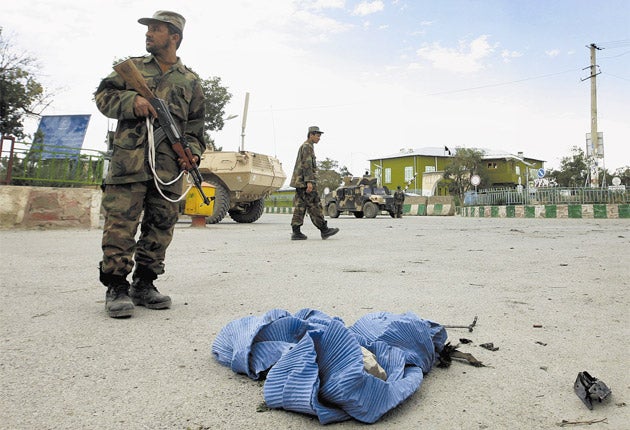
Male suicide bombers disguised in womens' burqas stormed government buildings and security headquarters in co-ordinated attacks which killed a dozen people and injured 22 others in eastern Afghanistan yesterday.
Hamid Karzai's government described the "commando-style" raids as a new tactic being employed by the Taliban in what has been one of the most violent months in the country's war.
Bombers wearing burqas, male and female, have struck on a number of occasions in Iraq. The modus operandi is, however, new to Afghanistan where, due to religious sensibilities, women in traditional dresses face less risk of being searched than in Iraq.
Fierce firefights broke out in the towns of Gardez and Jalalabad after about 15 bombers produced Kalashnikov assault rifles from under their long robes and opened fire. Several of the insurgents who managed to get inside the buildings then detonated their explosive vests, causing carnage.
Azizuddin Wardak, the provincial police chief said that all the bombers had entered Gardez town centre wearing all-enveloping burqas.
"This is a new type of tactic. They wanted to kill innocent people as well as government officials," he said.
The Taliban claimed responsibility for the attacks which came during the "surge" of US and British forces in southern Afghanistan which aims to establish secure zones ahead of next month's national elections.
The bombings yesterday were described by Afghan and American officials as attempts by the Taliban to relieve pressure on their fighters in the south.
The east was the scene of ferocious clashes between US-led Nato forces and the insurgents before the focus moved to Helmand and Kandahar.
Curfews have been imposed in Jalalabad and also in Gardez. Mohammed Nizam Ali, a Gardez shopkeeper, said that residents were afraid. "You can try to keep away from the fighting, but this is now happening in places we have to walk past every day," he said.
"What happened was very bad, I saw a lot of blood and also a body of a policeman who was shot."
Zabiullah Mujahid, a Taliban spokesman, said the organisation claimed responsibility for the bombings and that "similar missions" would take place in the future. According to Nato sources, there has been increasing evidence of insurgents crossing over the border from Pakistan. One official said: "They have been coming over in some numbers. The first batches, it was felt, may have been pushed out by the Pakistani military offensive. But what we are seeing subsequently have been well-armed and well-organised groups who are obviously being sent on operations."
Taliban assaults have shown increasing signs of complexity and attacks have also targeted the capital, Kabul. Two months ago, 11 Islamist fighters took over government buildings in Khost, 40 miles east of Gardez, leading to gunbattles in which 20 people died and 17 were injured, including three American soldiers.
Kyle Landers, a US military analyst who is writing a book on Taliban tactics, said: "These types of operations obviously follow training and that is taking place across the border in Pakistan. Al-Qa'ida may have been the ones who are responsible for the training, but there is also bound to be suspicion that the ISI [Pakistani intelligence] may be involved."
The EU foreign policy chief, Javier Solana, said that there was widespread support among member countries for the American led "surge" but that the overall security situation in Afghanistan was "evolving not in an ideal manner".
Meanwhile, losses among Nato forces have continued to mount. A second British soldier was killed in 24 hours, the 18th to die this month, bringing the total number of UK fatalities since the mission began to 187. The soldier, from the Joint Force Explosive Ordnance Disposal Group, died after a blast in Helmand while he was on patrol.
Lieutenant-Colonel Nick Richardson, the spokesman for UK forces in the province, said: "The death of any comrade brings sadness to the task force but we are consoled by the fact that these deaths are not in vain."
The engagements have also seen a steep rise in the numbers of the injured. Captain Harry Parker, the 26- year-old son of General Sir Nick Parker, the third highest officer in the British army, is reported to have lost a leg after being severely injured by a roadside bomb at Nad Ali in Helmand.
General Parker is to be deployed to Afghanistan in September, becoming the most senior ranking British officer in the mission, when he takes over as deputy to the US commander of Nato forces, General Stanley McChrystal.
The outgoing Nato secretary- general, Jaap de Hoop Scheffer, who leaves office on 1 August, declared during a visit to London that withdrawing from Afghanistan was not an option as this would mean that "al-Qa'ida will have a free run again, and their terrorist ambitions are global".
During his visit, Mr de Hoop Scheffer met with Prime Minister Gordon Brown who stressed the need for "further burden-sharing" by Nato allies.
Yesterday, a former Labour minister accused the head of the Armed Forces and the chief of the Army of making comments that "threaten to undermine" Britain's effort in Afghanistan and give "succour to the enemy".
During Lords Question Time, Lord Foulkes of Cumnock called for the Defence minister Baroness Taylor of Bolton to remind the Army head, General Sir Richard Dannatt, and the Chief of the Defence Staff, Air Chief Marshal Sir Jock Stirrup of the "importance of loyalty".
The deadliest month: Surge brings setbacks
19 June British troops move into Helmand for Operation Panther's Claw.
1 July Lt-Col Rupert Thornloe killed, the most senior soldier to die in combat since the Falklands.
2 July About 4,000 US troops move into Helmand in fresh surge.
9 July Truck bomb kills 21 in Logar.
9-10 July Eight soldiers die in the UK's worst 24 hours in Afghanistan.
18 July Taliban bomb in Kandahar kills 12, including five children.
22 July With 30 US and 17 British troops killed, this is now the deadliest month of the conflict to date.
Join our commenting forum
Join thought-provoking conversations, follow other Independent readers and see their replies
Comments