The men who gave Aids to rural China
The scandal that saw 'blood merchants' infect thousands of people with HIV has always been a taboo subject. But a new film hopes to change that
In Gu Changwei's star-studded new film, Love for Life, a beautiful Aids sufferer, Qinqin, explains how she sold her blood to buy expensive shampoo. "Another girl in the village had it," she says, shrugging. "I wanted my hair to be as shiny as hers." Qinqin now suffers from the "fever", a mysterious illness sweeping the region following a visit from a "blood merchant", with whom the villagers had hungrily traded their blood for cash.
Opening in Chinese cinemas last week, the film marks the first time the blood-selling scandal of the 1990s has been featured in mainstream Chinese culture. Set in a remote village during the period, it is about a love-struck couple, Shang Qinqin and Zhao Deyi, who are struggling to come to terms with the fever. It is the result of four years work for the 53-year-old Gu, a cinematographer-turned-director who has worked on some of the biggest films in Chinese movie history, including Farewell My Concubine (for which he was nominated for an Academy Award). Starring two of Asia's hottest pinups – the actress Zhang Ziyi, of Crouching Tiger, Hidden Dragon, and Aaron Kwok, a huge Cantopop star – it's set to be one of the biggest Chinese films of 2011.
What is perhaps most remarkable about Love for Life is that it is backed by the Government, marking a U-turn on a subject that has, until now, been rigorously censored. Aids itself has been touchy, but most sensitive of all has been the blood-selling scandal, an episode that infected tens of thousands of people in rural China with HIV and in which the Government was implicitly involved.
In the 1990s, entrepreneurs known as "blood heads" started collecting blood from peasants. They extracted the plasma and returned the blood to the donor. In the interim, however, the blood was mixed in contaminated pools and equipment was reused. Aids swept through rural parts of Henan, Shanxi and Anhui provinces, killing people, as the narrator says at the beginning of the film, "like leaves falling from the trees". In an office above one of Shanghai's oldest cinemas, Gu explains the rationale behind the movie. "In contemporary China, people still turn pale at the mere mention of Aids," he says. "You know there is an old saying in China that people 'turn pale at the mention of a tiger' [people grow fearful if something bad is merely mentioned]. This film is attempting to get people over that fear."
Its release could not be more timely. Last month, the Ministry of Health announced that deaths from Aids were peaking in China. Total Aids deaths have increased more than eightfold since 2005, from fewer than 8,000 to 68,000 in 2011. Last year alone there were 7,700 deaths, the most recorded in a single year. This peak, a senior health official told the China Daily last month, was because "those infected in the 1990s [are now] developing full-blown Aids. So the number of deaths has surged".
China has about 740,000 people living with HIV/Aids, although it is estimated that 400,000 are not aware of their condition. "We don't know where this other half is," Gu says. "They are probably just ordinary people around us. When we were shooting the film, several people left the production, for they thought it would be dangerous to work with HIV-positive people. They lacked even basic knowledge about Aids."
This widespread ignorance is largely down to the official choking of media reports and the suppression of activists when Aids broke out in the 1990s. Books on the topic, such as Yan Lianke's Dream of Ding Village, remain banned.
"The Chinese Government has never stood up and explained things to the public," says Zhang Beichuan, the director of the China Sexology Association, who has been honoured by the United Nations for his Aids work in China. "Not a lot of people in China are aware of the [blood-selling] scandal. Sadly, nobody seems to be taking responsibility for the disaster. If nobody is responsible, then there was never a problem."
It's not just the nature of the disease that Love for Life dramatises, but the acute discrimination against HIV/Aids sufferers in China. In the film, the villagers with Aids are social outcasts. When Aaron Kwok's character, Zhao Deyi, buys some fruit, he is given his change with pincers. Qinqin's husband says she is too "filthy" to be buried next to him.
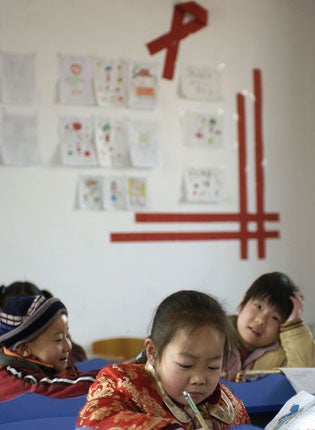
Released alongside Love for Life is a documentary called Together, co-produced by Gu, which acts as both a "making of" and a spotlight on contemporary Aids sufferers. It includes the story of a 12-year-old boy who is not allowed to put his chopsticks in the communal hotpot for fear of infecting his family. In another scene, a 30-year-old drug user known as Duckweed recounts how she sprinkled her son's rice with rat poison. "I couldn't see the point in living any more," she tells the camera, sobbing. Her son was four and, like Duckweed herself, infected with HIV. "My boy wanted to eat the rice straight away. But then I thought, 'How can I let him leave the world after only a few years of life?' I changed my mind."
One of the biggest challenges for Together's director, Zhao Liang, was finding Aids sufferers willing to be filmed. "They were very protective; they really didn't want other people to know," Zhao says. After trawling online chat rooms for several months and conducting 60 interviews, he found six people willing to join the production. But only three agreed to their faces being shown.
"I asked Gu: if people don't want to show their faces, what should I do?" Zhao says. "He said: 'If it's like that it's no problem. If no one wants to reveal their face, if no one dares to stand up, it shows how serious the discrimination is'."
Back at the cinema, Gu says: "Together and Love For Life have different prerogatives. Together is informative, while Love for Life works on an emotional level. I just hope that audiences share in the emotions of my characters, and that the film helps cut down discrimination in China. When you only have a short time left in the world, your core humanity is magnified. I want my characters' humanity to shine through; to show that everybody fights for life, everybody loves, and every individual has the right to live with dignity."
Additional reporting by Luxiang Li
Join our commenting forum
Join thought-provoking conversations, follow other Independent readers and see their replies
Comments