The quake victims who won't be silenced by the state
Clifford Coonan reveals how he was caught in the clampdown by Chinese police struggling to stifle dissent from angry parents
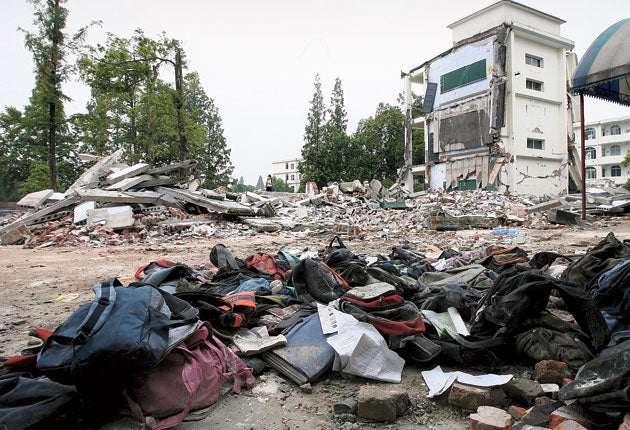
Private interviews are forbidden." the police officer told me. "This is a sensitive time." His words, uttered yesterday at a barracks in Juyuan, a town devastated by the earthquake in Sichuan province last year, made absolutely clear why I had just been detained by police for doing my job as a reporter. They also showed there is a total shutdown on media coverage of China's "sensitive" areas, despite a much applauded initial openness in allowing foreign journalists to witness the aftermath of the quake. Since then, the voices of angry parents who lost their children in the wreckage have been silenced because public anger over shoddily-built schools is seen as politically destabilising.
I had been driving to Dujiangyan, one of the towns badly hit by the quake, to pick up a special press pass needed to visit earthquake zones. Since Juyuan is on the way to Dujiangyan, I decided I would try to revisit its middle school, where I had been the day after the quake. Up to 300 children died in this school, which folded in on itself as buildings all around stayed standing: a horrible sight that turned the grief of parents into outrage. A year ago, I witnessed hellish scenes as parents dug their children out of the mud and rubble. Since the quake, families have been harassed and arrested as they continue to seek justice for their children.
Yesterday, there was a heavy police presence in the town and the atmosphere was tense. The middle school has been sealed off, just as it was one month after the earthquake, the last time I tried to visit. Back then, too, I was told to leave. Driving down a country road to see if I could track down one of the parents, I received a friendly phone call to say police were after me and had the registration number of our car. Unwilling to risk confrontation, and to cause trouble for the families, I turned around and drove back up the track.
Shortly after reaching the main road, three police motorbikes, each with two uniformed officers, pulled us over. They were joined by two patrol cars and one more motorcycle. An officer jumped in the front seat of our vehicle and directed the driver to the local government building.
We formed quite a cavalcade as we drove through the town, 30 miles from the provincial capital Chengdu. In the grounds of the local government headquarters, makeshift barracks had been constructed. I was glad to see uniformed police, as they tend to follow the rules. A day earlier, my colleague Jamil Anderlini from the Financial Times had been roughed up and had his camera smashed by a group of local officials and thugs in plain clothes. Other journalists have also been harassed.
There were probably eight officers in the room to which we were taken, all wearing the black uniforms that showed they were not locals but special police, deployed from other parts of China. They gave us tea, and were polite in the interrogation room, trying to establish to whom we had spoken, details which I was not in a position to give. I asked why I could not see the Juyuan Middle School, saying I had been there a year ago and wanted to see how reconstruction was going.
That's when I was told "private interviews" were forbidden and the school was closed. We were told to leave Juyuan. I asked once again to see the school and a friendly officer accompanied us to a makeshift building where students are being taught while new premises are built. We were allowed only as far as the gates.
The father who called with the tip-off that police were tailing us lost his 17-year-old son at Juyuan Middle School. His identity must remain secret. His testimony illustrates how, for many parents who lost children, the horror of 12 May 2008 remains very real, and is intensified because they do not feel they are getting answers to their questions about why their children died.
"I have been arrested seven times in the past year," the father told me. "The police just arrested me without saying anything since last year till now. They put me in custody for up to three weeks. I tried to talk to the local courts but they just ignored me. All I want is a thorough investigation into why and how my child died. The government should let us speak.
"I have not had a job since then. My wife and I just rely on the government relief for earthquake victims, which is too little. In my family, I'm the only one petitioning. I raised my boy for 17 years. It is difficult for me to forget him and forget my life with him. I miss him so much." At this point, he began to cry.
This week, the human rights group Amnesty International called on the Chinese government to stop intimidating the parents and relatives of children who died in the Sichuan earthquake. They have been given compensation and letters of sympathy but still no explanations.
The government has introduced measures to stifle any dissent arising from the aftermath of the quake. This applies particularly keenly to the parents, but keeping journalists on a tight leash is part of that policy. Foreign journalists enjoy unprecedented freedom of movement in China, which allows them to report on the incredible story of change in a new and open China, an amazing country that is stepping up as a world power. These rules were introduced before last summer's Olympic Games in Beijing, and have been allowed to continue since then in a sign of a more confident China. But this confidence does not extend to the ruined schools of Sichuan.
Join our commenting forum
Join thought-provoking conversations, follow other Independent readers and see their replies
Comments