The super-fast way to show the world you mean business
The new Beijing-Shanghai bullet train is the latest emblem of China's rise as a global superpower. Clifford Coonan hops aboard

For free real time breaking news alerts sent straight to your inbox sign up to our breaking news emails
Sign up to our free breaking news emails
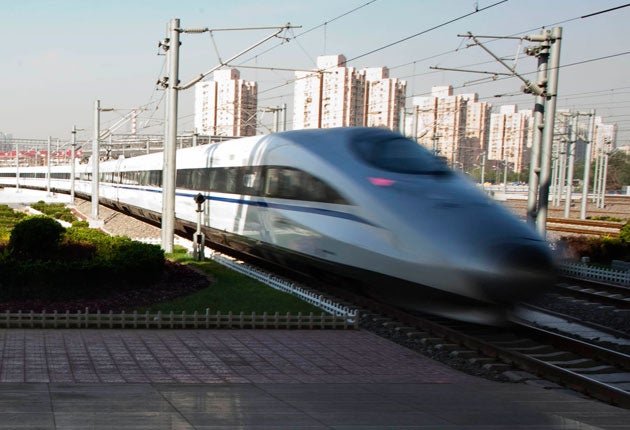
The sleek high-speed train zips along at 205mph through hazy hills and paddy fields dotted with new blue-roofed factories and Ming dynasty villages, from the capital Beijing to the trading centre of Shanghai.
This journey, and the trains that make it, mark a new high point of China's much vaunted high-speed rail project, the latest emblem of China's rise as a global superpower.
After boarding at Beijing's gleaming Southern Station, where elegantly suited attendants bring you to your seat in a style reminiscent of the golden era of train travel, we get ready to try a new way to move between China's political capital and its financial hub.
One hundred years ago, the trip from Beijing to Shanghai would have taken three weeks of hard and often hazardous travel. Yesterday, a train journey that normally takes 10 hours, took just four hours and 48 minutes, all of it on a shiny bullet train crossing the painterly, verdant landscape of eastern China. Imagine travelling London to Manchester in 53 minutes. No delays, no apologies and at the speed of a bullet.
Settling into a comfortable seat in business class, it's hard not to think about how things used to be in China, and not so long go. In 1992, travelling in an overnight compartment, an elderly woman boarded and got underneath the seat, from where she proceeded to fire sunflower seed shells and refused to come out. Later, she found great amusement in tickling this correspondent's feet.
Events take a slightly surreal turn, as they often do in China, when we are served KFC for breakfast, with a roll of what looks like Tibetan pastry. But all done with great grace.
We zoom past construction sites building the factories and shopping centres to be served by the railway. At several points in Jiangsu province, there are ghostly tower blocks under construction within sight of the track. Tickets for the journey between China's top two cities range from 410 yuan (£40) to 1,750 yuan (£169). A flight would set you back between 1,000 yuan and 2,000 yuan, and it takes about two hours. But factor in the check-in times, the security checks and fact that most airports tend to be located a long way out of town, and you can see why China is pushing the high-speed rail project in a major way.
The rail project is the high point to date of China's push to become more than just a low-cost manufacturer, and is up there with the space programme and Olympic achievement in terms of national pride.
The 221 billion-yuan (£21.4bn) service from Beijing to Shanghai's Hongqiao station, a purpose-built terminus beside the city's downtown airport, is the biggest star of the programme, and it goes fully operational later this week. Rail authorities said the 819-mile line will run 90 pairs of trains a day and could increase the capacity of the current line to 80 million passengers a year.
It reached the top speed of 205mph on a segment of journey between Zaozhuang city in Shandong and Bengbu city in Anhui province. Technically it can go faster, but the government has reduced the speed, to around 186mph for large stretches, and ticket prices following complaints it is too expensive and dangerously fast. "The safety of China's bullet train is guaranteed," said He Huawu, China's top rail engineer at the Ministry of Railways, in response to questions about safety.
The high-speed train was developed by China, based on foreign technology from Japanese and German firms. Chinese engineers readily admit that its bullet trains and rail lines have "absorbed" many ideas from the West. But China has been speedy in getting the technology to work, and this success is what they hope will translate abroad. Chinese companies are building high-speed rail networks in Turkey, Iran and Venezuela, and are hoping to build in Britain and the US.
But is has not been all been such a smooth ride. The high-speed rail network has been beset with corruption issues, with the former railway minister Liu Zhijun being dismissed in February in a graft probe. Stories abound of sub-standard building practices leading to delays in construction as sections of track are taken down and reinstalled. In Taiyuan, the capital of Shanxi province, local media reported subsidence causing gaps of up to 40cm between the ground.
Former deputy chief engineer at the rail ministry, Zhou Yimin, went public with his concerns, causing a huge scandal. He said the minister exaggerated the project's performance, saying the train would reach a maximum speed of 236 mph and maintain a constant speed of 217mph. His utterances were part of the reason why the train is travelling slower than it might have.
By 2013, China will have the world's most comprehensive high-speed railway network and 800 bullet trains. The plan is one of extension with the project expected to be expanded to the Iron Silk Road, which will use the technology to link Shanghai to Singapore via Rangoon, and Kunming in south western Yunnan province to New Delhi, Lahore and on to Tehran.
If all goes to plan, and if serious political negotiations are successful, in 2025 you could board at Harbin at China's border with Russia in Heilongjiang province, and embark on an epic voyage to eastern and southern Europe via Russia, eventually pitching up in London.
Subscribe to Independent Premium to bookmark this article
Want to bookmark your favourite articles and stories to read or reference later? Start your Independent Premium subscription today.
Join our commenting forum
Join thought-provoking conversations, follow other Independent readers and see their replies