Tibet in grip of Chinese 'martial law' 50 years after rising
Police and troops are deployed to contain dissident monks on anniversary
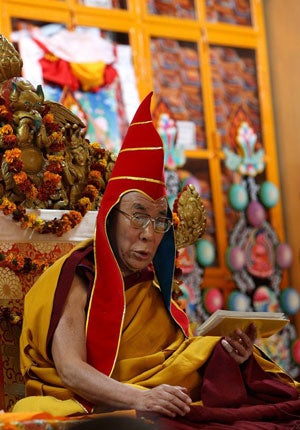
China has dramatically stepped up security in Tibet and imposed "de facto martial law" ahead of today's anniversary of a failed uprising 50 years ago that forced the Dalai Lama to flee the country and establish the exiled freedom movement in India. China's President has also called for a "Great Wall of stability" in Tibet.
Police patrols have increased near Buddhist monasteries known to contain dissident monks and the number of checkpoints has increased. Foreign journalists are banned from the region.
The independence uprising, triggered by reports that the Dalai Lama was to be kidnapped, began on 10 March, 1959, and was brutally crushed by the Chinese authorities. Last year's anniversary was marked by the biggest demonstrations in Lhasa and other Tibetan cities for decades. The demonstrations, at times deadly, resulted in a crackdown by the authorities that left countless dead and saw hundreds jailed. Many are still said to be missing.
It also forced the Tibetan independence movement to review tactics. Last November, there was an unprecedented meeting of activists and politicians at the home of the exiled government in Dharamsala.
The meeting ultimately voted to continue to pursue the non-confrontational "Middle Way" promoted by the 73-year-old Dalai Lama, though many of the younger generation of activists came away unhappy.
Police and troops have been deploying across Tibet for days and has focused on monasteries such as the one at Rebkong in Tongren. Underscoring the potential for unrest, two homemade bombs yesterday damaged police cars and a fire engine in Qinghai province, though it was not clear whether the blasts were linked to independence activists. In Beijing, Fu Hongyu, a senior official with the border control agency, said: "To protect stability in Tibet, we have deployed military troops to strengthen controls at entry points and on key roads along Tibet's [international] border. We will go all-out to maintain security and stability."
Yet despite what activists have termed the de facto imposition of martial law in the region, protests have continued. Dozens of monks from Gomang monastery in Aba are said to have launched a protest march chanting "Long live the Dalai Lama" and "We want human rights".
A week after the 1959 uprising, the man considered a living god, dressed in peasant clothes and slipped out of the Lhasa temple where he lived and made his way to the Indian border. On 31 March, he entered India, where he has lived and where the so-called Tibetan government in exile has since been based.
Today, as has been his habit on every 10 March, His Holiness will lead prayers and deliver his "annual political statement" to his followers, outlining the state of progress of talks with China. He will speak with the media in the afternoon, said his spokesman, Tenzin Takhla.
There is little progress to report. After the most recent meeting between Chinese officials and representatives of the Dalai Lama late last year, Beijing said "serious differences" remained between the two sides and accused the Dalai Lama of failing to honour promises allegedly made earlier in the year. China said the religious leader had vowed not to support independence for Tibet or violent opposition to Chinese rule.
As a result, the independence movement has grown increasingly frustrated and depressed. While His Holiness remains personally respected, a new generation disagree with his tactics. "This 50th anniversary shows that we have been here [in exile] for 50 years and the situation inside Tibet is getting worse day by day," said Tenzin Norsang, joint secretary of the Tibetan Youth Congress, one of the more radical Tibetan groups but which remains committed to non- violence. "If something happens in Tibet on 10 March, we are ready to act. The Dalai Lama and the Tibetan government are committed to the Middle Way but we are committed to independence for Tibet. There is no scope for the Middle Way."
In China, there are no signs that attitudes towards notions of Tibetan independence are getting anything but tougher. The Chinese President Hu Jintao told delegates to the annual parliament: "Tightly grasp the big tasks of development and stability ... Ensure national security and Tibet's social stability. We must build a sturdy Great Wall against separatism and to protect the unity of the motherland, advancing Tibet from basic stability to ensuring lasting order and tranquility."
His words underline how China remains happy to continue playing hardball on issues such as Tibet, particularly as the government also has to deal with social unrest on the back of the slowing economy, plus the prospect of the 20th anniversary of the Tiananmen Square massacre in June.
Join our commenting forum
Join thought-provoking conversations, follow other Independent readers and see their replies
Comments