What has the war in Afghanistan really achieved?
<i>The IoS</i> takes stock after one of the bloodiest months since the conflict began, and a week in which President Obama announced a speeding up of troop withdrawals
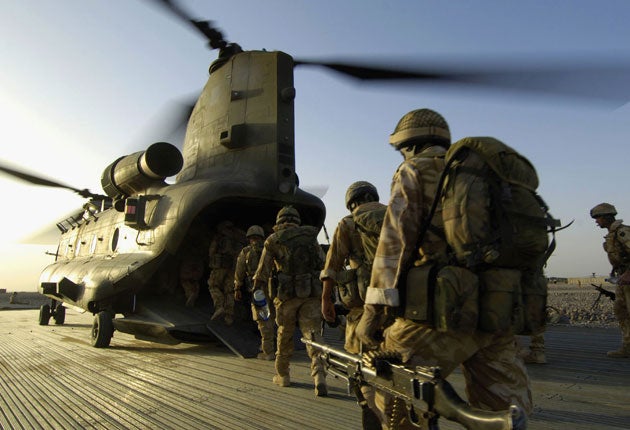
At least 60 people died in a suicide bombing just 25 miles from Kabul yesterday. In a few days' time, a report on Afghanistan from the International Crisis Group will say that violence and the billions of dollars in international aid have brought wealthy officials and insurgents together. As a result, "the economy is increasingly dominated by a criminal oligarchy of politically connected businessmen".
The negatives column in the Afghan war's balance sheet does not get any shorter. So far, the conflict has lasted nine years, eight months and 17 days, cost the lives of 2,547 coalition troops, and between 14,000 and 34,000 civilians, created millions of refugees, and opened up a black hole in Western economies that has sucked in more $500bn dollars. Afghanistan costs the US around $10bn (£6.3bn) a month; and Britain will pay £4.5bn this year.
Such is the change in mood that the Foreign Secretary, William Hague, has openly admitted the prospect of parleying with the Taliban, the very people we went to war to remove. Sources have told The Independent on Sunday these are, at present, talks about talks, but have involved middle-ranking officials from the State Department and CIA on the US side (initially brokered by the German ambassador), and Tayeb Agha, former chef-de-cabinet of Mullah Omar, on the Taliban side.
So, as these preliminaries are gone through, and President Obama announces a speeding up of troop withdrawal, we ask: what has been achieved by the war?
Al-Qa'ida and the terror threat
The hunt for Osama bin Laden and removal of the Taliban regime sheltering him was the original war aim, long since replaced by fighting insurgency, winning those elusive hearts and minds, and the neo-cons' idea – preposterous in the face of so much corruption and lawlessness – of building a Western-style civic society. Bin Laden is now gone, but Afghanistan has long since ceased to be a major trainer and fomenter of terrorism outside its own borders, and the killing of Bin Laden has demonstrated that special forces, police work and drones are a far more effective weapon against terrorists than wars.
A stable Afghanistan?
There are undoubted achievements, principally that the country is no longer ruled by a regime of fanatics. Afghan security forces now exist; roads, schools, and clinics have been built; and the numbers of children in school have soared. In Helmand province, where British forces are concentrated, 11 of its 14 districts now have a governor and some officials. Schools have reopened with almost 80,000 children enrolled today, virtually double the number in 2007. Two-thirds of Afghans now have access to basic health services – up from 8 per cent during Taliban rule; more than 1,000 judges, 200 of them women, have been trained; and elections, albeit increasingly corrupt ones, are routinely held.
But with violence at record levels, a dysfunctional government plagued by corruption, and a police and army riddled with illiteracy and dependent on coalition support, Afghanistan is anything but stable. Despite billions of dollars being poured into creating an Afghan army and police force capable of fighting the Taliban on their own, only a single army unit is assessed as being able to operate independently, according to the International Security Assistance Force.
The Afghan security forces are suffering from a shortage of hundreds of instructors, not to mention infiltration by the Taliban. Speaking to The IoS last week, Dr Jack Kem, deputy commander for the Nato training mission in Afghanistan, admitted there is no end date by which the security forces would be capable of functioning without outside support. Meanwhile, violence in Afghanistan hit a high last month, with 961 civilians killed or injured, making May the deadliest month since the United Nations began compiling statistics in 2007. The UN said insurgents were responsible for 82 per cent of the deaths. Nato-led troops suffered record losses in April and May with 110 dead – the highest death toll for those two months since the war began.
A new report by the Carnegie Endowment for International Peace, called Afghanistan: The Impossible Transition, says that the idea of transition by 2014 is "unrealistic" and warns: "If the transition were carried out, it would provide a considerable boost to the insurgency and, ultimately, the defeat of the Karzai regime." Over the past two years, the security situation has deteriorated in the border provinces, according to the report. And President Karzai is showing increasing signs of moving closer to Iran and Pakistan.
The Afghan economy
Government tax revenues exceeded $1bn for the first time last year, but a US Senate report estimated that 97 per cent of the country's GDP is derived from the international military and aid. And, as the troops depart, so will a lot of the reconstruction cash. US aid is falling this year from $4.2bn, and, by 2014, when the last troops leave, it will be substantially less.
Drug production
Afghanistan is by far the world's most important producer of heroin and cannabis, and the war has done little to alter that. Poppy growing is too important to the warlords, corrupt government officials, the Taliban, and the untold numbers of poor Afghans involved in growing, processing, and transporting the substances. Last year, the country's opium harvest was markedly down, mainly because of poppy blight. Yet Afghanistan still accounts for 74 per cent of the world's production. As Yury Fedotov, executive director of the UN Office on Drugs and Crime, said: "Our preliminary findings indicate Afghan opium production will probably rebound to high levels in 2011." The reason is not hard to find. In Kabul, the price of a gramme of heroin is $4. Yet this will sell for between $170 and $200 in northern Europe and the US.
Women's rights
At the top of Afghan society, rights for women appear good: 69 out of 249 MPs are female, 28 per cent – well ahead of the UK's 22 per cent. Some 57 per cent of women and girls now go to school, whereas under the Taliban education for girls was banned. There are strong advocacy groups, while one of the more prominent female MPs, Fawzia Koofi, has hopes of running for the presidency in 2014.
Yet the reality on the ground, especially in areas where the Taliban has regained control over the past five years, is far grimmer: 20 girls' schools were burned down during a six-month period last year. Many teachers are threatened with "night letters" – notes left anonymously overnight – from insurgents warning them to stop educating girls or be killed. A Human Rights Watch report last year warned that women's rights in the country risked being sacrificed if the West "cut a deal" in peace talks with the Taliban.
US regional relations?
Even if in 2014 there is a full allied handover to Afghan security forces, the US will presumably maintain some form of anti-terrorist capability there, to make sure that a reborn al-Qa'ida can never take root again.
But even total success will have little bearing on what happens in Pakistan, which has all of Afghanistan's problems – a corrosive Taliban/al-Qa'ida presence, a weak and corrupt central government, a security apparatus infiltrated by militants – but on a larger scale, with nuclear weapons to boot. The fragility of the US-Pakistan relationship, once underpinned by the existence of a common enemy, the Soviet Union, has now been laid bare. Pakistan and the US are condemned to work together. But it is a mutually resentful and suspicious partnership, and will remain so.
Join our commenting forum
Join thought-provoking conversations, follow other Independent readers and see their replies
Comments
Bookmark popover
Removed from bookmarks