Where did you get that hat? Secrets of the Easter Island statues
Mystery of the giant headgear on the Easter Island statues has been solved by a team of British archaeologists
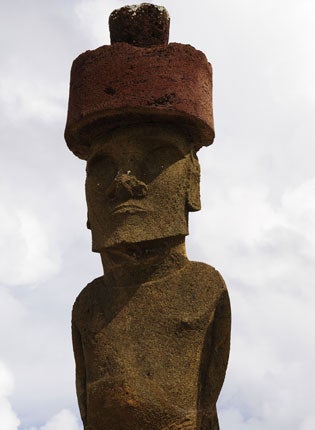
It is one of the great mysteries that has baffled explorers, archaeologists and anthropologists alike – what was the meaning of the giant Easter Island statues and what role did they play in the demise of this once-complex civilisation? But since the first non-islanders arrived in the remote archipelago half a millennium ago, another equally profound question has niggled away at the backs of their minds: where did they get those hats?
Now British experts, the first to work on the island since the legendary Edwardian archaeologist Katherine Routledge, believe they are a step closer to resolving the puzzle of the huge red boulders which sit astride the massive monolithic heads in the world's most remote inhabited place.
Dr Colin Richards from the University of Manchester and Dr Sue Hamilton from University College London have discovered the existence of a road used to transport the outcrops of volcanic rock leading to a previously unstudied "sacred" quarry where the material was mined. They have also found an axe believed to have been left at the quarry as an offering confirming the site's quasi-religious meaning to the ancient Polynesians. Dr Hamilton believes the "hats" may have represented a plait or top knot worn by the elite chieftains, who were engaged in a bitter struggle for prestige and power, which was symbolised by the building of ever-taller statues known as moai created in memory of their ancestors.
But while more than 1,000 statues have been found on the island only 70-75 hats have been discovered, suggesting the headgear was an added symbol of power – and perhaps even an early example of Pacific "bling".
As well as weighing several tons the "hats" are carved from a crater full of red scoria, a volcanic pumice whose colour symbolises high birth and status. They may have been later additions to existing statues to boost them beyond their rivals.
"Chieftain society was highly competitive and it has been suggested that they were competing so much that they over-ran their resources," said Dr Hamilton.
It is believed these elite leaders mobilised vast teams of workers to harvest the rock, which was then transported several miles on rolling tree trunks to the three-storey high statues, which were placed on special platforms to enhance their position of grandeur. Dr Hamilton said: 'The quarry is in a secret place which is invisible from other parts of the island and the noise of production would have been contained by the crater. These people lived in a successful and well-organised society – the Easter Island of 500 years ago was a managed living environment."
The academics, who will spend a month each year for the next five years investigating their findings, which include an obsidian adze – a seven-inch axe-like tool which was used for squaring up logs or hollowing out timber – believe the first "hats" appeared between 1200 and 1300. This coincided with a dramatic increase in the size of the statues across the island.
Situated some 2,500 miles off the coast of Chile, Easter Island, known to its indigenous people as Rapa Nui, has long been a magnet for adventurers. Katherine Routledge arrived in 1914 with her husband William as part of a pioneering British expedition to map the famous statues. With the help of a local man they excavated 30 figures and recorded the island's unique legends and oral histories. The exact cause of the dramatic decline of Easter Island, named by a Dutch explorer in 1722, is hotly debated but is agreed that it was brought on by a dramatic crisis possibly as a result of resource depletion, war or disease.
It was annexed by Chile in 1888 and in the 1960s was pressed into service by NASA as an emergency landing site for its space shuttles. Today Easter Island is a magnet for 20,000 eco tourists who are in danger of swamping the 3,500 native Rapanuins. But scientists working there are battling to keep the indigenous traditions alive. Each major excavation by the British team has been accompanied by a traditional "umu" ceremony with locals dressing up in white feathers and building ovens out of hot stones to offer cooked offerings to placate the island's spirits.
"We are excavating a living culture so we have to be very careful. There are very strict rules about what we can and cannot do and we have to respect them," said Dr Hamilton.
Dr Richards added: "It is clear that the quarry had a sacred context as well as an industrial one. The Polynesians saw the landscape as a living thing and after they carved the rock the spirits entered the statues."
Join our commenting forum
Join thought-provoking conversations, follow other Independent readers and see their replies
Comments
Bookmark popover
Removed from bookmarks