Young Chinese go crazy for shopping discount coupons
Chasing bargains has become a way of life for many as western-style consumerism takes hold
Ding Can is obsessed with bargains. Her purse is crammed with more than 30 discount cards and dozens of coupons. Her apartment is packed with freebies, from cosmetic samples to key chains. She often lines up before dawn for tickets to discounted movies.
Her yen for savings isn't out of necessity. The software testing engineer, 32, is relatively well off. She says, simply, "I've never come across a good deal I didn't like." More than a craze, discount shopping is becoming a way of life for young Chinese. Known as the "coupon generation", they are changing the way business is done in the world's second largest economy.
Companies as global as Nike and as local as the Yonghe fast-food chain are courting the bargain hunters. The eagerness for deals has spawned discount clubs, online group-buying and pavement kiosks that dispense coupons. A planned three-week campaign by Mercedes-Benz for its two-seat Smart car was over in less than four hours when more than 200 cars were snapped up from China's most popular online retailer for 135,000 yuan (£13,000) each, a 20 per cent discount.
It's a relatively new and youth-oriented phenomenon in China, where consumerism has taken off as the country has shifted from central planning to capitalism. People in Western countries have been clipping coupons for years – Coca-Cola began offering discounts around the start of the 20th century. But in China, the trend has implications for the global economy.
The spending habits of 350 million Chinese aged 18 to 35 are seen as crucial to boosting the world's recovery from recession and to, one day, vaulting China past the US as the world's largest consumer market. That could come as early as 2020, according to Goldman Sachs, the investment banking giant. "This isn't your grandma or a housewife cutting out Sunday newspaper coupons in her kitchen. They [the coupon users] are the future," said Leeon Zhu, a senior planner at the advertising firm Young and Rubicam's Shanghai office. "And they're at the forefront of retail consumption growth in this country."
Ms Ding and other members of "Discounts for Singles", an online forum, traded war stories at a spicy Chinese restaurant recently. Ms Ding showed off a sports watch she earned by taking photos of herself in front of a Lenovo computer store during a promotional event. A dining partner regaled the others with her latest steal: two dozen half-priced cartons of fruit juice at 4 yuan a carton. "How are you going to drink all the juice?" one asked. "I'll give it away to friends and family as gifts," said Shan Yunfei, who makes about £320 a month as an administrative assistant at an architecture firm. "They love it when I bring home new products."
Even the dinner is free. New eateries looking for publicity offer meals to people such as Ms Ding and Ms Shan, who are frequent reviewers on Dianping.com, China's most popular restaurant listing site. Frugality is highly valued in China, a legacy of generations of poverty. Savvy consumers are applauded by friends and family. Television shows such as Beijing's popular Managing Money broadcast interviews with Chinese who made big savings through group-buying events and promotional deals.
The biggest target is the 18-35 age bracket, born after the chaos of radical Maoism. They have largely known steadily rising incomes. "Young Chinese consumers love to spend and rarely save because they are optimistic that they'll always have money," said Fu Guoqun, a marketing professor at Beijing University. Ms Shan, 23, concedes that discounts get her to buy more than she would otherwise. Her bag is stuffed with McDonald's coupons and other discount cards. "I'm obsessed," she said. "Whether it's at work or home, I'm dreaming of the next deal."
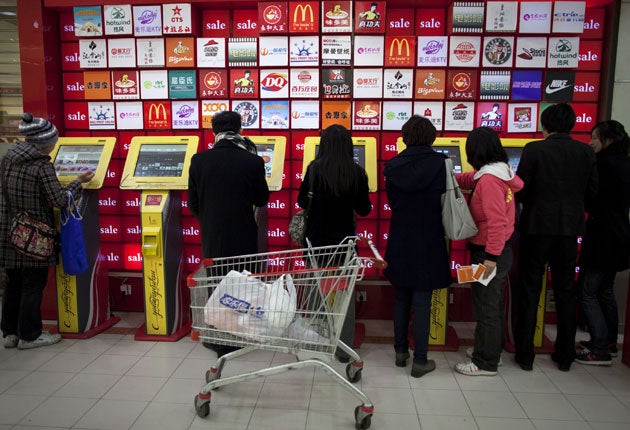
There are coupon kiosks in subways, shopping centres and supermarkets, and almost every major brand offers a discount card. Eyeball China, a Beijing-based company, prints 170,000 coupons every day for restaurants, car rentals and other goods and services and places them in about 200 kiosks across the capital. "The market is so saturated with brand names that a small discount makes a huge difference, helping the brand stand out with their target consumers," said Xie Dehui, Eyeball China's vice general manager.
Amy Yu, an estate agent, stopped to collect more than a dozen coupons for Yonghe restaurant's noodles and McDonald's chicken burgers at a kiosk outside French hypermarket Carrefour in southern Beijing.
Ms Yu looked like a pro. She pecked furiously at the kiosk's touch screen, scanning for the best deals. The machine, which is in front of a Yonghe shop, spews out coupon after coupon for up to 16p off meals priced between £1 and £2.50. "I work and eat around here, so I usually print a lot of coupons that look good regardless of whether or not I use them," she said. "It's also thoughtful to give them out to colleagues and friends, too.
Join our commenting forum
Join thought-provoking conversations, follow other Independent readers and see their replies
Comments