Bows, arrows and a dream of liberation
For 40 years, they've fought a jungle war for freedom. Alexander Groom meets one of the world's most isolated rebel armies
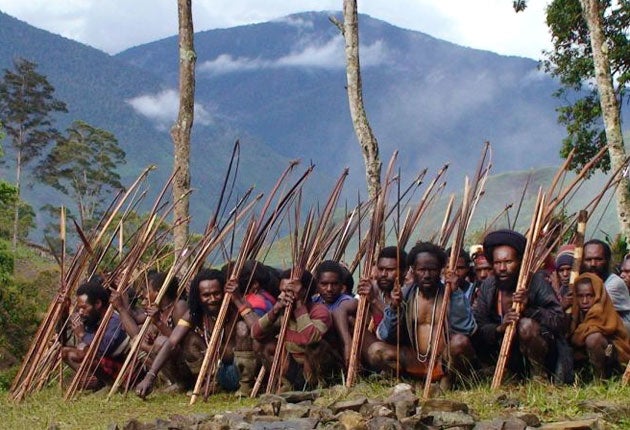
A sound of gunshots filled the air as we clambered through thick undergrowth to a clearing. There, perched on a a steep mountainside surrounded by lush rainforest, was a breathtaking sight. Villagers charged around chanting in a state of high excitement.
The village leader, dressed in little more than a wooden penis koteka and a feathered hat, solemnly called everyone to attention. Then two men stepped forward to raise the outlawed national flag.
A wild pig had been slaughtered, and we settled down to a feast with spinach and sweet potatoes. Around us, a ragged bunch of men sat watching, smiling and looking on as they smoked the locally grown tobacco.
Armed with bamboo spears, bows and arrows, (as well as a few old AK47 assault rifles) 400 rebel fighters are hidden here in one of the remotest places on earth, the jungle highlands of West Papua. Some of the soldiers were dressed in old T-shirts and combat fatigues, but most wore little more than wooden kotekas (penis gourds), their hair and limbs decorated with garlands of leaves.
The AK47s had been stolen, they explained, during a raid on an Indonesian security post, after a nearby village had been attacked leaving 45 people dead, more than half of them women and children. "These guns were used against our people," one of the men said, brandishing a rifle. "Look at them, they are US-supplied. What more evidence do you need that Western-supplied weapons are being used by the Indonesian military to kill West Papuans? We are defending our land and people against this illegal occupier that is killing so many of us".
As the tenth anniversary of East Timor's independence from Indonesia draws near, this other troubled province of the vast Indonesian archipelago looks set to renew its bid for freedom. It lies 155 miles north of Australia, on the western half of the island of New Guinea. For more than 40 years it has been waging a small-scale war against the occupying Indonesian army.
Human-rights groups estimate that the Indonesian security forces have killed as many as 200,000 native Papuans since the territory was absorbed into Indonesia in 1963. Yet this is a forgotten war, due in part to an Indonesian-imposed ban on foreign media entering the region.
Becoming the first western journalist to reach the stronghold of the outlawed West Papua liberation army – the Organisasi Papua Merdeka (OPM) in the remote central highlands of the country, involved evading Indonesian army road-blocks, trekking through inhospitable jungle terrain, and a series of clandestine rendezvous. Home to over 300 different tribes, the territory is one of the most remarkable places on earth. Most Papuans live subsistence or hunter-gatherer lives that have changed little in centuries. Between them these tribes speak some 125 languages.
There are snow-capped mountains, breathtaking highlands and a coastline of mangrove swamps and pristine beaches, as well as a dizzying array of flora and fauna. Research scientists uncovered 50 new species of plants and animals in the Forja Mountain region in 2005. But despite its appearance as a tropical paradise, the reality for those living there could not be more different.
A former Dutch colony, West Papua gained independence in 1961, but Indonesia invaded the following year. The UN oversaw a plebiscite on August 22 1969 but out of a population of 800,000 people, only 1,000 tribal elders were allowed to vote. Many later told how the Indonesian military had forced them at gunpoint to vote in favour of integration.
Some international huma-rights observers estimate that almost 400,000 Papuans have lost their lives in atrocities committed by the Indonesian military. Thousands of others have reportedly been tortured, raped, imprisoned or "disappeared" for speaking out against Indonesian rule.
Forty years on, an upsurge in armed activity by the separatist movement is a statement of intent about their efforts to force international attention and a re-run of the bitterly contested vote. But the rebels, who include school teachers and civil servants, provide little match for the 50,000 Indonesian soldiers deployed across West Papua.
Many regard the camp as a sanctuary where they can live a traditional lifestyle devoid of Indonesian-imposed values which they complain are swamping traditional culture. Others come for refuge from army raids routinely carried out on highland villages. "I walked with my daughter for three days to come here," one woman said. "The Indonesian military stormed our village and took my husband and son away. I don't know where they are".
There were haunting accounts from young men who'd seen their mothers and sisters raped by Indonesian soldiers; a former school teacher told of his despair at how the teaching of Papuan history and culture is banned: "It destroyed my soul being forced to teach Javanese history and being told that Papuan history is not important. We are a proud people with our own identity and rich history. We are not Indonesian."
Daily life at the camp starts at dawn with a traditional flag ceremony. By day the women tend crops or collect firewood, while elders provid battle training to the rebel fighters. At night, everyone crowds into the communal huts to eat.
With all forms of political opposition to Indonesian rule banned, the Organisasi Papua Merdeka (OPM) was established in 1965 and is still labelled an illegal separatist movement by the Indonesian authorities. Hundreds of its members are currently in prison, thousands more have been killed or 'disappeared'. Yet, despite being poorly armed, the OPMs military wing has been a constant thorn in the side of the Indonesian forces.
The consequences of resistance to Indonesian rule are well documented. British-supplied Hawk jets have been used in bombing raids against Papuan highland villages. Papuans also allege that in 2006, British-supplied water cannons were filled with acid and used against peaceful protesters in the provincial capital of Jayapura. Dozens of people were blinded and badly burnt.
Indonesia's interest in West Papua runs deep. The region is rich not only in natural beauty, but also natural resources. Freeport, the world's largest copper and gold mine, is located in the highland region. A joint venture between the British mining company Rio Tinto and the US giant Freeport McMoran, it provides Indonesia with revenues of $350bn a year. Papuans bitterly resent it, claiming none of the revenues are directed at solving any of their innumerable social and economic problems.
After the death of the Indonesian dictator Suharto in 1998, West Papua enjoyed a brief political respite. The Papuan Presidium Council (PDP) was launched, the OPM declared a ceasefire, and independence rallies and flag raisings were common. But the Indonesian military moved in. Thousands were rounded up and imprisoned, and many others disappeared. An escalation in events culminated in the assassination of the PDP chairman, Theys Eluay in November 2001. Yusak Pakage is one of the province's best known political prisoners. Recognised as a "Prisoner of Conscience" by Amnesty International, he is currently serving a ten-year sentence. Ill and now in hospital, he is a small figure with hunched shoulders who speaks vividly about his dream of freedom. "Every day I pray to God for freedom here in West Papua. Me and my people have only known suffering under Indonesian rule. We need the UK, the US and Australia to help us."
The British government continues formally to recognise Indonesia's territorial integrity. The Foreign Office favours implementation of autonomy laws that Indonesia introduced in 2001. Many Papuans believe that far from transferring power and money to their land, the autonomy process has actually made them poorer.
Benny Wenda is widely regarded as Papuans' leader in waiting. But he is a political refugee in Britain. "Our world has been turned upside down by the Indonesian occupation," he says. "We have been crying for help for over 40 years but our voice has never been heard". Back in the jungle, the actions of the ragged band of rebels may prove just as decisive as his words. "We will not wait another year for freedom to come," one rebel vowed. "We'd rather die trying to get our freedom than spend another year under Indonesian rule."
For more information, go to www.forgottenbirdofparadise.net.
Join our commenting forum
Join thought-provoking conversations, follow other Independent readers and see their replies
Comments