Down under - the movie: But can Baz, Nicole and Hugh persuade us to go to Australia?
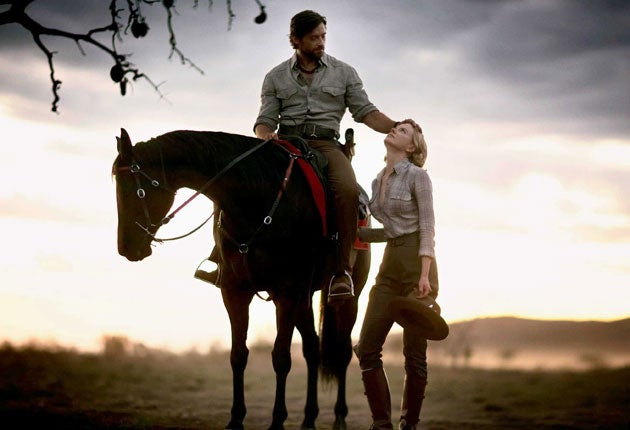
It is one of the most hotly anticipated Australian films of all time, featuring two of the country's leading actors, Nicole Kidman and Hugo Jackman, and a backdrop of magnificent outback scenery.
But there is more than box office success and critical acclaim riding on the fortunes of the epic film, Australia, a Second World War saga of romance, conflict and adventure, directed by Baz Luhrmann, who made Moulin Rouge and Strictly Ballroom.
Australians are hoping that the film – described as an Antipodean Gone With The Wind – will help revive their flagging tourism industry, reawakening interest in the country and promoting its landscapes as effectively as the Lord of the Rings movies did for New Zealand. So excited are tourism officials that they have commissioned Luhrmann to direct a $50m (£22m) series of advertisements, which will be shown in Europe, the United States and across Asia next month, in the lead-up to the film's November release.
During the 1980s and 1990s, it seemed as if the whole world wanted to visit Australia, with cheap flights, soap operas such as Neighbours and the impending Sydney Olympics transforming the country into an irresistible holiday destination. Since the Olympics, though, visitor numbers have stagnated and tourism operators now describe the situation as dire.
The last attempt to revitalise the industry came two years ago, with an advertising campaign based on a bikini-clad model inquiring: "Where the bloody hell are you?" The ads, which were banned in Britain, one of Australia's most important markets, were an expensive ($180m) and embarrassing flop.
Many Australians cringed at the crassness of the campaign, and at its retrograde nature, evoking an image of their country that was already outdated when, 20 years ago, Paul Hogan urged visitors: "C'mon, come and say g'day, I'll slip an extra shrimp on the barbie for you."
The new campaign projects a very different image of Australia, albeit one closely linked with a period film set in even further bygone times. According to Luhrmann, it will comprise a series of contemporary stories that reflect Australia's "transformative" potential – one of the messages of his movie. He explained recently: "What we hope to do is convey an emotional experience that is possible from going the extra distance and coming to this unique, special place on the edge of the world."
The trailer for 'Australia'
Much of the film is set in the vast, inhospitable Kimberley region of Western Australia, in the country's far north-west. Kidman plays an English aristocrat who inherits Faraway Downs, a ranch the size of Belgium, just before the outbreak of war. Initially alienated by her surroundings, she gradually falls under the outback's spell. But rival cattle barons are eyeing her property, and in order to save it, she and a taciturn drover (Jackman) drive 2,000 head of cattle hundreds of miles across country to Darwin, where, as it turns out, the city is being bombed by the Japanese.
The tourism ads will not feature Kidman or Jackman, although another of the film's stars, an 11-year-old Aboriginal actor, Brandon Walters, will appear in one. Tourism officials reportedly hope that Walters will help promote Australia's indigenous heritage as an "authentic experience".
Luhrmann, whose last film was Moulin Rouge in 2001, also starring Kidman, was initially lukewarm when approached by Australian tourism officials. But "we engaged in a really productive conversation about this country", he explained, and he felt that he "couldn't walk away from" the project. He was paid "mates' rates" to direct the advertisements.
Describing the five weeks he spent filming in the Kimberley, region, Luhrmann said: "The sun would come down... We'd sit around the fire and you'd look up at that sky... I remember sitting there thinking, no matter what the outcome of the film, this is what I'm looking for... That's what this place can do for you. And I hope we can convey just a little bit of that in the pieces that we make [for the campaign]."
According to Olivia Wirth, the executive director of Australia's Tourism and Transport Taskforce, which represents 200 leading tourism operators, the industry urgently needs a shot in the arm. "This is an ongoing trend," she told the Australian Broadcasting Corporation. "This is not a blip. This is a great concern to the industry.
"We're seeing the same number of holiday visitors that we did in 2000. That means we've got eight or nine years of flatlining growth of holiday visitors. So we absolutely support the Australia movie. It's a fantastic opportunity. If you have a look at what New Zealand did with Lord of the Rings, they made that work for the tourism industry."
The entire Lord of the Rings trilogy was filmed in New Zealand, which was able to showcase its stunning landscapes as never before. A country viewed as staid and unexciting suddenly became a hip holiday destination, and visitor numbers have increased by a million in the past decade. New Zealand is still reaping the benefits, and numerous operators offer tours to Edoras, Helms Deep and other Middle Earth locations.
Now Australia hopes to rebrand itself in a similar fashion, although it is doubtful whether Luhrmann's film could ever compete with Peter Jackson's blockbuster trilogy. Nonetheless, outback towns vied for a piece of the action; locations where filming took place included the Kimberley town Kununurra, Bowen on the Queensland coast, and Darwin. Some are sceptical about the benefits of the cinema-linked campaign. Sue Beeton, an associate professor in tourism at Australia's La Trobe University, pointed out that a 2003 film about Ned Kelly, the 19th-century bushranger, failed to attract more visitors to Kelly's stamping-ground in Victoria. Films based on successful books, such as Lord of the Rings and the Da Vinci Code, were likely to help the tourism industry more, she told the Sydney Morning Herald.
Jane Caro, a communications consultant, questioned Luhrmann's advertising flair. "It's a very different discipline," she said. "Film-making is storytelling, and it's about narrative, and it's about expressing a story and an artistic vision. Advertising, to be blunt, is about selling something."
There is, of course, the danger that Luhrmann's film could be a flop – a prospect that the director himself has described as "an absolute reality ... an absolute possibility".
But his advertisements could hardly do more damage to the tourism industry – which has also been hit by rising fuel prices and a strong Australian dollar – than the previous campaign. The Tourism minister, Martin Ferguson, has admitted that it was a "dismal failure", particularly in the key market of Asia. The campaign featured lines such as: "We've poured you a beer, we've had the camels shampooed, we've saved you a spot on the beach and we've got the sharks out of the pool... so where the bloody hell are you?" Regulators in Britain banned it from billboards and commercial TV, and this was only relaxed after Mr Ferguson's predecessor, Fran Bailey, flew in to argue that "bloody" was not offensive.
Luhrmann told Vanity Fair earlier this year that his new film features "big emotion, big comedy, big stars, big stories and big landscapes". Kidman, who gave birth to her first baby while Australia was in production, has described it as "the last of a dying breed", in the tradition of classics such as Gone With The Wind. She has her own reasons for hoping it's a hit. Forbes magazine recently named her the most overpaid star in Hollywood, based on her earnings and her films' takings.
Join our commenting forum
Join thought-provoking conversations, follow other Independent readers and see their replies
Comments