Lucrezia Borgia is unmasked... in Australia
First portrait of Renaissance Italy's most notorious femme fatale identified after years of research
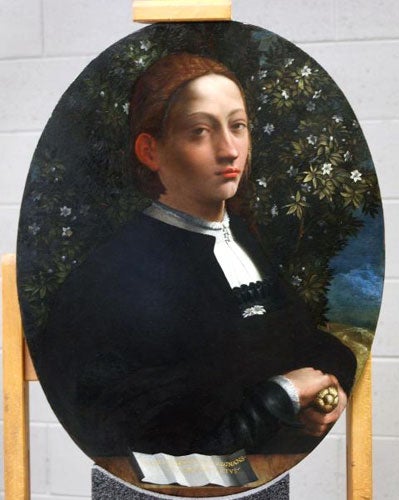
She was history's most notorious femme fatale, with three husbands, numerous lovers, and a rumoured penchant for poisoning men of whom she grew tired. Yet not a single portrait survives of Lucrezia Borgia, the infamous Italian Renaissance noblewoman – or so it was believed until now.
After four years of detective work, the National Gallery of Victoria (NGV) announced yesterday that it had identified Borgia as the subject of a mystery painting held in its collection for more than four decades. The oval portrait is believed to be the work of Dosso Dossi (1486-1542), a contemporary of Titian, Raphael and Michelangelo, and to have been painted between 1515 and 1520.
The gallery bought it for £8,000 in London in 1965. It was entitled Portrait of a Youth, by an unknown north Italian painter. Displayed on and off for the past 43 years, it baffled every expert on the subject, and was always assumed to depict a young man – in part because its subject was holding a dagger.
But lengthy technical analysis and research by the NGV's paintings conservator, Carl Villis, yielded astonishing results. Not only was the portrait the work of Dossi, a great artist, albeit less well known than some of his peers, Mr Villis concluded, but its subject was a woman whose name was synonymous with dark deeds, corruption and sexual profligacy.
Gerald Vaughan, the gallery's director, was barely able to contain his excitement during the announcement in Melbourne. He said: "What was previously a portrait of an unknown sitter by an unidentified artist now seems likely to be one of the most significant portraits surviving from the Renaissance, by one of the great north Italian painters."
The NGV believes it is the only portrait in existence of Borgia, the illegitimate daughter of Rodrigo Borgia, the powerful Valencian who ruled as Pope Alexander VI from 1492 to 1503, and his mistress, Vanozza dei Cattanei.
Mr Villis said: "If it is accepted for what we believe it to be, then it will be highly significant, because it will be incredibly rare. We believe this to be the only formal painted portrait of Lucrezia Borgia."
That note of caution may have been sounded because, in a highly embarrassing mistake that came to light last year, the NGV misattributed a painting to Vincent Van Gogh.
However, Mr Villis appeared confident, saying that the portrait's idiosyncratic style and oval shape matched the work of Dossi, who worked for the ruling family of Ferrara when Borgia was duchess. "It has been very exciting to unlock the secrets of this beautiful and enigmatic painting," Mr Villis said. "Generations of art historians have attempted to identify portraits of Lucrezia Borgia, but this appears to be the only one that contains direct personal references to this intriguing historical figure."
He said the only reliable likeness of Borgia was found on a bronze portrait medal made in 1502. "The facial profile on the medal bears a striking resemblance to our portrait."
Life and times Lucrezia Borgia
1480 Borgia born to Cardinal Rodrigo Borgia and Vanozza Catanei.
1493 Pope gives blessing to wedding of Lucrezia to Giovanni Sforza, on condition that marriage should not be consummated for a year.
1497 Pope grants Lucrezia a divorce on grounds on non-consummation. Sforza accuses Borgia family of incest.
1498 Lucrezia marries Alfonso, Duke of Bisceglie, but he falls foul of Lucrezia's family and is murdered.
1502 Lucrezia marries Alfonso d'Este, Prince of Ferrara.
1505 Lucrezia becomes Duchess.
1514 Lucrezia dies from complications after birth of her eighth child.
Join our commenting forum
Join thought-provoking conversations, follow other Independent readers and see their replies
Comments