Poll puzzle for immigrants as Australia votes
With both major parties talking tough on refugees, who will its settlers support in this week's election?
Khanh Phan immigrated to Australia from Vietnam five years ago. Next Saturday, he will vote in his first federal election. But neither the incumbent Labor Party nor the opposition Liberals appeal to him much. "They're both quite unfriendly to people coming here from other countries," he says. His sentiments are understandable.
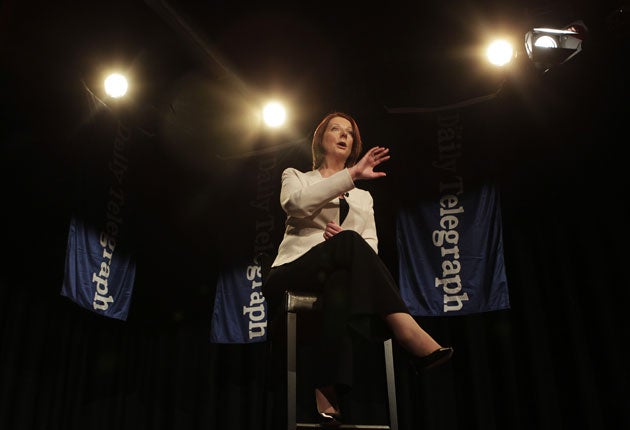
During the run-up to what is expected to be one of the most closely fought elections in years, the two major parties – led by the Prime Minister, Julia Gillard, and the opposition leader, Tony Abbott – have been vying to appear tough on asylum-seekers. Indeed, "border protection" has been one of the few concrete policy issues aired during a campaign light on substance and heavy on stage-managed photo-opportunities.
That, in itself, is not surprising: the "boat people" card has been brandished at every election since 2001, when John Howard's conservative government scraped back into power shortly after turning away the Tampa, a Norwegian tanker carrying shipwrecked Afghans and Iraqis. This time, though, the debate has widened beyond the relatively tiny number of people who arrive by boat every year.
The country's entire immigration policy is under scrutiny, in the light of growing concern about a population that is growing faster than that of any other developed country – and faster even than that of developing nations such as India and China. The population is increasing by nearly half a million annually, with two-thirds of those arriving from overseas.
Although the continent is vast, arable land and water are scarce, so recent treasury predictions of a population of 35 million in a few decades (compared with 22.5 million now) alarmed many citizens, particularly city-dwellers already suffering the effects of urban congestion.
In her first major policy pronouncement after deposing her predecessor, Kevin Rudd, in June, Ms Gillard – the country's first female prime minister – declared herself opposed to a "big Australia". She has since stressed the importance of "sustainable" growth; Mr Abbott has promised to cap the number of new immigrants at 170,000 a year.
Khanh Phan, a mechanical engineer, came to Australia under the country's skilled-immigration programme. He lives in the Adelaide neighbourhood of Mansfield Park, one of the most staunchly pro-Labor areas of South Australia. Mr Phan, thoughno great fan of Ms Gillard – but will probably end up voting Labor. Digging up weeds outside his bungalow yesterday, he said: "To me, Tony Abbott is not looking like a good guy. And Kevin Rudd did a good job during the economic crisis."
Both parties have pledged to send asylum-seekers overseas for processing: the Liberals favour the South Pacific island of Nauru, which housed an Australian detention centre during the Howard era, while Labor has proposed establishing a centre in neighbouring East Timor. (The East Timorese are distinctly lukewarm about it.)
Ms Gillard is a migrant herself – her family arrived from Wales when she was five – and she spent most of her childhood in Adelaide. Labor strategists are hoping her links with South Australia will reap dividends, helping to compensate for the swath of seats the party seems destined to lose in the key states of New South Wales and Queensland. Across the country, according to the latest opinion poll, published in yesterday's Sydney Morning Herald, Labor leads the Coalition (the Liberals and their allies, the rural-based National Party) by 53 per cent to 47 per cent.
Labor is counting on retaining marginal seats such as Kingston, in Adelaide's southern suburbs, which it holds with a majority of 4.4 per cent, and is optimistic about its chances in electorates such as Boothby, just to the north, where the Liberals have a 2.9 per cent majority.
Many swing voters, however, have yet to make up their minds. Linda and Stephen Lavender, who were shopping yesterday at the sprawling Centro Colonnades mall in Kingston, voted Labor last time. In the past, they have voted Liberal. This time they are "stuck in a hard place", according to Mrs Lavender. "Labor has made a mess of so many things. But I can't see Tony Abbott as prime minister either."
Mr Abbott, a former minister in Mr Howard's government, is widely regarded as the Liberals' main obstacle to power. He is a staunch Catholic who once studied for the priesthood, and has hardline views on abortion and same-sex partnerships. Although no fool – he is a Rhodes Scholar – the 52-year-old, who was born in London, has a tendency to let his tongue run away with him. He is a fitness fanatic keen on early morning swims and bike rides; and he has been ridiculed for his frequent public appearances in tight swimming trunks – or "budgie smugglers", as they are known here.
Ms Gillard, 48, a former student activist and industrial lawyer, is a different proposition. Forthright, personable and formidably bright, she is an atheist. She has no children. She is unmarried, although she has a partner, Tim Mathieson, who used to be a hairdresser. His absence from the campaign trail has attracted adverse comment, as has Ms Gillard's fashion sense, her broad accent and her lack of talent in the kitchen.
In Boothby, posters of Ms Gillard – featuring the much-derided Labor election slogan "Moving Australia forward" – are almost as ubiquitous as those of the party's candidate, Annabel Digance. The Prime Minister grew up in the area, and her parents, John and Maureen, still live there. Visiting her old school last week on the campaign trail, she recalled "putting pieces of cactus in a cake" during cookery lessons.
Even in her former stamping-ground, though, there seems to be little enthusiasm for Ms Gillard. Maxine Reding, who migrated to Australia from India 40 years ago, says: "I admire her from the point of view of being female and getting to where she's got to, but that's about it. I still have no idea who I'm going to vote for."
Many voters are disappointed that climate change has barely figured during the election campaign, despite warnings that Australia will be the first developed nation to be afflicted badly by global warming. Mr Abbott, who once described climate change as "crap", has ruled out setting a carbon price. Ms Gillard has proposed to establish a "citizens assembly" to gauge community support for an emissions-trading scheme. Mr Rudd's deferral of such a scheme was one of the reasons his popular support plummeted, triggering the events that led to Ms Gillard overthrowing him.
Disillusionment with both Labor and the Liberals is prompting many Australians to consider voting Green. Although Green votes for members of the House of Representatives (the lower house) ultimately benefit the larger parties, under the preferential voting system, the Greens seem set to hold the balance of power in the Senate (upper house).
On foreign policy, there is little to distinguish Ms Gillard and Mr Abbott. Both would continue to place a strong emphasis on the US alliance, and on engagement with Asia. Both have committed themselves to keeping Australian troops in Afghanistan. Overall, it has been a lacklustre election campaign. One newspaper called it the "battle of the bland". While most recent polls have had the two big parties neck and neck, history favours Labor. Not since 1931 has an Australian government lost power after just one term.
How Australia goes to the polls
* Just over 14 million Australians are enrolled to vote in the election on 21 August.
* Voting is compulsory.
* Australians vote for members of the 150-seat House of Representatives (lower house) and for half the 76-seat Senate (upper house). Julia Gillard's Labor Party has 83 lower-house seats; Tony Abbott's Liberal-National Coalition has 63. There are four independents.
* Votes are counted by hand.
* Members of the House of Representatives represent constituencies. Voters rank candidates in order of preference. If no candidate wins a majority, the one with the least votes is eliminated and votes are redistributed according to voters' second preference. This goes on until one candidate has a majority.
* The Senate has 12 members from each of the six states and two from each of the two territories. Senators are elected by proportional representation.
Join our commenting forum
Join thought-provoking conversations, follow other Independent readers and see their replies
Comments
Bookmark popover
Removed from bookmarks