The legacy of Krakatoa
This week marks the 125th anniversary of the devastating eruption of the Indonesian volcano, now an unusual tourist attraction, despite being active. Or because of it...
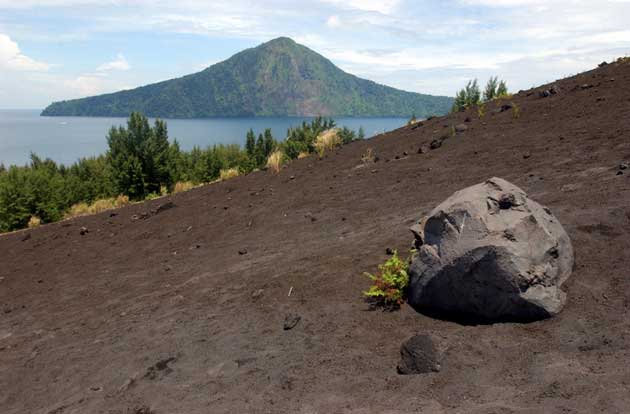
One hundred and twenty-five years ago this Wednesday occurred the biggest bang the inhabited world has ever known. Indonesia's Krakatoa volcano erupted. It did so with the force of 13,000 Hiroshima atom bombs, propelled a trillion cubic feet of rock, pumice and ash into the air, and made a noise loud enough to be heard 1,930 miles away in Perth. The explosions, fallout and resulting tidal wave (130 feet high in places) killed 36,417 people in Java and Sumatra, destroyed 165 villages and towns, and two-thirds of the island. Wind streams blew the fine ash as far away as New York; sea levels were raised in the English Channel, and over the following year, global temperatures were reduced by 1.2C.
Today, the remains of one of Indonesia's most active volcanoes continue to spit and bubble in the turquoise blue waters of the Sunda Strait between Java and Sumatra. Now part of Ujung Kulon national park, it is known as Anak Krakatoa, or Krakatoa's child, a post-collapse cone which has emerged from within the caldera of the original volcano over the past half-century and now stands about 600ft above sea level.
This Wednesday, the anniversary of the 1883 eruption, locals and tourists will remember the catastrophe when they visit Anak during the annual Krakatoa Festival – not exactly a celebration, more of a cultural memorial dedicated to one of history's most momentous natural disasters.
Richard Arculus, a professor of geology at the Australian National University in Canberra, will be sorry not to be there. He is among what he calls a "specialised gang" that traverses the world in search of the Earth's more unstable crusts and underwater volcanoes. Anak Krakatoa is a must. "It's got a kind of status. You can go to the lip and sometimes, if it's not erupting, you will see an active vent with smoke and steam coming out of it," he said. While it is not the most orthodox of tourist attractions, it pulls a steady stream of visitors excited by the Hollywood version of events, immortalised by the 1969 film Krakatoa, East of Java.
"A lot of people try to get there, not realising its current state of activity," said Professor Arculus. "It's off the north-west coast of Java and is certainly a bit of a haul, but there are plenty of people willing to hire a boat and make the voyage." What they see is that there is very little greenery on Anak Krakatoa itself apart from some stunted vegetation around the perimeter. Professor Arculus added, "If it stopped erupting, if ash stopped coming out of it, it would be colonised by tropical vegetation very quickly." But at the moment, it appears to be more of a barren rock.
The national park it is part of, roughly the size of Bedfordshire, is home to Java's largest remaining area of lowland rainforest, and became a Unesco World Heritage Site in 1992. It is known for its Javan one-horned rhino, the rarest large animal on Earth with only 50 left, 250 species of birds, and, possibly, the Javan tiger, although this has not been sighted since 1950.
Krakatoa has provided writers and film-makers with a feast of stories. There is the account of the steamship thrown nearly two miles by the giant tidal waves that engulfed many nearby islands. But the most extraordinary tale, apparently confirmed by the official report into the tragedy, involved a German quarry manager who told how he was swept off the roof of his three-storey office, only to be saved by a passing crocodile. As he cascaded through the jungle propelled by the giant wave, he spotted the croc beside him and leapt on its back. Safely aboard, he dug his thumbs into the creature's eye sockets and was carried along for the next few miles until he was dumped on the jungle floor.
Myth or not, it is part of the folklore of Krakatoa, which sits astride the same faultline responsible for 2004 earthquake off the coast of Sumatra. Surprisingly, the volcanic eruption of l883 was not as severe as more recent seismic movements. Professor Arculus said the total amount of water displaced by the Krakatoa volcano was much less. "The problem around Krakatoa was that there was a big population living around the Sumatran and Javan shores, and because they were only a few kilometres away they copped a lot of it, but the tsunami was relatively trivial in size."
Professor Arculus also corrects the misspelling of the volcano's name, which is officially Krakatua. "It was wrongly spelt on the telegraph when the news was sent to London and it's been corrupted by the Brits ever since," he pointed out. While Anak Krakatua – or Krakatoa – is largely dormant, tourists can still witness wisps of smoke erupting from the emerging cone. But there is no real reason to worry, at least for the moment. It'll take several thousands of years before it gets to the same size and has the potential to erupt and collapse again.
"The cone, which is essentially the remains of the old caldera, is currently in one of its many stages of growth prior to a new destructive episode. Sooner or later it will happen again."
Join our commenting forum
Join thought-provoking conversations, follow other Independent readers and see their replies
Comments