World's smallest state aims to become the first smoke-free paradise island

For free real time breaking news alerts sent straight to your inbox sign up to our breaking news emails
Sign up to our free breaking news emails
It is the world's smallest self-governing state, with a population of just 1,400 and few resources other than fish and coconuts. But the South Pacific island of Niue believes it can set an example by becoming the first country in the world to go smoke-free.
There are about 250 smokers on Niue, a speck of coral with a GDP of barely NZ$6,000 (£2,280) per person, and local officials say the cost of treating smoking-related illnesses is placing a heavy strain on the health budget.
Sitaleki Finau, Niue's director of health, is backing a bill to prohibit smoking and the sale of tobacco in public areas and private homes. The bill has been presented to parliament, but the government has not yet signed up to it. Dr Finau said he expected a ban to face stiff opposition from the tobacco industry and other commercial interests. But he urged MPs to be bold and vote for it.
"Small countries are allowed to be ambitious," he said yesterday. "If a small country can do this, then big countries will start thinking. Imagine what that means." The government would lose revenue from tobacco taxes but that would be more than offset by savings in the health budget, he said.
Like many countries, Niue – which translates as "behold the coconut" – has banned smoking in government offices and public buildings. But outlawing tobacco would be a radical step – particularly on an island so relaxed that, according to one saying, the dogs chase the cats at walking pace.
One village, Tuapa, has already declared itself smoke-free. Tobacco is not sold there, and villagers refrain from smoking in public and during ceremonies.
Dr Finau said the government would have to consider whether a ban infringed smokers' rights. "There has been mixed reaction," he said. "It's one of those difficult political issues, because there are commercial interests against it, and the government has to look at it in relation to tax. A tobacco-free country sounds pretty straightforward and simple, but there are some complex issues involved."
No date has been set for a vote, which could be two years away. Niue, 1,375 miles north-east of Auckland and 312 miles from Tonga, its nearest neighbour, is a former British protectorate. Britain gave it to New Zealand as a reward for the latter's contribution to the Anglo-Boer War, but since 1974 it has been independent "in free association" with Wellington.
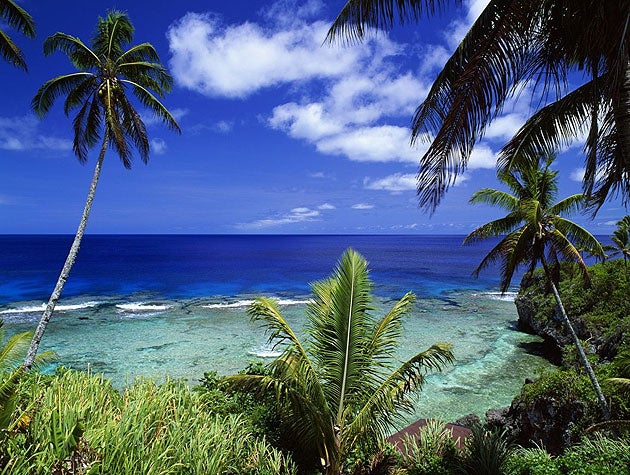
Those who live on the island, 100 miles square, regard it as a South Pacific paradise. Beaches are heavenly, crime is non-existent, and the plentiful seafood includes crabs so large that people walk them on leashes. The locals serenade each other on guitars while watching tropical sunsets.
Niue's problem is that, despite all that, everyone is leaving. The population is in steep decline, and some believe it has dropped below a sustainable level.
When Niue was granted independence, its people were given New Zealand citizenship and the chance to emigrate – an offer that now threatens Niue's survival. There are 20,000 Niueans in New Zealand, and those left behind intermittently debate whether the island should rejoin its former colonial ruler.
Successive governments have failed to lure expatriate Niueans home. The island's isolation and lack of resources make for a fragile economy and Niue is heavily dependent on New Zealand aid and foreign remittances. Its main export is taro, a root vegetable. The capital, Alofi, has two shops.
If Niue becomes smoke-free, it may lose another 250 residents. New Zealand's anti-smoking laws are not quite so draconian.
Subscribe to Independent Premium to bookmark this article
Want to bookmark your favourite articles and stories to read or reference later? Start your Independent Premium subscription today.
Join our commenting forum
Join thought-provoking conversations, follow other Independent readers and see their replies