A concert for Ossetians – to Russia's tune
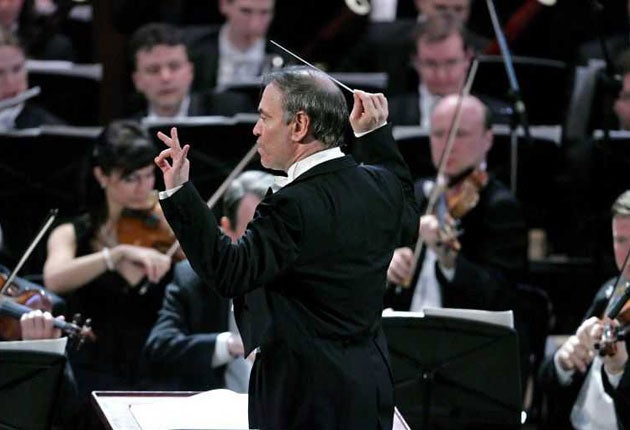
Many have lost relatives, some no longer have homes, but they all put on their best evening dress and flocked to Tskhinvali's central square to see one of the world's most famous conductors lead an emotional concert in support of his people – and Russian military action.
Valery Gergiev has given some extraordinary concerts in his time, but last night he conducted perhaps the most unusual and emotional concert of his career.
As dusk fell, the sounds of Dmitry Shostakovich's Leningrad Symphony rang out, less than two weeks after the capital of Georgia's breakaway territory of South Ossetia saw fierce fighting between Russian and Georgian troops.
Gergiev was conducting the London Symphony Orchestra in Edinburgh last weekend. Last night's concert, with the orchestra of the Mariinsky Theatre, was rather different.
The open-air performance took place outside the ruined headquarters of the South Ossetian separatist government.
The Kremlin, realising the PR potential of the concert, bussed in foreign journalists to see the show. The event was a musical affirmation that South Ossetia is unlikely to be part of Georgia again in the near future.
A jubilant Eduard Kokoity, the South Ossetian de facto president, wearing the Ossetian and Russian flags on his lapel, joined the audience of local people, government officials and religious dignitaries. "This concert is support for the people of South Ossetia, and for the justified military actions of Russia," he said.
"It is also against the cynical position of the United States. Everywhere they go there is war."
Dozens of Russian troops stood on armoured personnel carriers nearby, waving Russian flags. A few Ossetian flags were also visible in the crowd, but it was the Russian tricolour that dominated. The concert was broadcast live on Russian TV.
A convoy of Kamaz trucks brought the musicians and their instruments to Tskhinvali from Vladikavkaz in North Ossetia, through the Roki Tunnel, the same route that Russian tanks took in the first days of the conflict with Georgia.
Gergiev made it clear in an exclusive interview with The Independent last week that he felt the international media coverage of Russia's conflict with Georgia had been one-sided and biased. "Georgians were killing Ossetians," he said. "It was brutal and criminal. I have talked to about 20 or 30 people on the phone who were there and everybody tells me this one story.
"There was a massacre in which more than 2,000 Ossetians died. There are villages that no longer exist."
In Tskhinvali yesterday, Gergiev reiterated that this was not a concert to remember both the Georgian and Ossetian victims of the war, this was an attempt to tell the world that the Russian invasion of Georgia was not a crime but in fact a courageous and humanitarian act.
"Intelligent people around the world should know the truth about what happened here, especially on the first night."
Gergiev is undoubtedly the world's most famous Ossetian – in fact he's the world's only famous Ossetian. He eagerly accepts the role as unofficial ambassador for the region. He has spoken many times about his admiration for the ancient roots of Ossetian culture and his version of Wagner's Ring Cycle uses imagery from Ossetian legends to suggest a link between Wagner's otherworldly visions and his own Caucasian heritage.
Gergiev, who is renowned across the world for starting late, appeared on the dot of 8pm as scheduled, to conduct the Mariinsky Orchestra in an emotional rendition of Tchaikovsky's Pathetique Symphony and Shostakovich's Seventh Symphony, which was written as the Nazis had the city of Leningrad under siege during the Second World War. The choice of music was clearly not accidental. Both Russia and Georgia have accused the other of "fascist" tactics.
Last night was the first since the conflict began when there was no curfew in Tskhinvali, and the well dressed locals almost gave the city a normal feel. It will be a long time before true normality returns to South Ossetia, and the mood in Tskhinvali yesterday makes it seem unlikely that the region will ever be part of Georgia again.
Join our commenting forum
Join thought-provoking conversations, follow other Independent readers and see their replies
Comments