Al fresco vs al desko: Death to le sandwich
After a lawyer's jibe at the long lunches of his French colleagues caused a row, Samuel Muston studies the cross-Channel midday dining differences
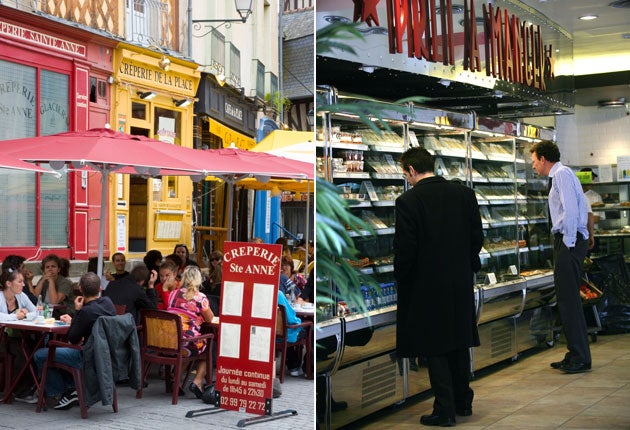
France and England are separated not just by 22 miles of cold water, we are two nations separated by an afternoon meal. We're two slices of bread divided by ham and cheese.
Lunches, like religion and fillet steaks, are done differently over there. Head to a provincial French tourist town of a lunchtime and you will likely see spatterings of confused first-time visitors. Perplexed, they stand grouped together on the cobbled streets outside closed boulangeries, charcuteries and other guidebook-approved pleasures of French life. Having come to buy baguettes, they find the shops closed at 12pm. At 1.45pm they return, but leave again baguette-less.
Out of shot, and out of the way, sit France's 35,000 bistros. One for roughly every 1,771 citizens. It's a fall from the glory days of the 1960s, when there was one for every 250. In the bistro sit the baker, the butcher, the artist and the civil servant taking time to lean back in their street-front seats. They draw the chilled Beaujolais across their tongue and take another slice of saucisse. "A one-hour lunch is sacrosanct," says Harry Eastwood, Paris-based food writer and co-founder of Petit Pois Cakes. "Two [hours] is not unusual."
And it is not just in the provinces. "When it comes to... 12.30pm, everyone who speaks French [at the International Criminal Court] refuses to work any more and will not come back to work until trois heures," commented world-renowned jurist Professor Philippe Sands, QC – who's half-French – in a talk at last month's Hay Literary Festival.
"For two and a half hours, the Anglo-speaking people are twiddling their thumbs," he continued. "They can't work because the French speakers refuse to work with them [over lunchtime].
"They won't have sandwiches... they have food laid out... and the cutlery has to be silver."
When contacted a few weeks later, Professor Sands is at pains to point out his comments were light-hearted. But umbrage has been taken by at least one French colleague at the court.
"I regret causing offence to a colleague and it's silly to stereotype, but the fact is that there are cultural differences in our engagement with food, including joking about it," he says.
"I'm equally rude about the British and I often prepare for a hearing with a long lunch followed by a visit to the movies. It's a craving for those endless summer lunches in France – warm days, big tables, massive salads – during school holidays. Most days when I'm in central London I go to Pret."
Pret a Manger, Marks & Spencer and Tesco loom large in Lunchtime Britain. A survey by catering company Eurest Services (which admittedly has a vested interest in sit-down eating) suggested that 7 per cent of Britons don't stop for any lunch. Instead they graze on shop-bought snacks throughout the day. If we do pause, it is for an average of 29 minutes – we then spend the remaining 31 minutes feeling guilty about having taken 29. Sandwiches in offices, held in one hand as the other stays umbilically attached to the computer mouse, are the norm. Cutlery, if employed, is likely to be plastic. Only a lucky 1 per cent feel able to fortify body and mind against the afternoon with a glass of wine. The same percentage, incidentally, who manage to have sex.
Why so different, then? Why is a midday break of an hour, maybe two, maybe with wine, certainly with freshly cooked food, a near human right in France? And why is it beyond the wildest imaginings of most British workers?
Some think it's down to history. "In England, lunch is a midday meal," says Trish Deseine, French-based cookery writer and presenter. "In France it is a concentrated representation of several centuries of epicurean living."
The French have the guillotine to thank for that. French food culture really took off when the princes of the Ancien Régime – who had spent most of the 1770s and 1780s gorging themselves – took off into exile. Along with their châteaux, they left their armies of chefs behind, who, sensing the way the wind was blowing, set up restaurants to feed the rising men of the middle class.
"The advent of the restaurant," wrote the great gourmand Jean Anthelme Brillat-Savarin in his 1825 book The Pleasures of the Table, "has proved a boon to all citizens." It was certainly an eldorado for the middle class, and the effect trickled downwards. Bistros and restaurants proliferated, survived the Terror, and flourished during the Empire and the Restoration. "Food became an end in itself rather than a means to an end," says Penelope Vogler, the mastermind behind Penguin's Great Food books.
The same could not be said for Britain. The late 17th century was a time of the coaching inn, boiled meat and, if you were on the move, Scotch eggs. It was a time when William Verrall, an enthusiastic English cook schooled in French cooking, wrote Recipes from the White Hart Inn, and mocked English gentlemen who professed an interest in food but possessed only one saucepan ("black as my hat and with a handle long enough to obstruct half the passage") and would eat only plain mutton chops.
In 19th-century France, the hand that held the pen also began to dip the ladle. Food culture was eulogised in print and gourmandism took hold. Brillat-Savarin said: "Tell me what you eat, and I will tell you what you are." (One wonders what he would have made of the Scotch egg.) Balzac mused on midday eating in his New Theory of Lunch in 1830. Alexandre Dumas, when not busy writing The Three Musketeers, was busy recording his recipes for bamboo pickle and strawberry omelette, and rejoiced in preparing a lunch for an hour and a half and taking four to eat it.
Mrs Beeton's Book of Household Management, published in 1861 for England's housewives, did not contain a chapter on "The Foundations of Pleasure", as Brillat-Savarin's had done. Sensuous pleasure in lunching and dining was for someone else – probably for venal foreigners or, as English writer Hannah Glasse said, those men who, full of "blind folly", employed a French chef and "their tricks". "They would," she harrumphed in her book Everlasting Syllabub and the Art of Carving, "rather be imposed on by a French Booby than give encouragement to a good English cook."
It hasn't always been fire and brimstone, though; we have at times aped the French. "The sensuous pleasure may have been largely absent, but for some people, mainly in the city, a lunching culture did emerge in the Fifties, Sixties and Seventies," Penelope Vogler says. "The Eighties probably put paid to that, though."
By the Eighties, simple pleasures became uneconomical. The Prime Minister gave up sleeping and lunch was for wimps. Well-upholstered City gents, who had previously led the vanguard of British lunching in the restaurants of St James's, were to be found, prawn sandwich in hand, in front of a trading screen in a glass box in Canary Wharf. "We were back to where we started: lunch as fuel to power us into the afternoon," Vogler says.
Our attitude to lunch might have changed, formed and re-formed, but the French have remained largely immovable. Even the invasion of McDonald's has been appropriated by the French. Recent headlines proclaiming France to be the second-most profitable market for Ronald and Co (after the US) are true but that's because, as The New York Times points out, the French go to the fast-food chain less often but spend much more, ordering "more than one course" as they would in any other restaurant.
"They have, at all levels of society, raised an attitude to food to the level of philosophy. They take pleasure in the pleasure of cooking and eating," Deseine says. "They take it seriously."
"Food is a grill," Roland Barthes wrote, "through which all the sciences which we now call social and human may be exercised." Claude Lévi-Strauss wrote incomprehensible treatises on honey, cannibalism and the communicative structures of English and French meals, while here we have had to content ourselves with the more homely utterances of Delia Smith. ("Food is for eating, and good food is to be enjoyed.")
It never really looked good for us Brits. We take our food at separate tables, in opposite ends of the restaurant. They sit in the front window; we sit by the kitchen door. We stick to our cheese sandwiches; they eat their pork cassoulet. We eat with a computer mouse in one hand; they have a wine glass or their mistress's thigh in theirs.
Perhaps it's time we aped our Gallic neighbours, put pleasure first, put down the sandwich, picked up our coat and popped to the local café. It may not be good for international justice or the tourist industry but it would certainly perk up those office-bound afternoons.
Join our commenting forum
Join thought-provoking conversations, follow other Independent readers and see their replies
Comments