Alexander Solzhenitsyn, scourge of the Soviet Union, dies aged 89
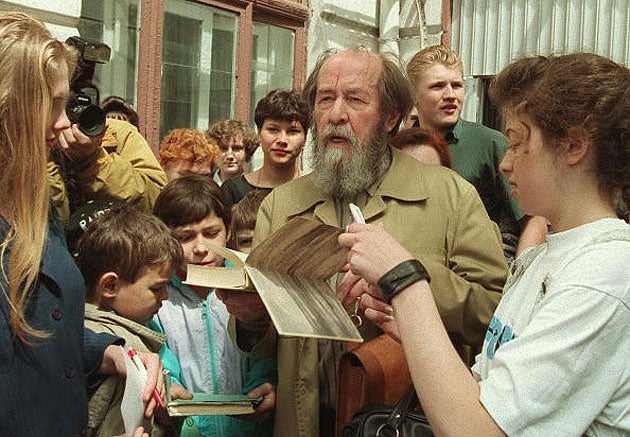
Alexander Solzhenitsyn, a towering figure in Soviet Russia whose Gulag Archipelago and other works revealed the full extent of Stalin's labour camp network, has died at the age of 89.
His son, Stepan, said that the writer, who had become somewhat disillusioned and marginalised since his triumphant return from exile 14 years ago, had died of heart failure.
Solzhenitsyn, a leading Soviet dissident of the same generation as the human rights campaigner Andrei Sakharov, won the Nobel prize for literature in 1970 for his works One Day in the Life of Ivan Denisovich, The First Circle and The Cancer Ward, which detailed his own experiences as a victim of Stalin's terror.
The Swedish Academy praised the "ethical force with which he has pursued the indispensable traditions of Russian literature". But he became best known for the Gulag Archipelago which, like his other works, was banned under Soviet rule. The first parts of the book were published in Paris in 1973. Until then, the West had been unaware that millions of people who had dissented from the Communist system between 1918 and 1956 had been cast into the network of prison camps which he compared to an archipelago of islands.
He was expelled from the Soviet writers' union in 1970 for opposing the tenets of Soviet literature, and was arrested, charged with treason and deported in 1974 following the Gulag's publication in the West.
The bearded, ascetic Solzhenitsyn remained in US exile with his wife and sons for 20 years and became known as the "hermit of Vermont" for his reclusive existence behind a barbed wire fence in Cavendish. Solzhenitsyn returned to Russia in 1994 and embarked on a cross-country train journey. But, once home, he remained an isolated figure, a Russian nationalist often described as the conscience of the nation but no longer in tune with the rampant materialism of modern-day Russia. Political leaders nevertheless sought him out.
Vladimir Putin, now Russia's Prime Minister, found it necessary to seek Solzhenitsyn's blessing when he was President, visiting the writer and his wife, Natalya, in their house at Troitse-Lykovo on the outskirts of Moscow.
Solzhenitsyn spent his years in exile writing his epic Red Wheel, but it failed to strike the same chord as his earlier works, either with the Russian public or among Western readers.
Solzhenitsyn began his journey into dissidence in 1945 when he was arrested in an East Prussian village while serving as an artillery officer and accused of making derogatory remarks about Stalin in a letter to a friend. He spent the next eight years in a prison camp and was sent into internal exile in Soviet Central Asia. It was in Tashkent that he recovered from stomach cancer in a prison hospital, which he recounts in Cancer Ward – with the illness serving as a metaphor for the sickness of the Soviet system.
While working as a mathematics teacher in Ryazan he wrote One Day in the Life of Ivan Denisovich, the story of a carpenter struggling to survive in a Soviet labour camp. The short novel was published on the orders of Soviet leader Nikita Khrushchev in 1962 during his de-Stalinisation campaign and caused a sensation at home – in photocopied samizdat form – and abroad. It was subsequently made into a film.
The First Circle, which has been described as one of the most important novels of the 20th century, came out in 1968. The title refers to Dante's first circle of hell and concerns a group of scientists and intellectuals who agree to collaborate with the regime in return for better conditions than in the gulag. His publishers were preparing to publish the first uncut version of the book in English shortly before the writer's death.
Voice of the gulags who won the Nobel prize
Born in Kislovodsk on 11 December 1918, Solzhenitsyn studied mathematics at Rostov University. He served in the Red Army in the Second World War but in 1945 was accused of anti-Soviet propaganda and spent 10 years in prison camps and internal exile. Solzhenitsyn, pictured in 1946, published 'One Day in the Life of Ivan Denisovich', a largely autobiographical novel, in 1962.
Novels 'The First Circle' and 'Cancer Ward' followed in 1968 and the play 'The Love-Girl and the Innocent' in 1969. He won the Nobel Prize for Literature in 1970. In 1973, the first volume of 'The Gulag Archipelago' was published, documenting Soviet abuses in prison camps. He was stripped of his citizenship and sent to West Germany in 1974. He later settled in Vermont and finished the remaining two volumes. Vladimir Putin awarded him the State Prize of the Russian Federation last year.
Join our commenting forum
Join thought-provoking conversations, follow other Independent readers and see their replies
Comments