Anne Frank’s helper turns 100
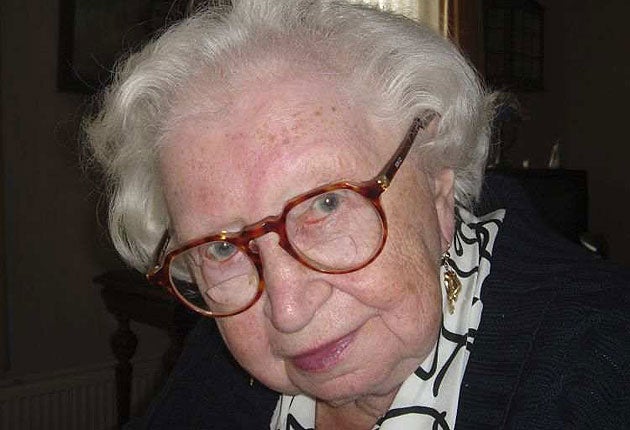
When Miep Gies rescued a jumble of notebooks and papers from an Amsterdam attic in August 1944, she had no idea that she was creating a literary, and historical, phenomenon. She thought that she was preserving the precious diary of a 15-year-old girl, who would be overjoyed to rediscover her "old friend" when she returned "after the war".
Anne Frank never returned. Her private diary went on to become the most read book in the world, second only to the Bible. Her one-time "helper", Miep Gies, will be 100 years old tomorrow and is still living in Amsterdam, the last survivor of the the small band of Dutch people who helped the Franks, together with another Jewish family who shared the attic, to hide from the Nazis for two years before they were betrayed.
Ms Gies, who has devoted her life to commemorating the Holocaust and the Frank family, has asked not to be disturbed on her 100th birthday.
In a brief email exchange with Associated Press this week, she also requested that she should not be remembered as a heroine or as someone who did something exceptional. "This is very unfair. So many others have done the same or even far more dangerous work," she wrote.
She said she would like the world to dwell instead on the many "unnamed heroes" who helped a small percentage of Dutch Jews to escape deportment and death in the Nazi camps. "I would like to name one, my husband Jan," she wrote. "He was a resistance man who said nothing but did a lot. During the war he refused to say anything about his work, only that he might not come back one night. People like him existed in thousands but were never heard."
Maatge Mostart of the Anne Frank Foundation said yesterday that Ms Gies was "still well, physically and mentally, still living on her own and looking after herself, but too tired to answer many questions." Ms Mostart added: "She still gets hundreds of letters from all over the world and takes an interest in all of them."
On 4 August, 1944, after the Frank family were arrested, it was Ms Gies and another of the trusted "helpers" who gathered Anne Frank’s papers and notebooks. It was Ms Gies who locked the diary in a safe and handed it to Anne’s father, Otto, in September 1945, on the day that he discovered that his daughter had died of typhus in the Bergen-Belsen concentration camp six months earlier. Mr Frank published the diary in Dutch in 1947 and in English in 1952, first as the The Diary of a Young Girl and then as the The Diary of Anne Frank.
The strong, quiet voice of Anne, with her enthusiasm, her dislikes, her initial optimism and her encroaching fears for the future, helped the world to make human sense for the first time of the incomprehensible statistics of the Holocaust.
Ms Gies, born in Austria, had been Otto Frank’s secretary before the war and was one of the Dutch people who took turns to smuggle food into the "secret annexe"of his canalside warehouse where the Franks and another family took refuge in 1942.
In an internet interview in 1997 with schoolchildren all over the world, Ms Gies remembered the frail, noisy, friendly, inquisitive teenage girl she had tried to rescue. "Anne … was the one asking me questions all the time, particularly about what was going on in the world outside the hiding-place ... I was 20 years older than she was, but it was like talking to a much older person than a teenager." Ms Gies told her young questioners of her "tremendous disappointment" that her
"friends" should have been arrested "so close to the end of the war" when the Allies were "less than 250 miles from Amsterdam". In another interview, in 2000, Ms Gies said that she was sometimes asked how she would respond to people who denied that the Nazi genocide had occurred. She said: "My response is that on 4 August, 1944, at nine o’clock in the morning, I did meet a healthy and strong 15-year-old girl, Anne Frank. The next thing I saw was her name in a German list of people on a cattle train to Auschwitz."
Join our commenting forum
Join thought-provoking conversations, follow other Independent readers and see their replies
Comments