Arcachon Bay oysters banned after health scare
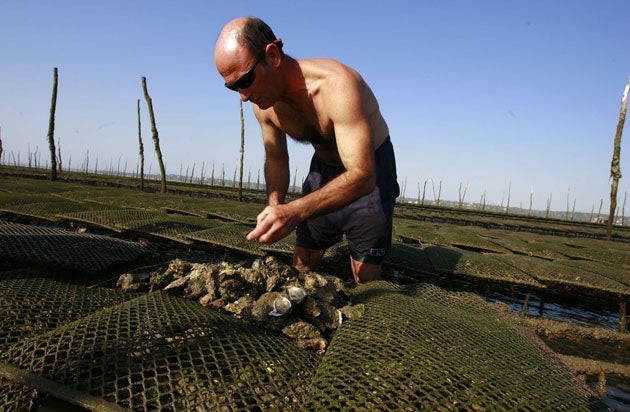
In another blow to the beleaguered French shellfish industry, authorities have banned for up to two weeks the sale and consumption of oysters from the beautiful Arcachon Bay in south-western France.
The ban – one of a series of scares in the past three years – follows the discovery of an unknown, potential threat to health during routine tests of oysters from the bay.
Oyster producers in Arcachon and elsewhere around the French coast are still reeling from the death of 80 per cent of their baby oysters after an especially virulent outbreak of a common herpes virus. The ban on the harvesting, transport, sale and consumption of full-grown oysters from the shallow Arcachon bay, west of Bordeaux, follows the discovery that local shellfish may have been tainted by poisonous microalgae.
There has been a series of scares around the French coast this summer, including the closure to bathers of several beaches which were invaded by poisonous algae and the ninth successive mass jellyfish invasion of the Mediterranean coast. Marine scientists have suggested that the common factor in all these problems may be a slight rise in water temperature linked to global warming.
Arcachon Bay has been prized for its oysters since the fourth century, and their cultivation was developed there 150 years ago. It provides, one way or another, all the oysters reared in France: only a small proportion of the full-grown ones but almost all of the oyster fry used in the beds of Brittany, Normandy, Charente-Maritime and the Mediterranean.
The new ban on the sale of Arcachon oysters is the latest in a series of calamities to affect the bay. Two years ago, sales were suspended for almost a month after the death of two elderly tourists who had eaten local oysters. Tests later proved that both tourists had died from other causes.
The entire committee of the local shellfish producers' association resigned yesterday, protesting against the oyster ban. They said that they would bring a legal action against the government for permitting the pollution of the bay.
In the past three years, Arcachon and other oyster-producing areas have suffered a series of similar closures as a result of a "mouse" test introduced as the European Union standard five years ago. Liquid from oysters is injected into mice. If two out of three mice die, the local oysters are declared to be unsafe for human consumption. On several occasions – including the latest ban – the mice have died despite the apparent absence of poisonous microalgae in the bay.
Marine scientists fear that unknown forms of algae may be reaching the French coast, encouraged to roam by global warming or by ships illegally dumping their water ballast.
The oyster producers insist, however, that the "mouse test" itself is an absurdly over-sensitive instrument. They say the amount of oyster liquid injected into each mouse is the equivalent to a human eating more than 1,000 oysters in one sitting.
The French Agriculture and Fisheries Minister, Michel Barnier, promised yesterday to work at EU level to establish a more accurate test.
Meanwhile, the mysterious sudden death of 80 per cent of French baby oysters last month has been attributed to a known herpes virus. The virus often afflicts baby oysters but the effects were more dramatic this year. The warmer sea temperature had increased the amount of micro-plankton and allowed the baby oysters to grow fatter – and more vulnerable to the virus.
Staying safe with shellfish
You should only eat oysters during months with an "r" in the name, or so the saying goes. In fact there's a handier way of checking whether an oyster is good to eat – a gentle tap will do it. If an oyster is open, tap the shell. It should close right away. If it is unresponsive and the shell stays open, throw it away since it is most likely dead. Oysters can stay fresh and alive for up to two weeks after they are harvested. A good oyster supplier will keep the tags showing where the oysters originate from, which can prove useful if any problems should arise.
Join our commenting forum
Join thought-provoking conversations, follow other Independent readers and see their replies
Comments