Artists take on the new cult of Stalin
Attempts in Russian society to rehabilitate the despotic leader have provoked rebellion. Shaun Walker reports from Moscow
"Not a step back!" shouts the poster's caption, echoing the famous wartime cry of Joseph Stalin. But the image alongside the text in block capitals is not a patriotic depiction of the Soviet war effort, instead it's a downtrodden prisoner struggling under the weight of a statue of Stalin.
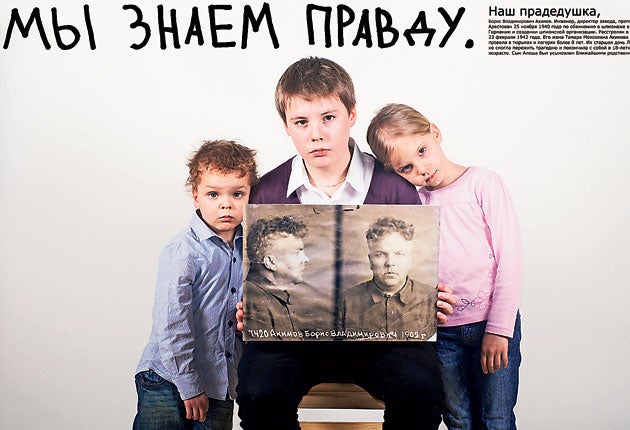
The poster is one of many anti-Stalin artworks that make up an exhibition that opened in Moscow this week aimed at commemorating the dictator's purges, and hitting back at what the organisers say is a rehabilitation of the despot in Russian society.
The exhibition is part of a campaign organised by Snob, a magazine and internet site aimed at Russia's business and cultural elite, to raise awareness among Russians about Stalin's crimes. It abandons the ambivalent language of much official Russian discourse surrounding the Stalin period, and paints the dictator as an unequivocal villain. At the launch of the exhibition, 75 years to the day since a decree was signed establishing the "troikas" that were one of the key elements in Stalin's purges, people who lost relatives in the repression wore white ribbons bearing the names of the dead.
The troikas were three-man tribunals with powers to sentence those accused of crimes to lengthy imprisonments, or more often death by shooting. The use of the troika peaked in 1937, the most ruthless year of Stalin's purges, when it is estimated that well over half a million people were killed, most of them with a bullet to the head.
The exhibition was prompted by a renewed pride in Stalin among Russians, which many say has been fostered by Russian authorities. Two years ago, the dictator came third in a television poll to name the greatest Russian of all time, and this year the Moscow mayoralty planned to display portraits of Stalin across the city as part of a celebration of the Soviet victory in the Second World War. The decision was rescinded only at the last minute.
"Five years ago, we thought this was all in the past," said Marat Guelman, who runs the gallery where the exhibition took place. "People who loved Stalin were just a few weirdos who hung out on the internet – like paedophiles, or cult members. But over the past five years there has been a strange mutation in society, and suddenly Stalin has become a symbol." He said it was important that Russians who know the truth about Stalin don't remain quiet, and begin to educate the masses.
Others praised the sentiment but doubted that it would help significantly. "I'm not sure how much of a difference this will make," said Andrei Bilzho, a well-known Russian satirist and cartoonist, who had a series of Stalin-themed cartoons on display as part of the exhibition. Both of his grandfathers were killed during the Stalinist repressions. "In many ways, this is by people and for people who already understand everything about Stalin. It won't make much of a difference to those who still respect him. What we need is for the political leaders to come out and say with 100 per cent certainty that Stalin was evil. That would help people change their minds."
Part of the problem is that Russia has never come to terms with the dark chapters in its past in the same way Germany has. There have never been proper trials of those accused of crimes, nor has there been any serious attempt at reconciliation.
Even the organisers of the exhibition doubt that Russia could set up a tribunal to attribute blame for those behind the crimes of the Stalin era – after all, the boundaries are blurred, and the purges were so vicious that many of those responsible for repression were later accused and shot themselves. But there is a sense among the Russian intelligentsia that a more unequivocal stance needs to be taken by the country's political leaders in regard to the personality of Stalin.
Vladimir Putin, previously the President and currently Prime Minister, has never directly endorsed Stalin as a positive figure in Russian history. But on several occasions he has displayed an ambivalent attitude to the dictator, saying that nobody should make Russians feel guilty for their history. While he was President, an infamous school textbook referring to Stalin as an "effective manager" was released. Mr Putin has made the Soviet effort in the Second World War one of the key building blocks of a new national pride. Victory Day on 9 May has become one of Russia's most important national holidays. "We won the Great Patriotic War," said Mr Putin last year. "Even if we look back at the casualties, you know that no one can throw a stone at those who organised and led that victory, because if we had lost that war, the aftermath would have been much more catastrophic."
Many descendants of those who died in the purges came to the exhibition as a mark of respect to their lost relatives. "My mother became an orphan at the age of three and a half," said Alexey Nikolov, the deputy editor-in-chief of Russia Today, the Kremlin-backed television channel. "My grandfather was one of the top cultural officials in Leningrad and was accused of sabotage in 1937. I requested the files from the archives – it was awful. He denied all the charges, and then in later questioning, obviously after being tortured, he admitted he was guilty. The signature on the confession is written in a trembling hand."
Mr Putin's successor, Dmitry Medvedev, has been far more forthright about Stalin's crimes. In an interview he condemned the period, but said it was natural that some people still respected the leader and that "everyone has the right to their own opinion" about Stalin.
"When people say they love Stalin, they don't really mean it," said Mr Guelman. "What they mean is that they are unhappy now. They don't like capitalism. They don't like the fact that there are a few rich people in Russia while they are poor. And hankering for Stalin is a convenient way to voice this."
Join our commenting forum
Join thought-provoking conversations, follow other Independent readers and see their replies
Comments