Auschwitz sign was 'stolen for trophy hunters'
Arrested men were professional criminals 'without links to extremists'
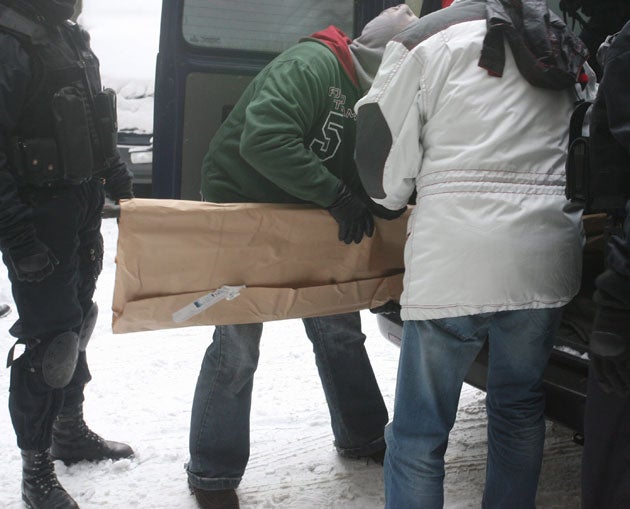
Police and Holocaust experts have said that Nazi memorabilia collectors were behind the theft of the infamous "Arbeit Macht Frei" sign that has been recovered three days after it was stolen from the entrance of the former Auschwitz death camp.
Five men, aged between 20 and 39, were arrested late on Sunday after the sign, with the cynical inscription that means "Work sets you free", was torn from its mountings at the camp early on Friday prompting international outrage, a major police investigation and the tightening of controls at Poland's borders
Police said the sign, which had been cut into three sections, was found in woods near one of the arrested men's homes outside the northern city of Torun. They ruled out that any of the suspects had neo-Nazi connections. "They are all ordinary thieves with past convictions, some for robbery, others for violence," said Andrzej Rokita, the deputy head of Krakow police, who is leading the investigation.
Mr Rokita said that police were following leads that suggested the theft could have been commissioned by Nazi memorabilia hunters. "This will be determined in the process of the investigation," he said. Four of the men were said to be unemployed. One owned a small construction company.
The police said they had been tipped off about the sign's whereabouts by neighbours of one of the suspects following the offer of a reward. One element pointing to a commissioned theft was that two of the men were picked up in the Baltic harbour town of Gdynia, which is Poland's main container port.
Speculation about the involvement of memorabilia hunters was backed by Dr Bertrand Perz, an expert at Vienna's Wiesenthal Institute for Holocaust Studies. "There is a huge market on the internet for this kind of stuff," he said. "Many of the collectors are in the United States. Even such things as faked World War Two Jewish ghetto money can fetch thousands."
Dr Perz said it was impossible to put a value on something like the "Arbeit Macht Frei" sign. "It is one of the most important symbols of the Nazi Holocaust. It is actually invaluable," he said.
Several Polish MPs have demanded that more reliable surveillance cameras be installed at Auschwitz – the world's best preserved and most chilling Nazi death camp that is now a museum attracting tens of thousands of visitors each year. Police revealed yesterday that the existing cameras at the camp had picked up images of the thieves, but that they were too poor to have been of any use to them as it had been too dark.
The sign's swift recovery was nevertheless welcomed by Auschwitz museum staff and Holocaust survivors' groups. "It is an enormous relief," said Pawel Sawicki, a museum spokesman. "We are extremely grateful to the police who have done fantastic work. This sign is probably one of the most important symbols of the past century and now it can be put back where it belongs," he added.
Avner Shalev, chairman of Israel's Yad Vashem Holocaust memorial also expressed relief. Echoing the outrage felt by many at the sign's theft, he said the incident had given "pain to Holocaust survivors and people of conscience everywhere".
The Nazi slogan "Arbeit Macht Frei" was first put up at the Dachau concentration map, where inmates were often worked to death, and became the cynical welcome to at least four other camps. Auschwitz started operating as an extermination camp in 1942 and more than a million people were murdered in its gas chambers and those of nearby Birkenau.
Join our commenting forum
Join thought-provoking conversations, follow other Independent readers and see their replies
Comments