Bailout deal thrown into new chaos after Greek PM wins vote
Papandreou scrapes through confidence test – but opposition's demands for elections threaten timetable and hold euro to ransom
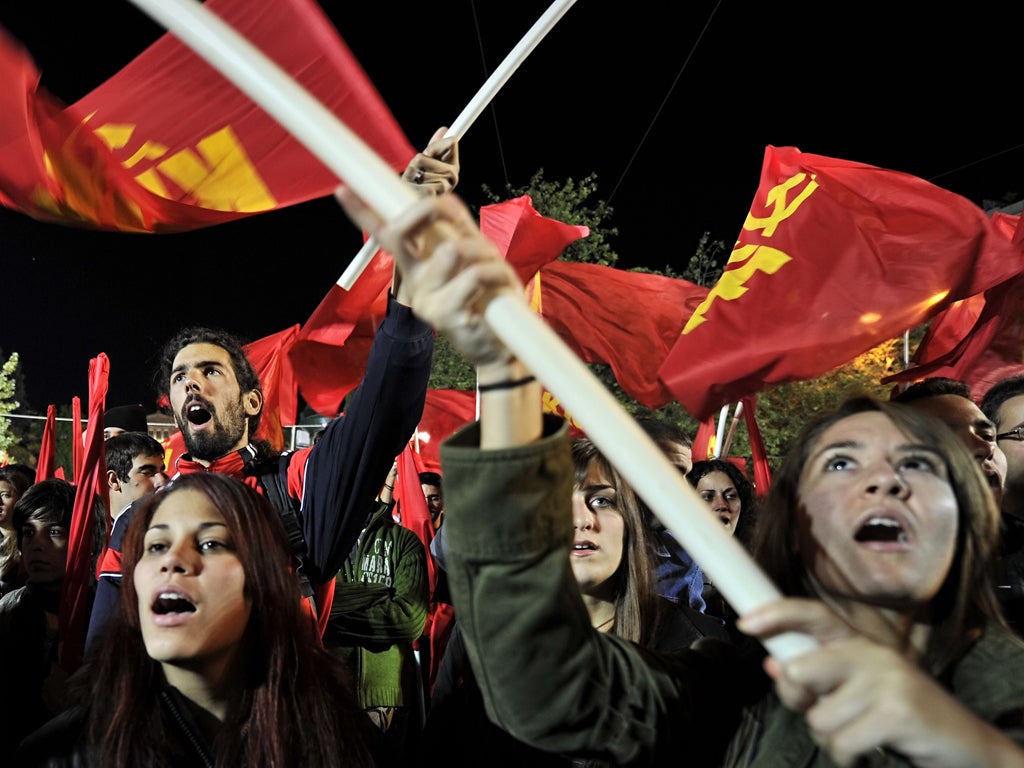
Greece's future in the euro remained in serious doubt last night, as the government narrowly survived a confidence vote with no sign of the consensus the EU has demanded in return for a proposed rescue package.
It was a pyrrhic victory for George Papandreou, the Greek Prime Minister, who had earlier in the week announced a euro referendum which he was later forced to abandon. Last night he had to promise parliament that he will begin talks immediately to form a power-sharing government and appoint his successor.
"The last thing I care about is my post," Mr Papandreou told parliament last night. "I don't care even if I am not re-elected." He gave his backing to the Finance Minister, Evangelos Venizelos, as interim prime minister, but could still remain in office if a broader unity deal cannot be forged.
The feverish political horsetrading in Athens failed to deliver the consensus that EU leaders have demanded in order to go ahead with loans that Greece needs to avoid a default that would threaten the broader eurozone. A bitter stalemate over the terms of a unity government took hold – and the EU has made it clear that the bailout offer cannot wait for Greece to resolve its political crisis in fresh elections.
"The masks have fallen," warned opposition leader, Antonis Samaras. "Mr Papandreou has rejected our proposals in their entirety... The only solution is elections."
A night of drama in Athens with impassioned speeches and mass walkouts did nothing to resolve the impasse that threatens to return Greece to the drachma and the wilderness of default. Mr Papandreou pleaded for a period of grace until February to pass vital but unpopular legislation that would pave the way for the country's survival in the eurozone, but the opposition demanded elections before the end of the year in return for its support.
A compromise scenario in which a "government of the talents" – drawn from outside active politics – would be appointed to secure Greece's future in the euro with the unpopular legislation demanded by the EU and the IMF, struggled to win support. "We need three or four months... to rationalise the situation, restore calm to the country, get rid of that €100bn [£85.91bn] in debt and build international credibility," pleaded ruling party spokesman, Christos Protopappas, before the vote. "Then we can get back at each others' throats for a month with elections – at that point everyone will be able to wait for us."
A third option envisaged a transitional government of technocrats assuming power for the next two years. Names put forward for this administration have included the former prime minister, Costas Simitis, and the former vice president of the European Central Bank, Lucas Papademos.
None of these scenarios addresses the deeper crisis in which public support for the country's political system has collapsed with potentially dangerous consequences. "The biggest problem in Greek politics is the absence of public support," said Christoforos Vernadakis, from opinion polling firm VPRC. "Everyone is furious with the politicians and the anger has reached violent proportions."
Mr Papandreou told the Greek parliament on Thursday that he "was not glued to his chair" and would not seek re-election, but ruling party sources said he is adamant he will choose the manner and timing of his departure.
France and Germany have made it clear that a rescue package of loans and debt forgiveness remains Greece's only option for remaining in the euro. They have also stipulated the bailout must be passed into law by at least 180 of Greece's 300 parliamentarians for the next tranche of loans to be released.
Contenders: The men who would be PM
1 Costas Simitis will be remembered as the man who took Greece into the euro as socialist Prime Minister. Given what we now know of the country's finances that might be enough to rule him out. But the cooking of the books for the most part came after 2001.
2 Lucas Papademos is widely respected as the former vice president of the European Central Bank. A safe pair of hands to some, he is seen as too close to George Papandreou by others. His public support is untested and bankers are hugely unpopular in Greece.
3 Evangelos Venizelos managed to stop the referendum this week but may find the Finance Ministry is as high as he reaches. The political bruiser may be unable to take the top job.
4 Antonis Samaras came back from the wilderness to lead the conservative opposition and seems the inevitable winner of new elections. Not taken seriously by the political élite, his populist patriotism will win few friends in Brussels, and any stay in office could be brief.
5 Stavros Dimas nearly took the top job in a caretaker administration in June before Mr Papandreou decided to hold out. The former European Commissioner is the conservative elder statesman in the wings if a transitional government is agreed.
Join our commenting forum
Join thought-provoking conversations, follow other Independent readers and see their replies
Comments